

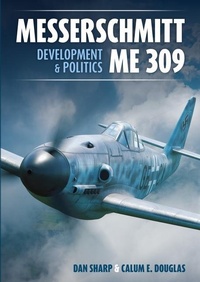
Messerschmitt Me 309 Development & Politics
Published on 3. May 2024
Book
Hardback
200 pages
978-1-911658-96-2 (ISBN)
Description
Using contemporary documents, authors Dan Sharp and Calum E. Douglas explain and explore the development and eventual failure of this fascinating 'secret project'.
Chosen in 1941 to replace the Bf 109 as the Luftwaffe's standard front-line fighter, Messerschmitt's innovative Me 309 embodied a wealth of hard-won experience from the Battle of Britain. Its sturdy tricycle undercarriage would make landings safer, its capacious wings could accommodate much heavier weaponry, its retractable radiator would make it aerodynamically clean, its pressure cabin would allow high-altitude operations and its ejection seat would help preserve the Luftwaffe's most precious asset - its pilots.
All of this was made possible by a fuselage specifically tailored to accommodate Germany's newest and most powerful fighter engines: Daimler-Benz's DB 603 and Junkers' Jumo 213. Production of up to 800 Me 309s a month had been planned by May 1942 - more than all other German fighter types combined. Yet the type's advancement from prototype to full series production was reduced to a crawl, not by technical difficulties but by political in-fighting, deception and manipulation behind closed doors.
The Me 309 was set up to fail - doomed to join a lost generation of mid-war Luftwaffe combat aircraft alongside types such as Focke-Wulf's Fw 190 C and Junkers' Ju 288 - but why and by whom? Messerschmitt Me 309 Development & Politics, the first book ever written solely about this aircraft, sets out its full history - from its forerunners and commissioning to its eventual cancellation and sale to the Japanese military.
Using contemporary documents, authors Dan Sharp and Calum E. Douglas explain and explore the development and eventual failure of this fascinating 'secret project'.
Chosen in 1941 to replace the Bf 109 as the Luftwaffe's standard front-line fighter, Messerschmitt's innovative Me 309 embodied a wealth of hard-won experience from the Battle of Britain. Its sturdy tricycle undercarriage would make landings safer, its capacious wings could accommodate much heavier weaponry, its retractable radiator would make it aerodynamically clean, its pressure cabin would allow high-altitude operations and its ejection seat would help preserve the Luftwaffe's most precious asset - its pilots.
All of this was made possible by a fuselage specifically tailored to accommodate Germany's newest and most powerful fighter engines: Daimler-Benz's DB 603 and Junkers' Jumo 213. Production of up to 800 Me 309s a month had been planned by May 1942 - more than all other German fighter types combined. Yet the type's advancement from prototype to full series production was reduced to a crawl, not by technical difficulties but by political in-fighting, deception and manipulation behind closed doors.
The Me 309 was set up to fail - doomed to join a lost generation of mid-war Luftwaffe combat aircraft alongside types such as Focke-Wulf's Fw 190 C and Junkers' Ju 288 - but why and by whom? Messerschmitt Me 309 Development & Politics, the first book ever written solely about this aircraft, sets out its full history - from its forerunners and commissioning to its eventual cancellation and sale to the Japanese military.
Using contemporary documents, authors Dan Sharp and Calum E. Douglas explain and explore the development and eventual failure of this fascinating 'secret project'.
More details
Language
English
Place of publication
United Kingdom
Product notice
sewn/stitched
Cloth over boards
Dimensions
Height: 299 mm
Width: 215 mm
Thickness: 14 mm
Weight
950 gr
ISBN-13
978-1-911658-96-2 (9781911658962)
Copyright in bibliographic data and cover images is held by Nielsen Book Services Limited or by the publishers or by their respective licensors: all rights reserved.
Schweitzer Classification
Persons
Dan Sharp studied history at the University of Liverpool before beginning a career in journalism. Having spent several years as the news editor of a regional daily newspaper, he switched to motorcycle magazines. His previously published works on aviation have covered subjects ranging from German Second World War projects to Concorde. He lives in Nottinghamshire with his wife and two children.