

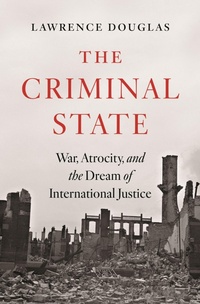
The Criminal State
War, Atrocity, and the Dream of International Justice
Will be published approx. on 28. April 2026
Book
Hardback
456 pages
978-0-691-18041-0 (ISBN)
Description
A sweeping history of the struggle to hold states to account for their gravest crimes
The Criminal State offers a gripping account of how law has confronted the most radical forms of state violence. Beautifully written, broad in scope, and bracingly original, it weaves history with political thought to trace the shifting legal response to state aggression and atrocities, from Leopold's rule over the Congo to Putin's war in Ukraine.
At its heart is Lawrence Douglas's fresh interpretation of the law's reckoning with Nazi aggression and atrocity. He shows how the Nuremberg trials challenged centuries of thought-rooted in Hobbes and other canonical thinkers-that shielded sovereigns from legal scrutiny. Yet Nuremberg's bid to frame aggression as the cornerstone of a new order of international criminal law largely failed, giving way to a system now centrally concerned with crimes against humanity and genocide-while leaving unresolved the legality and effectiveness of using force to stop the worst violations of human rights.
Providing rare historical perspective on the dilemmas facing international courts, The Criminal State is a sweeping, provocative history of the struggle to bring perpetrators of state violence to justice.
The Criminal State offers a gripping account of how law has confronted the most radical forms of state violence. Beautifully written, broad in scope, and bracingly original, it weaves history with political thought to trace the shifting legal response to state aggression and atrocities, from Leopold's rule over the Congo to Putin's war in Ukraine.
At its heart is Lawrence Douglas's fresh interpretation of the law's reckoning with Nazi aggression and atrocity. He shows how the Nuremberg trials challenged centuries of thought-rooted in Hobbes and other canonical thinkers-that shielded sovereigns from legal scrutiny. Yet Nuremberg's bid to frame aggression as the cornerstone of a new order of international criminal law largely failed, giving way to a system now centrally concerned with crimes against humanity and genocide-while leaving unresolved the legality and effectiveness of using force to stop the worst violations of human rights.
Providing rare historical perspective on the dilemmas facing international courts, The Criminal State is a sweeping, provocative history of the struggle to bring perpetrators of state violence to justice.
Reviews / Votes
"One of Foreign Policy's Most Anticipated Books of the Year" "Douglas deftly weaves together philosophy, history, and law to show how the international community has beaten a hasty retreat from prosecuting the crime of aggression since Nuremberg."---Laura Mills, Foreign Policy "[A] comprehensive history of the evolution of laws criminalizing state violence. . . . A lucid investigation of a complex area of international law and the political order." * Kirkus Reviews *More details
Language
English
Place of publication
New Jersey
United States
Target group
College/higher education
Professional and scholarly
Product notice
Trade binding
Illustrations
38 b/w illus.
Dimensions
Height: 235 mm
Width: 155 mm
Weight
898 gr
ISBN-13
978-0-691-18041-0 (9780691180410)
Copyright in bibliographic data and cover images is held by Nielsen Book Services Limited or by the publishers or by their respective licensors: all rights reserved.
Schweitzer Classification
Other editions
Additional editions
E-Book
04/2026
University of Pennsylvania Press, Inc.
€34.49
Available for download
Person
Lawrence Douglas is the James J. Grosfeld Professor of Law, Jurisprudence, and Social Thought at Amherst College and a Guggenheim fellow. His many books include The Right Wrong Man (Princeton) and The Memory of Judgment. His writing has appeared in leading publications such as Harper's, The Wall Street Journal, and The Economist. He is a regular contributor to The Times Literary Supplement and The Guardian.