

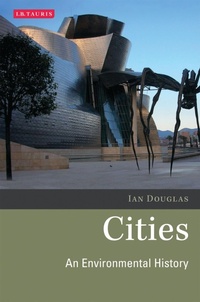
Cities
An Environmental History
Published on 30. September 2012
Book
Paperback/Softback
384 pages
978-1-84511-796-2 (ISBN)
Description
Cities are amongst our greatest creations. Yet, with cities now home to over half the world's population, there is increasing concern over their unchecked expansion and the detrimental effect this is having on the planet. This unfettered growth is affecting every ecosystem on Earth, from the deepest oceans to the highest mountains, as induced climate change and ever increasing demands upon the world's resources take effect. As the pace of urbanisation quickens, how can we make the world's cities more sustainable? Ian Douglas tells the story of cities. He shows why they exist, how they have evolved and the problems they have encountered, revealing how from the very beginning environmental management played a key role in urban life. He addresses specific problems, such as noise and air pollution, water supply and waste management, as well as the vulnerability of cities to hazards such as earthquakes and flooding. And he considers strategies to make cities more sustainable and help them adapt to climate change, such as waste recycling, energy conservation, dual water systems, sustainable housing, as well as initiatives to retrofit existing cities.
Written by an acknowledged international authority, this unique volume will be welcomed by students and specialists in environment, planning, geography, ecology and the built environment.
Written by an acknowledged international authority, this unique volume will be welcomed by students and specialists in environment, planning, geography, ecology and the built environment.
More details
Series
Language
English
Place of publication
United Kingdom
Publishing group
Bloomsbury Publishing PLC
Target group
College/higher education
Professional and scholarly
Product notice
Paperback (trade)
Illustrations
67 figures, 39 tables
Dimensions
Height: 234 mm
Width: 156 mm
Thickness: 20 mm
Weight
538 gr
ISBN-13
978-1-84511-796-2 (9781845117962)
Copyright in bibliographic data and cover images is held by Nielsen Book Services Limited or by the publishers or by their respective licensors: all rights reserved.
Schweitzer Classification
Other editions
Person
Ian Douglas is Emeritus Professor of Geography in the School of Environment and Development, Manchester University. He is Past-President of the Society for Human Ecology, President of the International Council for Ecopolis Development; Chairman of the UK UNESCO MAB (Man and the Biosphere) Urban Forum; and Chairman of the UNESCO SCOPE Expert Group on Urban Futures. He is a member of the editorial boards of Catena, Ecological Processes, Geographical Research, and Land Degradation and Development. His books include The Urban Environment (1983), Humid Landforms (1977) and (as co-editor) Companion Encyclopaedia of Geography (2007) and Routledge Handbook of Urban Ecology (2011).
Content
List of Figures and Tables
Acknowledgements
Introduction
Chapter 1: Trading Village to Global Megalopolis: The Origins and Expansion of Cities
Chapter 2: Communities Responding to Disasters and Threats: Vulnerable and Resiliant Cities
Chapter 3: Foods, Goods, Materials and Ornaments: The Metabolism of Cities
Chapter 4: Smoke, Fumes, Dust and Smog: Changing the Atmosphere of Cities
Chapter 5: Water from the Hills, the Ground, the Sea and the Roof: Towards Integrated Water Resource Management in Cities
Chapter 6: Sanitation, Sewage and Mountains of Trash: Wastewater and Garbage in Cities
Chapter 7: Urban Sounds and Smells: The Noisy, Aromatic City
Chapter 8: Cities and a Dynamic Earth: Urban Changes to the Land Surface and Responses to Geophysical Hazards
Chapter 9: Urban Greenspaces: The Tamed and Wild Nature in Cities
Chapter 10: Urban Sustainability: Cities for Future Generations
Final Thoughs
Notes
Bibliography
Index
Acknowledgements
Introduction
Chapter 1: Trading Village to Global Megalopolis: The Origins and Expansion of Cities
Chapter 2: Communities Responding to Disasters and Threats: Vulnerable and Resiliant Cities
Chapter 3: Foods, Goods, Materials and Ornaments: The Metabolism of Cities
Chapter 4: Smoke, Fumes, Dust and Smog: Changing the Atmosphere of Cities
Chapter 5: Water from the Hills, the Ground, the Sea and the Roof: Towards Integrated Water Resource Management in Cities
Chapter 6: Sanitation, Sewage and Mountains of Trash: Wastewater and Garbage in Cities
Chapter 7: Urban Sounds and Smells: The Noisy, Aromatic City
Chapter 8: Cities and a Dynamic Earth: Urban Changes to the Land Surface and Responses to Geophysical Hazards
Chapter 9: Urban Greenspaces: The Tamed and Wild Nature in Cities
Chapter 10: Urban Sustainability: Cities for Future Generations
Final Thoughs
Notes
Bibliography
Index