

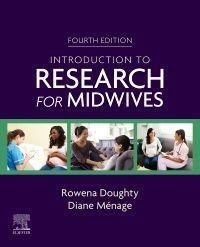
Introduction to Research for Midwives
4th Edition
Published on 19. August 2022
Book
Paperback/Softback
222 pages
978-0-7020-8003-6 (ISBN)
Description
With an increasing expectation that all health professionals, including midwives, will base their practice on evidence, this popular book demystifies the world of research for midwives in the UK.
Introduction to Research for Midwives is a highly regarded resource that helps the reader develop their research skills and guides them toward using evidence effectively in their clinical work. Written clearly and simply, it covers research methods and processes, critical evaluation of research, and application of research to practice.
This book is suitable for both students and practising midwives, whether they are producers or end-users of research, or simply need to understand how to critique research articles and produce literature reviews.
Simple language, clear writing and structure - can be dipped into or read from cover to cover
Extensive guidelines on critiquing research articles and producing successful literature reviews
Student friendly - includes tips for producing successful assignments
New chapter on 'How to Write an Undergraduate Dissertation'
'Conducting Research' and 'Critiquing Research' sections in each chapter - suitable for midwives using research in different ways
Reflection prompts to encourage readers to engage with the narrative
Reader activities to enhance learning and understanding
Comprehensive and fully updated throughout
Glossary to provide clear explanations of research jargon
Linked to the NMC Standards and Proficiencies for Midwives, and can support professional revalidation
Introduction to Research for Midwives is a highly regarded resource that helps the reader develop their research skills and guides them toward using evidence effectively in their clinical work. Written clearly and simply, it covers research methods and processes, critical evaluation of research, and application of research to practice.
This book is suitable for both students and practising midwives, whether they are producers or end-users of research, or simply need to understand how to critique research articles and produce literature reviews.
Simple language, clear writing and structure - can be dipped into or read from cover to cover
Extensive guidelines on critiquing research articles and producing successful literature reviews
Student friendly - includes tips for producing successful assignments
New chapter on 'How to Write an Undergraduate Dissertation'
'Conducting Research' and 'Critiquing Research' sections in each chapter - suitable for midwives using research in different ways
Reflection prompts to encourage readers to engage with the narrative
Reader activities to enhance learning and understanding
Comprehensive and fully updated throughout
Glossary to provide clear explanations of research jargon
Linked to the NMC Standards and Proficiencies for Midwives, and can support professional revalidation
More details
Edition
4th edition
Language
English
Place of publication
London
United Kingdom
Target group
College/higher education
Dimensions
Height: 232 mm
Width: 190 mm
Thickness: 11 mm
Weight
430 gr
ISBN-13
978-0-7020-8003-6 (9780702080036)
Copyright in bibliographic data and cover images is held by Nielsen Book Services Limited or by the publishers or by their respective licensors: all rights reserved.
Schweitzer Classification
Other editions
Previous edition
Book
03/2011
3rd Edition
Churchill Livingstone
€50.94
Article exhausted; check for reprint
Content
1. Midwifery, research and evidence-based practice
2. Key concepts in research
3. The basic framework of research
4. Qualitative research approaches
5. Critiquing research articles
6. Reviewing the literature
7. The research question
8. Ethics and research
9. Surveys and questionnaires
10. Interviews
11. Observation
12. Experiments
13. Statistics in research
14. Sampling methods
15. Writing an undergraduate dissertation
16. The challenge for the future
2. Key concepts in research
3. The basic framework of research
4. Qualitative research approaches
5. Critiquing research articles
6. Reviewing the literature
7. The research question
8. Ethics and research
9. Surveys and questionnaires
10. Interviews
11. Observation
12. Experiments
13. Statistics in research
14. Sampling methods
15. Writing an undergraduate dissertation
16. The challenge for the future