

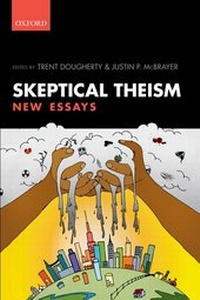
Skeptical Theism
New Essays
Published on 28. January 2016
Book
Paperback/Softback
358 pages
978-0-19-875739-9 (ISBN)
Description
Given that we meet evils in every quarter of the world, could it be governed by an all-good and all-powerful deity? Whilst some philosophers argue that the problem of evil is strong evidence for atheism, others claim that all of the evils in our world can be explained as requirements for deeper goods. On the other hand, skeptical theists believe in God, but struggle with the task of explaining the role of evils in our world.
Skeptical theism tackles the problem of evil by proposing a limited skepticism about the purposes of God, and our abilities to determine whether any given instance is truly an example of gratuitous evil. This collection, of 22 original essays, presents cutting-edge work on skeptical theistic responses to the problem of evil and the persistent objections that such responses invite. Divided into four sections, the volume discusses the epistemology of sceptical theism, conditions of reasonable epistemic access, the implications for theism, and the implications for morality.
Skeptical theism tackles the problem of evil by proposing a limited skepticism about the purposes of God, and our abilities to determine whether any given instance is truly an example of gratuitous evil. This collection, of 22 original essays, presents cutting-edge work on skeptical theistic responses to the problem of evil and the persistent objections that such responses invite. Divided into four sections, the volume discusses the epistemology of sceptical theism, conditions of reasonable epistemic access, the implications for theism, and the implications for morality.
Reviews / Votes
Trent Dougherty and Justin McBrayer's Skeptical Theism: New Essays is a collection of twenty-two essays by leading lights in religious epistemology. The essays are well-argued and briskly presented, and Dougherty and McBrayer's preface and analytic table of contents for the essays are helpful and clear. The most impressive feature of this collection is how consistently the editors have encouraged the contributors to critically interact. ... this collection has four well organized exchanges in addition to stand-alone articles. * Scott Aikin, International Journal for the Study of Skepticism *More details
Language
English
Place of publication
Oxford
United Kingdom
Target group
College/higher education
Professional and scholarly
Dimensions
Height: 232 mm
Width: 155 mm
Thickness: 20 mm
Weight
538 gr
ISBN-13
978-0-19-875739-9 (9780198757399)
Copyright in bibliographic data and cover images is held by Nielsen Book Services Limited or by the publishers or by their respective licensors: all rights reserved.
Schweitzer Classification
Other editions
Additional editions
Book
07/2014
Oxford University Press
€201.18
Shipment within 15-20 days
Persons
Trent Dougherty is Assistant Professor of Philosophy at Baylor University in Waco, Texas. He publishes regularly in epistemology and philosophy of religion. He is editor of Evidentialism and Its Discontents (OUP 2011) and author of The Problem of Animal Pain: A Theodicy for All Creatures Great and Small (Palgrave MacMillan 2014).
Justin P. McBrayer is Assistant Professor of Philosophy at Fort Lewis College in Durango, Colorado. He works in both philosophy of religion and ethics. He is the co-editor of Introducing Ethics: A Critical Thinking Approach with Readings (OUP 2013) and The Blackwell Companion to the Problem of Evil (Wiley Blackwell 2013).
Justin P. McBrayer is Assistant Professor of Philosophy at Fort Lewis College in Durango, Colorado. He works in both philosophy of religion and ethics. He is the co-editor of Introducing Ethics: A Critical Thinking Approach with Readings (OUP 2013) and The Blackwell Companion to the Problem of Evil (Wiley Blackwell 2013).
Content
PART I: KNOWLEDGE & EPISTEMIC HUMILITY; PART II: DEBATING CORNEA; PART III: SKEPTICAL THEISM'S IMPLICATIONS FOR THEISM; PART IV: SKEPTICAL THEISM'S IMPLICATIONS FOR MORALITY