

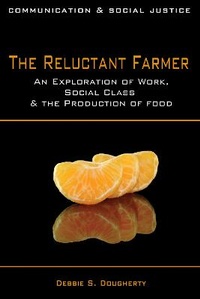
The Reluctant Farmer
An exploration of work, social class, and the production of food
Published on 7. June 2011
Book
Paperback/Softback
244 pages
978-1-84876-384-5 (ISBN)
Description
There are few social issues more pressing than the seemingly disparate issues of social class and safe food. At this point in history, food production, work, and social class are intertwined in a way that puts our collective health at risk, and discourse about food production has become 'classed language', designed to show one's place in the social stratosphere. Consequently, this shift in the function of discourse about food production has focused attention away from the three major issues facing the farming industry. First, farmers need to concern themselves with feeding the world's hungry populations. Second, farmers need to produce healthy food. Third, farmers need to be able to feed their own families.
To illustrate the relationship between social class, work, and food production the author uses her own experience as an academic and a farmer, as well as interviews with a family farmer, an organic farmer, and a family who are agribusiness farmers. The author concludes that farming needs to be more diverse in order to feed hungry people around the world, and produce high quality, healthy food for the regional population where the food is produced. Several suggestions are provided that can be used to help farmers achieve this.
The writer's gentle sense of humour and story telling approach make the book accessible to a wide range of readers. First, it would be a useful book for advanced undergraduates studying social justice, social class, or organizational communication. Second, the book will provide the material for the high level of conversation necessary in a graduate level course. Third, the book will be valuable to intelligent people concerned about both social justice and healthy food production.
To illustrate the relationship between social class, work, and food production the author uses her own experience as an academic and a farmer, as well as interviews with a family farmer, an organic farmer, and a family who are agribusiness farmers. The author concludes that farming needs to be more diverse in order to feed hungry people around the world, and produce high quality, healthy food for the regional population where the food is produced. Several suggestions are provided that can be used to help farmers achieve this.
The writer's gentle sense of humour and story telling approach make the book accessible to a wide range of readers. First, it would be a useful book for advanced undergraduates studying social justice, social class, or organizational communication. Second, the book will provide the material for the high level of conversation necessary in a graduate level course. Third, the book will be valuable to intelligent people concerned about both social justice and healthy food production.
More details
Series
Language
English
Place of publication
Leicester
United Kingdom
Target group
College/higher education
Dimensions
Height: 234 mm
Width: 156 mm
ISBN-13
978-1-84876-384-5 (9781848763845)
Copyright in bibliographic data and cover images is held by Nielsen Book Services Limited or by the publishers or by their respective licensors: all rights reserved.
Schweitzer Classification