

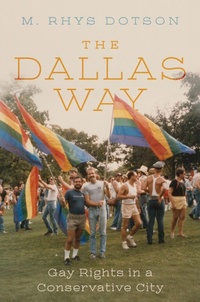
The Dallas Way
Gay Rights in a Conservative City
Published on 2. June 2026
Book
Hardback
208 pages
978-1-4798-3941-4 (ISBN)
Description
Uncovers the untold story of LGBT activists in the American South as they navigated faith and politics
For more than forty years, historians have researched the formation of gay communities and activism in the United States. Yet, the vast majority of scholarship on gay activism in the United States focuses on liberal urban areas like San Francisco, New York City, and Chicago, as opposed to conservative regions.
In The Dallas Way, M. Rhys Dotson examines the development and impact of Dallas's queer community throughout the twentieth century. The book explores the unique challenges and values that impacted queer residents' experiences in conservative regions, from the interplay of traditional family structures, to religious values, and skepticism of rapid social change. Responding to these circumstances, Dotson highlights how early gay activists adopted a nuanced form of activism that both challenged and aligned with their city's conservative values, forging a distinctive path to equality through their own "Dallas Way."
Moreover, the book illustrates how activists utilized strategies that complemented existing social and political structures in Dallas to further their advocacy for collective equality. From the formation of the state's first homophile organization, the Circle of Friends, in 1966, to the establishments of a gay-affirming church and the Dallas Gay Political Caucus in the 1970s, the book showcases the way Dallas' queer activism used religious communities and political activism to foster community and circumvent law enforcement raids. Offering a fresh perspective on the history of LGBT activism in the United States, The Dallas Way displays the unique strategies Southern gay activists leveraged to effect meaningful change and equality in Dallas.
For more than forty years, historians have researched the formation of gay communities and activism in the United States. Yet, the vast majority of scholarship on gay activism in the United States focuses on liberal urban areas like San Francisco, New York City, and Chicago, as opposed to conservative regions.
In The Dallas Way, M. Rhys Dotson examines the development and impact of Dallas's queer community throughout the twentieth century. The book explores the unique challenges and values that impacted queer residents' experiences in conservative regions, from the interplay of traditional family structures, to religious values, and skepticism of rapid social change. Responding to these circumstances, Dotson highlights how early gay activists adopted a nuanced form of activism that both challenged and aligned with their city's conservative values, forging a distinctive path to equality through their own "Dallas Way."
Moreover, the book illustrates how activists utilized strategies that complemented existing social and political structures in Dallas to further their advocacy for collective equality. From the formation of the state's first homophile organization, the Circle of Friends, in 1966, to the establishments of a gay-affirming church and the Dallas Gay Political Caucus in the 1970s, the book showcases the way Dallas' queer activism used religious communities and political activism to foster community and circumvent law enforcement raids. Offering a fresh perspective on the history of LGBT activism in the United States, The Dallas Way displays the unique strategies Southern gay activists leveraged to effect meaningful change and equality in Dallas.
Reviews / Votes
"Having joined the Dallas Gay Alliance in the late 70s, Dotson's work reads like a "Who's Who" of Dallas LGBTQ activism. From boardrooms to streets, his work forms a blueprint for The Dallas Way. While we may have had disagreements over process, the principles that underpin Dotson's report are clear. "The Dallas Way" held. While the model might not work for other cities, Dallas today enjoys one of the most active LGBTQ communities. Born out of the Dallas Gay Alliance, Resource Dallas maintains a vibrant campus that includes a community center, a senior residence, its own clinic and pharmacy, and a food bank. Dotson reveals a legacy left by individuals who did their best in the worst of times." - William Waybourn, Former President of the Foundation for Human Understanding and the Dallas Gay Alliance"All organizing is local - and most effective when it represents a community's actual needs and strengths. M. Rhys Dotson's beautifully written and meticulously researched The Dallas Way demonstrates this splendid illustrating in depth how activists organized and won battles for LGBTQ rights over four decades. Deftly illuminating the navigation of regional conservatism and strategically promoting connections with local political and church groups, Dallas's queer community found a voice and power. The Dallas Way is not simply history of local organizing but a template for how queer history can be written." - Michael Bronski, author of A Queer History of the United States
"The gay-rights movement since the 1970s cannot fully be understood until we appreciate its methods in relatively conservative areas, where it met the fiercest resistance. The Dallas Way succeeds admirably in calling much-needed attention to its tactics and leaders in a major urban center." - Dale Carpenter, author of Flagrant Conduct: The Story of Lawrence v. Texas
More details
Language
English
Place of publication
New York
United States
Target group
Professional and scholarly
College/higher education
Product notice
Trade binding
Illustrations
10 b/w images
Dimensions
Height: 162 mm
Width: 238 mm
Thickness: 143 mm
Weight
488 gr
ISBN-13
978-1-4798-3941-4 (9781479839414)
Copyright in bibliographic data and cover images is held by Nielsen Book Services Limited or by the publishers or by their respective licensors: all rights reserved.
Schweitzer Classification
Other editions
Additional editions
E-Book
06/2026
NYU Press
€30.99
Available for download
Person
M. Rhys Dotson is Assistant Professor of History at University of Texas at Tyler.