

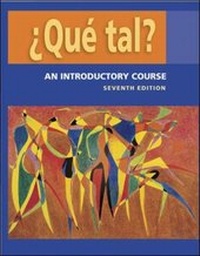
?Que tal?: An Introductory Course Student Edition with Bind-in OLC passcode card
7th Edition
Published on 16. February 2006
Book
Hardback
560 pages
978-0-07-320942-5 (ISBN)
Description
A long-time favorite of instructors who desire a four-skills approach in a briefer book, ?Que tal? combines a broad variety of materials and activities, exceptionally clear grammar presentations, and consistent organization. Its popular four-part chapter structure helps students manage the material without being overwhelmed and makes lesson planning easier for instructors.
More details
Edition
7th edition
Language
English
Place of publication
United States
Publishing group
McGraw-Hill Education - Europe
Dimensions
Height: 285 mm
Width: 218 mm
Thickness: 23 mm
Weight
1377 gr
ISBN-13
978-0-07-320942-5 (9780073209425)
Copyright in bibliographic data and cover images is held by Nielsen Book Services Limited or by the publishers or by their respective licensors: all rights reserved.
Schweitzer Classification
Persons
Thalia Dorwick has taught at Allegheny College, California State University (Sacramento), and Case Western Reserve University, where she received her Ph.D. in Spanish in 1973. She has been recognized as an Outstanding Foreign Language Teacher by the California Foreign Language Teachers Association. Dr. Dorwick is the coauthor of several textbooks and the author of several articles on language teaching issues.
Ana Mari?a Pi?rez-Gironi?s is an adjunct Professor of Spanish oat Western University, Middletown, Connecticut. She received a Licenciatura en Filologi?a Anglogermi?nica from the Universidad de Sevilla in 1985, and her M.A. in General Linguistics from Cornell University in 1988. Her professional interests include second language acquisition and the integration of cultural competence and technology in language teaching
Marty Knorre was formerly Associate Professor of Romance Languages and Coordinator of basic Spanish courses at the University of Cincinnati, where she taught undergraduate and graduate courses in language, linguistics, and methodology. She received her Ph.D. in foreign language education from The Ohio State University in 1975. Dr. Knorre is coauthor of Cara a cara and Reflejos and has taught at several NEH Institutes for Language Instructors. She received a Master of Divinity at McCormick Theological Seminary in 1991.
William R. Glass is the Publisher for World Languages at McGraw-Hill Higher Education. He received his Ph.D. from the University of Illinois at Urbana-Champaign in Spanish Applied Linguistics with a concentration in Second Language Acquisition and Teacher Education (SLATE). He was previously Assistant Professor of Spanish at The Pennsylvania State University where he was also Director of the Language Program in Spanish. He has published numerous articles and edited books on issues related to second language instruction and acquisition.
Hildebrando Villarreal is Professor of Spanish at California State University, Los Angeles, where he teaches undergraduate and graduate courses in language and linguistics. He received his Ph.D. in Spanish with an emphasis in Applied Linguistics from UCLA in 1976. Professor Villarreal is the author of several reviews and articles on language, language teaching, and Spanish for Native Speakers of Spanish. He is the author of i?A leer! Un paso mi?s, an intermediate textbook that focuses on reading skills.
Ana Mari?a Pi?rez-Gironi?s is an adjunct Professor of Spanish oat Western University, Middletown, Connecticut. She received a Licenciatura en Filologi?a Anglogermi?nica from the Universidad de Sevilla in 1985, and her M.A. in General Linguistics from Cornell University in 1988. Her professional interests include second language acquisition and the integration of cultural competence and technology in language teaching
Marty Knorre was formerly Associate Professor of Romance Languages and Coordinator of basic Spanish courses at the University of Cincinnati, where she taught undergraduate and graduate courses in language, linguistics, and methodology. She received her Ph.D. in foreign language education from The Ohio State University in 1975. Dr. Knorre is coauthor of Cara a cara and Reflejos and has taught at several NEH Institutes for Language Instructors. She received a Master of Divinity at McCormick Theological Seminary in 1991.
William R. Glass is the Publisher for World Languages at McGraw-Hill Higher Education. He received his Ph.D. from the University of Illinois at Urbana-Champaign in Spanish Applied Linguistics with a concentration in Second Language Acquisition and Teacher Education (SLATE). He was previously Assistant Professor of Spanish at The Pennsylvania State University where he was also Director of the Language Program in Spanish. He has published numerous articles and edited books on issues related to second language instruction and acquisition.
Hildebrando Villarreal is Professor of Spanish at California State University, Los Angeles, where he teaches undergraduate and graduate courses in language and linguistics. He received his Ph.D. in Spanish with an emphasis in Applied Linguistics from UCLA in 1976. Professor Villarreal is the author of several reviews and articles on language, language teaching, and Spanish for Native Speakers of Spanish. He is the author of i?A leer! Un paso mi?s, an intermediate textbook that focuses on reading skills.
Content
Note: The preliminary chapter (Primeros pasos) and Capitulo 1 of this Contents list provide a comprehensive listing of content for those chapters, as representative of the other chapters. Capitulos 2-18 provide only the vocabulary topics, grammatical structures, and country of cultural focus.
CAPITULO PRELIMINAR: Primeros pasos Primer paso: Saludos y expresiones de cortesia / El alfabeto espanol /?Como es usted? / Spanish in the United States and in the World
Segundo paso: Pronunciacion / Los numeros 0-30; hay / Gustos y preferencias /?Que hora es? / A leer: La geografia del mundo hispanico / Estrategia: Guessing Meaning from Context CAPITULO 1: En la universidad
Paso 1: Vocabulario: En la clase / Las materias / Nota cultural: Las universidades del mundo hispanico / Pronunciacion: Diphthongs and Linking
Paso 2: Gramatica: 1. Singular Nouns: Gender and Articles / 2. Nouns and Articles: Plural Forms
Voces de los Estados Unidos: Literatura: Sandra Cisneros / Musica
Paso 3: Gramatica: 3. Subject Pronouns; Present Tense of -ar Verbs; Negation / En los Estados Unidos y el Canada: Jaime Escalante: Profesor de matematicas / Un poco de todo
Paso 4: Un paso mas: Videoteca: Entrevista cultural; Entre amigos / Enfoque cultural: Los hispanos en los Estados Unidos / Paso final: A leer: Las universidades hispanicas / Estrategia: More on Guessing Meaning from Context / A escribir / En resumen / VocabularioCAPITULO 2: La familia
Vocabulario:La familia y los parientes / Adjetivos / Los numeros 31-100
Gramatica:4. Adjectives: Gender, Number, and Position / 5. Present Tense of ser; Summary of Uses 6. Possessive Adjectives (Unstressed) / 7. Present Tense of -er and -ir Verbs
Enfoque cultural: Mexico CAPITULO 3: De compras
Vocabulario:De compras: La ropa / ?De que color es? / Mas alla del numero 100
Gramatica:8. Demonstrative Pronouns / 9. Tener, venir, preferir, querer,and poder; Some Idioms with tener / 10. Ir; ir + a + Infinitive
Enfoque cultural: NicaraguaCAPITULO 4: En casa
Vocabulario:?Que dia es hoy? / Los muebles, los cuartos y otras partes de la casa / ?Cuando? PreposicionesGramatica 11. Hacer, oir, poner, salir, traer, and ver / 12. Present Tense of Stem-Changing Verbs / 13. Reflexive Pronouns
Enfoque cultural: Costa RicaCAPITULO 5: Las estaciones y el tiempo
Vocabulario:?Que tiempo hace hoy? / Los meses y las estaciones del ano / ?Donde esta? Las preposiciones
Gramatica:14. Present Progressive: estar + -ndo / 15. Summary of the Uses of ser and estar / 16. Comparisons
Enfoque cultural: GuatemalaCAPITULO 6 ?Que le gusta comer?
Vocabulario:La comida / ?Que sabe Ud. y a quien conoce?
Gramatica:17. Direct Object Pronouns / 18. Indefinite and Negative Words / 19. Formal Commands
Enfoque cultural: PanamaCAPITULO 7: De vacaciones
Vocabulario:De viaje / De vacaciones
Gramatica:20. Indirect Object Pronouns; dar and decir / 21. gustar / 22. Preterite of Regular Verbs and of dar, hacer, ir, and ser
Enfoque cultural: Honduras, El SalvadorCAPITULO 8: Los dias festivos
Vocabulario:La fiesta de Javier / Emociones y condiciones
Gramatica:23. Irregular Preterites / 24. Preterite of Stem-Changing Verbs / 25. Double Object Pronouns
Enfoque cultural: CubaCAPITULO 9: El tiempo libre
Vocabulario:Pasatiempos, diversiones y aficiones / Los quehaceres domesticos
Gramatica:26. Imperfect of Regular and Irregular Verbs / 27. Superlatives / 28. Summary of Interrogative Words
Enfoque cultural: ColombiaCAPITULO 10: La salud
Vocabulario:La salud y el bienestar / En el consultorio
Gramatica:29. Using the Preterite and the Imperfect / 30. Reciprocal Actions with Reflexive Pronouns
Enfoque cultural: VenezuelaCAPITULO 11: Presiones de la vida estudiantil
Vocabulario:La vida estudiantil / !La profesora Martinez se levanto con el pie izquierdo!
Gramatica:31. Another Use of se / 32. ?Por o para?: A Summary of Their Uses
Enfoque cultural: Puerto RicoCAPITULO 12: La calidad de la vida
Vocabulario:Tengo... Necesito... Quiero... / La vivienda
Gramatica: 33. Tu Commands / 34. Present Subjunctive: An Introduction / 35. Use of the Subjunctive: Influence
Enfoque cultural: El PeruCAPITULO 13: El arte y la cultura
Vocabulario:Las artes / Ranking Things: Ordinals
Gramatica:36. Use of the Subjunctive: Emotion / 37. Use of the Subjunctive: Doubt and Denial
Enfoque cultural: Bolivia y el EcuadorCAPITULO 14: La naturaleza y el medio ambiente
Vocabulario:La naturaleza y el medio ambiente / Los coches
Gramatica:38. Past Participle Used as an Adjective / 39. Perfect Forms: Present Perfect Indicative and Present Perfect Subjunctive
Enfoque cultural: La Argentina CAPITULO 15: La vida social y la vida afectiva
Vocabulario:Las relaciones sentimentales / Etapas de la vida
Gramatica:40. Subjunctive after Nonexistent and Indefinite Antecedents / 41. Subjunctive After Conjunctions of Contingency and Purpose
Enfoque cultural: ChileCAPITULO 16: ?Trabajar para vivir o vivir para trabajar?
Vocabulario:Profesiones y oficios / El mundo del trabajo / Una cuestion de dinero
Gramatica:42. Future Verb Forms / 43. Subjunctive and Indicative After Conjunctions of Time
Enfoque cultural: El Uruguay y el Paraguay CAPITULO 17: En la actualidad
Vocabulario:Las noticias / El gobierno y la responsabilidad civica
Gramatica:44. Past Subjunctive
Enfoque cultural: Republica DominicanaCAPITULO 18: En el extranjero
Vocabulario:Lugares y cosas en el extranjero / En un viaje al extranjero
Gramatica:45. Conditional Verb Forms
Enfoque cultural: Espana
CAPITULO PRELIMINAR: Primeros pasos Primer paso: Saludos y expresiones de cortesia / El alfabeto espanol /?Como es usted? / Spanish in the United States and in the World
Segundo paso: Pronunciacion / Los numeros 0-30; hay / Gustos y preferencias /?Que hora es? / A leer: La geografia del mundo hispanico / Estrategia: Guessing Meaning from Context CAPITULO 1: En la universidad
Paso 1: Vocabulario: En la clase / Las materias / Nota cultural: Las universidades del mundo hispanico / Pronunciacion: Diphthongs and Linking
Paso 2: Gramatica: 1. Singular Nouns: Gender and Articles / 2. Nouns and Articles: Plural Forms
Voces de los Estados Unidos: Literatura: Sandra Cisneros / Musica
Paso 3: Gramatica: 3. Subject Pronouns; Present Tense of -ar Verbs; Negation / En los Estados Unidos y el Canada: Jaime Escalante: Profesor de matematicas / Un poco de todo
Paso 4: Un paso mas: Videoteca: Entrevista cultural; Entre amigos / Enfoque cultural: Los hispanos en los Estados Unidos / Paso final: A leer: Las universidades hispanicas / Estrategia: More on Guessing Meaning from Context / A escribir / En resumen / VocabularioCAPITULO 2: La familia
Vocabulario:La familia y los parientes / Adjetivos / Los numeros 31-100
Gramatica:4. Adjectives: Gender, Number, and Position / 5. Present Tense of ser; Summary of Uses 6. Possessive Adjectives (Unstressed) / 7. Present Tense of -er and -ir Verbs
Enfoque cultural: Mexico CAPITULO 3: De compras
Vocabulario:De compras: La ropa / ?De que color es? / Mas alla del numero 100
Gramatica:8. Demonstrative Pronouns / 9. Tener, venir, preferir, querer,and poder; Some Idioms with tener / 10. Ir; ir + a + Infinitive
Enfoque cultural: NicaraguaCAPITULO 4: En casa
Vocabulario:?Que dia es hoy? / Los muebles, los cuartos y otras partes de la casa / ?Cuando? PreposicionesGramatica 11. Hacer, oir, poner, salir, traer, and ver / 12. Present Tense of Stem-Changing Verbs / 13. Reflexive Pronouns
Enfoque cultural: Costa RicaCAPITULO 5: Las estaciones y el tiempo
Vocabulario:?Que tiempo hace hoy? / Los meses y las estaciones del ano / ?Donde esta? Las preposiciones
Gramatica:14. Present Progressive: estar + -ndo / 15. Summary of the Uses of ser and estar / 16. Comparisons
Enfoque cultural: GuatemalaCAPITULO 6 ?Que le gusta comer?
Vocabulario:La comida / ?Que sabe Ud. y a quien conoce?
Gramatica:17. Direct Object Pronouns / 18. Indefinite and Negative Words / 19. Formal Commands
Enfoque cultural: PanamaCAPITULO 7: De vacaciones
Vocabulario:De viaje / De vacaciones
Gramatica:20. Indirect Object Pronouns; dar and decir / 21. gustar / 22. Preterite of Regular Verbs and of dar, hacer, ir, and ser
Enfoque cultural: Honduras, El SalvadorCAPITULO 8: Los dias festivos
Vocabulario:La fiesta de Javier / Emociones y condiciones
Gramatica:23. Irregular Preterites / 24. Preterite of Stem-Changing Verbs / 25. Double Object Pronouns
Enfoque cultural: CubaCAPITULO 9: El tiempo libre
Vocabulario:Pasatiempos, diversiones y aficiones / Los quehaceres domesticos
Gramatica:26. Imperfect of Regular and Irregular Verbs / 27. Superlatives / 28. Summary of Interrogative Words
Enfoque cultural: ColombiaCAPITULO 10: La salud
Vocabulario:La salud y el bienestar / En el consultorio
Gramatica:29. Using the Preterite and the Imperfect / 30. Reciprocal Actions with Reflexive Pronouns
Enfoque cultural: VenezuelaCAPITULO 11: Presiones de la vida estudiantil
Vocabulario:La vida estudiantil / !La profesora Martinez se levanto con el pie izquierdo!
Gramatica:31. Another Use of se / 32. ?Por o para?: A Summary of Their Uses
Enfoque cultural: Puerto RicoCAPITULO 12: La calidad de la vida
Vocabulario:Tengo... Necesito... Quiero... / La vivienda
Gramatica: 33. Tu Commands / 34. Present Subjunctive: An Introduction / 35. Use of the Subjunctive: Influence
Enfoque cultural: El PeruCAPITULO 13: El arte y la cultura
Vocabulario:Las artes / Ranking Things: Ordinals
Gramatica:36. Use of the Subjunctive: Emotion / 37. Use of the Subjunctive: Doubt and Denial
Enfoque cultural: Bolivia y el EcuadorCAPITULO 14: La naturaleza y el medio ambiente
Vocabulario:La naturaleza y el medio ambiente / Los coches
Gramatica:38. Past Participle Used as an Adjective / 39. Perfect Forms: Present Perfect Indicative and Present Perfect Subjunctive
Enfoque cultural: La Argentina CAPITULO 15: La vida social y la vida afectiva
Vocabulario:Las relaciones sentimentales / Etapas de la vida
Gramatica:40. Subjunctive after Nonexistent and Indefinite Antecedents / 41. Subjunctive After Conjunctions of Contingency and Purpose
Enfoque cultural: ChileCAPITULO 16: ?Trabajar para vivir o vivir para trabajar?
Vocabulario:Profesiones y oficios / El mundo del trabajo / Una cuestion de dinero
Gramatica:42. Future Verb Forms / 43. Subjunctive and Indicative After Conjunctions of Time
Enfoque cultural: El Uruguay y el Paraguay CAPITULO 17: En la actualidad
Vocabulario:Las noticias / El gobierno y la responsabilidad civica
Gramatica:44. Past Subjunctive
Enfoque cultural: Republica DominicanaCAPITULO 18: En el extranjero
Vocabulario:Lugares y cosas en el extranjero / En un viaje al extranjero
Gramatica:45. Conditional Verb Forms
Enfoque cultural: Espana