

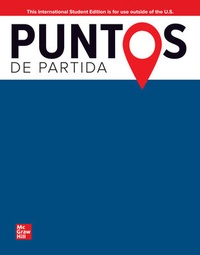
ISE Puntos (Student Edition)
11th Edition
Will be published approx. on 5. March 2020
Book
Paperback/Softback
674 pages
978-1-260-57528-6 (ISBN)
Description
It's more than a text. It's a program.
Success in the language classroom requires so much more than just a text. In any language-learning setting, students require numerous and various opportunities to read, write, hear, and speak.
Puntos de partida sets the standard for Spanish-language teaching. An innovative program that has been continuously refined for today's classroom, Puntos delivers proven pedagogy with clear and effective presentations, comprehensive teaching resources, and powerfully adaptive digital tools.
Now in its anniversary Tenth Edition, Puntos builds on the holistic, five-skills approach it pioneered. It's the Puntos you know. It's the Puntos of today.
Puntos hallmark features include:
Engaging and Immersive Digital Tools: Connect Spanish is the most powerful and flexible course management system available. Rooted in research on effective student learning practices, the platform integrates adaptive learning tools with dynamic, engaging language practice activities. McGraw-Hill's LearnSmart provides each student with a personalized and adaptive learning experience based on individual needs. Connect Spanish also provides the instructor with both the ability and flexibility to pull from the robust set of content available in the platform and craft a unique learning path based on the goals of the course. With Practice Spanish: Study Abroad, the market's first 3-D immersive language game designed exclusively by McGraw-Hill, Puntos brings the language to the students in a fun, engaging, and immersive gaming experience.Students "study abroad" virtually in Colombia where they will create their very own avatar, live with a host family, make new friends, and navigate a variety of real-world scenarios using their quickly developing Spanish language skills. The first and only analytics tool of its kind, Connect Insight is a series of visual data displays-each framed by an intuitive question-to provide instructors at-a-glance information regarding how your class is doing. Connect Insight provides analysis on five key insights, available at a moment's notice from your Connect course.
A Comprehensive scope and sequence: The comprehensive scope and sequence allows instructors to choose what to cover throughout the course without having to supplement their own materials to fill gaps present in other texts.
Carefully arranged organization: the overall organization carefully progresses from formulaic expressions to vocabulary and grammar relevant to daily life and personal interests (studies, family, home,leisure activities), then goes on to prepare students for survival situations(ordering a meal, traveling), and finally branches out to broader themes(current events, social and environment issues). This forward progress is reinforced by a cyclical structure where vocabulary, grammar, and language functions are continuously reviewed and recycled.
Clear and effective vocabulary and grammar presentations: Puntos' approach to vocabulary and grammar focuses on the acquisition of vocabulary during the early stages of language learning and then at the start of each chapter throughout the text.Grammar is introduced in thorough explanations, with careful attention given to skills development rather than grammatical knowledge alone. These explanations are now even more accessible to students, featuring conversational language, increased clarity,additional examples, and organization of complex, dense explanations into manageable chunks of concise grammar summary.
Integrated four-skills approach: Puntos carefully sequences activities, moving students from controlled to free-form tasks. In the tenth edition, this overall scaffolding is improved and introduced at the individual activity level.Starting with the very first activity fol
Success in the language classroom requires so much more than just a text. In any language-learning setting, students require numerous and various opportunities to read, write, hear, and speak.
Puntos de partida sets the standard for Spanish-language teaching. An innovative program that has been continuously refined for today's classroom, Puntos delivers proven pedagogy with clear and effective presentations, comprehensive teaching resources, and powerfully adaptive digital tools.
Now in its anniversary Tenth Edition, Puntos builds on the holistic, five-skills approach it pioneered. It's the Puntos you know. It's the Puntos of today.
Puntos hallmark features include:
Engaging and Immersive Digital Tools: Connect Spanish is the most powerful and flexible course management system available. Rooted in research on effective student learning practices, the platform integrates adaptive learning tools with dynamic, engaging language practice activities. McGraw-Hill's LearnSmart provides each student with a personalized and adaptive learning experience based on individual needs. Connect Spanish also provides the instructor with both the ability and flexibility to pull from the robust set of content available in the platform and craft a unique learning path based on the goals of the course. With Practice Spanish: Study Abroad, the market's first 3-D immersive language game designed exclusively by McGraw-Hill, Puntos brings the language to the students in a fun, engaging, and immersive gaming experience.Students "study abroad" virtually in Colombia where they will create their very own avatar, live with a host family, make new friends, and navigate a variety of real-world scenarios using their quickly developing Spanish language skills. The first and only analytics tool of its kind, Connect Insight is a series of visual data displays-each framed by an intuitive question-to provide instructors at-a-glance information regarding how your class is doing. Connect Insight provides analysis on five key insights, available at a moment's notice from your Connect course.
A Comprehensive scope and sequence: The comprehensive scope and sequence allows instructors to choose what to cover throughout the course without having to supplement their own materials to fill gaps present in other texts.
Carefully arranged organization: the overall organization carefully progresses from formulaic expressions to vocabulary and grammar relevant to daily life and personal interests (studies, family, home,leisure activities), then goes on to prepare students for survival situations(ordering a meal, traveling), and finally branches out to broader themes(current events, social and environment issues). This forward progress is reinforced by a cyclical structure where vocabulary, grammar, and language functions are continuously reviewed and recycled.
Clear and effective vocabulary and grammar presentations: Puntos' approach to vocabulary and grammar focuses on the acquisition of vocabulary during the early stages of language learning and then at the start of each chapter throughout the text.Grammar is introduced in thorough explanations, with careful attention given to skills development rather than grammatical knowledge alone. These explanations are now even more accessible to students, featuring conversational language, increased clarity,additional examples, and organization of complex, dense explanations into manageable chunks of concise grammar summary.
Integrated four-skills approach: Puntos carefully sequences activities, moving students from controlled to free-form tasks. In the tenth edition, this overall scaffolding is improved and introduced at the individual activity level.Starting with the very first activity fol
More details
Edition
11th edition
Language
English
Place of publication
OH
United States
Target group
College/higher education
US School Grade: From College Freshman to College Graduate Student
Illustrations
322 Illustrations
Dimensions
Height: 269 mm
Width: 198 mm
Thickness: 28 mm
Weight
1204 gr
ISBN-13
978-1-260-57528-6 (9781260575286)
Copyright in bibliographic data and cover images is held by Nielsen Book Services Limited or by the publishers or by their respective licensors: all rights reserved.
Schweitzer Classification
Persons
Thalia Dorwick has taught at Allegheny College, California State University (Sacramento), and Case Western Reserve University, where she received her Ph.D. in Spanish in 1973. She has been recognized as an Outstanding Foreign Language Teacher by the California Foreign Language Teachers Association. Dr. Dorwick is the coauthor of several textbooks and the author of several articles on language teaching issues.
Ana Maria Perez-Girones is an adjunct Professor of Spanish at Wesleyan University, Middletown, Connecticut. She received a Licenciatura en Filologia Anglogermanica from the Universidad de Sevilla in 1985, and her M.A. in General Linguistics from Cornell University in 1988. Her professional interests include second language acquisition and the integration of cultural competence and technology in language teaching
Ana Maria Perez-Girones is an adjunct Professor of Spanish at Wesleyan University, Middletown, Connecticut. She received a Licenciatura en Filologia Anglogermanica from the Universidad de Sevilla in 1985, and her M.A. in General Linguistics from Cornell University in 1988. Her professional interests include second language acquisition and the integration of cultural competence and technology in language teaching
Content
Capitulo 1 Ante todo
Vocabulary and Pronunciation
Primera parte
Saludos y expresiones de cortesia
El alfabeto espanol
Grammar
?Como es usted? (Part 1)
Los numeros del 0 al 30; Hay
Los gustos y preferencias (Part 1)
?Que hora es?
Capitulo 2 En la universidad
Vocabulary and Pronunciation
En el salon de clase
Las materias
Grammar
Naming People, Places, Things, and Ideas (Part 1): Singular Nouns: Gender and Articles
Naming People, Places, Things, and Ideas (Part 2): Nouns and Articles: Plural Forms
Getting Information (Part 1): Asking Yes/No Questions
?Que hora es?
Cultura: Los Estados Unidos de America
Capitulo 3 La familia
Vocabulary and Pronunciation
La familia y los parientes
Los numeros del 31 a 100
Los adjectivos
Grammar
Describing: Adjectives: Gender, Number, and Position
Expressing to be: Present Tense of ser; Summary of Uses (Part 2)
Expressing Possession: Unstressed Possessive Adjectives (Part 1)
Expressing Actions: Present Tense of -er and -ir Verbs; Subject Pronouns (Part 2)
Cultura: Mexico
Capitulo 4 De compras
Vocabulary and Pronunciation
De compras: La ropa
Los colores: ?De que color es?
Los numeros a partir del 100
Grammar
Pointing Out People and Things: Demonstrative Adjectives (Part 2) and Pronouns
Expressing Actions and States: Tener, venir, poder, preferir, querer; Some Idioms with tener
Expressing Destination and Future Actions: Ir; The Contraction al; Ir + a + Infinitive
Cultura: Guatemala y Honduras
Capitulo 5 En casa
Vocabulary and Pronunciation
Los muebles , los curators y otras partes de la casa
?Que dia es hoy?
?Cuando?: Las preposiciones (Part 1)
Grammar
Expressing Actions: Hacer, oir, poner, salir, traer, ver
Expressing Actions: Present Tense of Stem-changing Verbs (Part 2)
Expressing -self/-selves: Reflexive Pronouns (Part 1)
Cultura: El Salvador y Nicaragua
Capitulo 6 Las estaciones y el tiempo
Vocabulary and Pronunciation
?Que tiempo hace hoy?
Los meses y las estaciones
?Donde esta?: Las preposiciones (Part 2)
Grammar
?Que estan haciendo?: Present Progressive: Estar + -ndo
?Ser o estar?: Summary of the Uses of ser and estar
Describing: Comparisons
Cultura: Costa Rica
Capitulo 7 !A comer!
Vocabulary and Pronunciation
La comida y las comidas
?Que sabe Ud. y a quien conoce?
Grammar
Expressing what or who(m): Direct Objects: The Personal a; Direct Object Pronouns
Expressing Negation: Indefinite and Negative Words
Influencing Others: Commands (Part 1): Formal Commands
Cultura: Panama
Capitulo 8 De viaje
Vocabulary and Pronunciation
De viaje
De vacaciones
Grammar
Expressing to who(m) or for who(m): Indirect Object Pronouns; Dar and decir
Expressing Likes and Dislikes: Gustar (Part 2)
Talking About the Past (Part 1): Preterite of Regular Verbs and of dar, hacer, ir, and ser
Cultura: La Republica Dominicana
Capitulo 9 Los dias festivos
Vocabulary and Pronunciation
Una fiesta de cumpleanos para Javier
Las emociones y los estados afectivos
Grammar
Talking About the Past (Part 2): Irregular Preterites
Talking About the Past (Part 3): Preterite of Stem-changing Verbs
Avoiding Repetition: Expressing Direct and Indirect Object Pronouns Together
Cultura: Cuba
Capitulo 10 El tiempo libre
Vocabulary and Pronunciation
Los pasatiempos, diversions y aficiones
Los quehaceres domesticos
Grammar
Talking About the Past (Part 4): Descriptions and Habitual Actions in the Past: Imperfect of Regular and Irregular Verbs
Getting Information (Part 2): Summary of Interrogative Words
Expressing Extremes: Superlatives
Cultura: Puerto Rico
Capitulo 11 La salud
Vocabulary and Pronunciation
La salud y el bienestar
En el consultorio del medico
Grammar
Talking About the Past (Part 5): Using the Preterite and the Imperfect
Recognizing que, quien(es), lo que: Relative Pronouns
Expressing each other (Part 2): Reciprocal Actions with Reflexive Pronouns
Cultura: Venezuela
Capitulo 12 !Conestad@s!
Vocabulary and Pronunciation
La ciudad y el barrio
La tecnologia
Grammar
Influencing Others (Part 2): Tu (Informal) Commands
Expressing Subjective Actions or States: Present Subjunctive (Part 1): An Introduction
Expressing Desires and Requests: Use of the Subjunctive (Part 2): Influence
Cultura: Colombia
Capitulo 13 El arte y la cultura
Vocabulary and Pronunciation
Los artes
Los ordinales
Grammar
Expressing Feelings: Use of the Subjunctive (Part 3): Emotion
Expressing Uncertainty: Use of the Subjunctive (Part 4): Doubt and Denial
Expressing Influence, Emotion, Doubt, and Denial: The Subjunctive (Part 5): A Summary
Cultura: El Ecuador y Bolivia
Capitulo 14 Las presiones de la vida moderna
Vocabulary and Pronunciation
Las presiones de la vida academica
!Que mala suerta!
Grammar
Telling How Long Something Has Been Happening or How Long Ago Something Happened: Hace... que: Another Use of hacer
Expressing Unplanned or Unexpected Events: Another Use of se
?Por o para?: A Summary of Their Uses
Cultura: El Peru
Capitulo 15 La naturaleza y el medio ambiante
Vocabulary and Pronunciation
La ciudad y el campo
Los vehiculos
Grammar
Mas descripciones: Past Participle Used as an Adjective
?Que has hecho?: Perfect Forms: Present Perfect Indicative and Present Perfect Subjunctive
Cultura: La Argentina y El Uruguay
Capitulo 16 La vida social y afectiva
Vocabulary and Pronunciation
Las relaciones sentimentales
Las etapas de vida
Grammar
?Hay alguien que... ? ?Hay un lugar donde... ?: The Subjunctive (Part 6): The Subjunctive After Nonexisting and Indefinite Antecedents
Lo hago para que tu...: The Subjunctive (Part 7): The Subjunctive After Conjunctions of Purpose and Contingency
Cultura: El Paraguay
Capitulo 17 ?Trabajar para vivir or vivir para trabajar?
Vocabulary and Pronunciation
Las profesiones y los oficios
El mundo laboral
Una cuestion de dinero
Grammar
Talking About the Future: Future Verb Forms
Expressing Future or Pending Actions: The Subjunctive (Part 8): The Subjunctive and Indicative After Conjunctions of Time
Cultura: Chile
Capitulo 18 La actualidad
Vocabulary and Pronunciation
Las noticias
El gobierno y la responsabilidad civica
Grammar
Queriamos que todo el mundo votara: The Subjunctive (Part 9): The Past Subjunctive
Expressing What You Would Do: Conditional Verb Forms
Cultura: Espana
Vocabulary and Pronunciation
Primera parte
Saludos y expresiones de cortesia
El alfabeto espanol
Grammar
?Como es usted? (Part 1)
Los numeros del 0 al 30; Hay
Los gustos y preferencias (Part 1)
?Que hora es?
Capitulo 2 En la universidad
Vocabulary and Pronunciation
En el salon de clase
Las materias
Grammar
Naming People, Places, Things, and Ideas (Part 1): Singular Nouns: Gender and Articles
Naming People, Places, Things, and Ideas (Part 2): Nouns and Articles: Plural Forms
Getting Information (Part 1): Asking Yes/No Questions
?Que hora es?
Cultura: Los Estados Unidos de America
Capitulo 3 La familia
Vocabulary and Pronunciation
La familia y los parientes
Los numeros del 31 a 100
Los adjectivos
Grammar
Describing: Adjectives: Gender, Number, and Position
Expressing to be: Present Tense of ser; Summary of Uses (Part 2)
Expressing Possession: Unstressed Possessive Adjectives (Part 1)
Expressing Actions: Present Tense of -er and -ir Verbs; Subject Pronouns (Part 2)
Cultura: Mexico
Capitulo 4 De compras
Vocabulary and Pronunciation
De compras: La ropa
Los colores: ?De que color es?
Los numeros a partir del 100
Grammar
Pointing Out People and Things: Demonstrative Adjectives (Part 2) and Pronouns
Expressing Actions and States: Tener, venir, poder, preferir, querer; Some Idioms with tener
Expressing Destination and Future Actions: Ir; The Contraction al; Ir + a + Infinitive
Cultura: Guatemala y Honduras
Capitulo 5 En casa
Vocabulary and Pronunciation
Los muebles , los curators y otras partes de la casa
?Que dia es hoy?
?Cuando?: Las preposiciones (Part 1)
Grammar
Expressing Actions: Hacer, oir, poner, salir, traer, ver
Expressing Actions: Present Tense of Stem-changing Verbs (Part 2)
Expressing -self/-selves: Reflexive Pronouns (Part 1)
Cultura: El Salvador y Nicaragua
Capitulo 6 Las estaciones y el tiempo
Vocabulary and Pronunciation
?Que tiempo hace hoy?
Los meses y las estaciones
?Donde esta?: Las preposiciones (Part 2)
Grammar
?Que estan haciendo?: Present Progressive: Estar + -ndo
?Ser o estar?: Summary of the Uses of ser and estar
Describing: Comparisons
Cultura: Costa Rica
Capitulo 7 !A comer!
Vocabulary and Pronunciation
La comida y las comidas
?Que sabe Ud. y a quien conoce?
Grammar
Expressing what or who(m): Direct Objects: The Personal a; Direct Object Pronouns
Expressing Negation: Indefinite and Negative Words
Influencing Others: Commands (Part 1): Formal Commands
Cultura: Panama
Capitulo 8 De viaje
Vocabulary and Pronunciation
De viaje
De vacaciones
Grammar
Expressing to who(m) or for who(m): Indirect Object Pronouns; Dar and decir
Expressing Likes and Dislikes: Gustar (Part 2)
Talking About the Past (Part 1): Preterite of Regular Verbs and of dar, hacer, ir, and ser
Cultura: La Republica Dominicana
Capitulo 9 Los dias festivos
Vocabulary and Pronunciation
Una fiesta de cumpleanos para Javier
Las emociones y los estados afectivos
Grammar
Talking About the Past (Part 2): Irregular Preterites
Talking About the Past (Part 3): Preterite of Stem-changing Verbs
Avoiding Repetition: Expressing Direct and Indirect Object Pronouns Together
Cultura: Cuba
Capitulo 10 El tiempo libre
Vocabulary and Pronunciation
Los pasatiempos, diversions y aficiones
Los quehaceres domesticos
Grammar
Talking About the Past (Part 4): Descriptions and Habitual Actions in the Past: Imperfect of Regular and Irregular Verbs
Getting Information (Part 2): Summary of Interrogative Words
Expressing Extremes: Superlatives
Cultura: Puerto Rico
Capitulo 11 La salud
Vocabulary and Pronunciation
La salud y el bienestar
En el consultorio del medico
Grammar
Talking About the Past (Part 5): Using the Preterite and the Imperfect
Recognizing que, quien(es), lo que: Relative Pronouns
Expressing each other (Part 2): Reciprocal Actions with Reflexive Pronouns
Cultura: Venezuela
Capitulo 12 !Conestad@s!
Vocabulary and Pronunciation
La ciudad y el barrio
La tecnologia
Grammar
Influencing Others (Part 2): Tu (Informal) Commands
Expressing Subjective Actions or States: Present Subjunctive (Part 1): An Introduction
Expressing Desires and Requests: Use of the Subjunctive (Part 2): Influence
Cultura: Colombia
Capitulo 13 El arte y la cultura
Vocabulary and Pronunciation
Los artes
Los ordinales
Grammar
Expressing Feelings: Use of the Subjunctive (Part 3): Emotion
Expressing Uncertainty: Use of the Subjunctive (Part 4): Doubt and Denial
Expressing Influence, Emotion, Doubt, and Denial: The Subjunctive (Part 5): A Summary
Cultura: El Ecuador y Bolivia
Capitulo 14 Las presiones de la vida moderna
Vocabulary and Pronunciation
Las presiones de la vida academica
!Que mala suerta!
Grammar
Telling How Long Something Has Been Happening or How Long Ago Something Happened: Hace... que: Another Use of hacer
Expressing Unplanned or Unexpected Events: Another Use of se
?Por o para?: A Summary of Their Uses
Cultura: El Peru
Capitulo 15 La naturaleza y el medio ambiante
Vocabulary and Pronunciation
La ciudad y el campo
Los vehiculos
Grammar
Mas descripciones: Past Participle Used as an Adjective
?Que has hecho?: Perfect Forms: Present Perfect Indicative and Present Perfect Subjunctive
Cultura: La Argentina y El Uruguay
Capitulo 16 La vida social y afectiva
Vocabulary and Pronunciation
Las relaciones sentimentales
Las etapas de vida
Grammar
?Hay alguien que... ? ?Hay un lugar donde... ?: The Subjunctive (Part 6): The Subjunctive After Nonexisting and Indefinite Antecedents
Lo hago para que tu...: The Subjunctive (Part 7): The Subjunctive After Conjunctions of Purpose and Contingency
Cultura: El Paraguay
Capitulo 17 ?Trabajar para vivir or vivir para trabajar?
Vocabulary and Pronunciation
Las profesiones y los oficios
El mundo laboral
Una cuestion de dinero
Grammar
Talking About the Future: Future Verb Forms
Expressing Future or Pending Actions: The Subjunctive (Part 8): The Subjunctive and Indicative After Conjunctions of Time
Cultura: Chile
Capitulo 18 La actualidad
Vocabulary and Pronunciation
Las noticias
El gobierno y la responsabilidad civica
Grammar
Queriamos que todo el mundo votara: The Subjunctive (Part 9): The Past Subjunctive
Expressing What You Would Do: Conditional Verb Forms
Cultura: Espana