

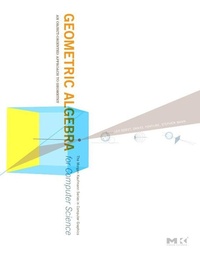
Geometric Algebra for Computer Science (Revised Edition)
An Object-Oriented Approach to Geometry
Published on 26. March 2009
Book
Hardback
664 pages
978-0-12-374942-0 (ISBN)
Description
Geometric Algebra for Computer Science (Revised Edition) presents a compelling alternative to the limitations of linear algebra.
Geometric algebra (GA) is a compact, time-effective, and performance-enhancing way to represent the geometry of 3D objects in computer programs. This book explains GA as a natural extension of linear algebra and conveys its significance for 3D programming of geometry in graphics, vision, and robotics. It systematically explores the concepts and techniques that are key to representing elementary objects and geometric operators using GA. It covers in detail the conformal model, a convenient way to implement 3D geometry using a 5D representation space. Numerous drills and programming exercises are helpful for both students and practitioners. A companion web site includes links to GAViewer, a program that will allow you to interact with many of the 3D figures in the book; and Gaigen 2, the platform for the instructive programming exercises that conclude each chapter.
The book will be of interest to professionals working in fields requiring complex geometric computation such as robotics, computer graphics, and computer games. It is also be ideal for students in graduate or advanced undergraduate programs in computer science.
Geometric algebra (GA) is a compact, time-effective, and performance-enhancing way to represent the geometry of 3D objects in computer programs. This book explains GA as a natural extension of linear algebra and conveys its significance for 3D programming of geometry in graphics, vision, and robotics. It systematically explores the concepts and techniques that are key to representing elementary objects and geometric operators using GA. It covers in detail the conformal model, a convenient way to implement 3D geometry using a 5D representation space. Numerous drills and programming exercises are helpful for both students and practitioners. A companion web site includes links to GAViewer, a program that will allow you to interact with many of the 3D figures in the book; and Gaigen 2, the platform for the instructive programming exercises that conclude each chapter.
The book will be of interest to professionals working in fields requiring complex geometric computation such as robotics, computer graphics, and computer games. It is also be ideal for students in graduate or advanced undergraduate programs in computer science.
Reviews / Votes
"Within the last decade, Geometric Algebra (GA) has emerged as a powerful alternative to classical matrix algebra as a comprehensive conceptual language and computational system for computer science. This book will serve as a standard introduction and reference to the subject for students and experts alike. As a textbook, it provides a thorough grounding in the fundamentals of GA, with many illustrations, exercises and applications. Experts will delight in the refreshing perspective GA gives to every topic, large and small." --David Hestenes, Distinguished research Professor, Department of Physics, Arizona State University"Geometric Algebra is becoming increasingly important in computer science. This book is a comprehensive introduction to Geometric Algebra with detailed descriptions of important applications. While requiring serious study, it has deep and powerful insights into GA's usage. It has excellent discussions of how to actually implement GA on the computer." --Dr. Alyn Rockwood, CTO, FreeDesign, Inc. Longmont, Colorado
More details
Series
Language
English
Place of publication
San Francisco
United States
Publishing group
Elsevier Science & Technology
Target group
College/higher education
Professionals working in fields requiring complex geometric computation such as robotics, computer graphics, and computer games. Students in graduate or advanced undergraduate programs in computer science.
Product notice
sewn/stitched
Paper over boards
Illustrations
Approx. 190 illustrations (200 in full color)
Dimensions
Height: 241 mm
Width: 194 mm
Thickness: 32 mm
Weight
1473 gr
ISBN-13
978-0-12-374942-0 (9780123749420)
Copyright in bibliographic data and cover images is held by Nielsen Book Services Limited or by the publishers or by their respective licensors: all rights reserved.
Schweitzer Classification
Other editions
Additional editions
Leo Dorst | Daniel Fontijne | Stephen Mann
Geometric Algebra for Computer Science (Revised Edition)
An Object-Oriented Approach to Geometry
E-Book
02/2009
Morgan Kaufmann
€54.95
Available for download
Previous edition
Leo Dorst | Daniel Fontijne | Stephen Mann
Geometric Algebra for Computer Science
An Object-Oriented Approach to Geometry
Book
04/2007
Morgan Kaufmann
€60.65
Shipment within 10-15 days
Persons
Daniel Fontijne holds a Master's degree in artificial Intelligence and a Ph.D. in Computer Science, both from the University of Amsterdam. His main professional interests are computer graphics, motion capture, and computer vision.
Content
CHAPTER 1. WHY GEOMETRIC ALGEBRA?
PART I GEOMETRIC ALGEBRA
CHAPTER 2. SPANNING ORIENTED SUBSPACES
CHAPTER 3. METRIC PRODUCTS OF SUBSPACES
CHAPTER 4. LINEAR TRANSFORMATIONS OF
SUBSPACES
CHAPTER 5. INTERSECTION AND UNION OF
SUBSPACES
CHAPTER 6. THE FUNDAMENTAL PRODUCT OF
GEOMETRIC ALGEBRA
CHAPTER 7. ORTHOGONAL TRANSFORMATIONS AS
VERSORS
CHAPTER 8. GEOMETRIC DIFFERENTIATION
PART II MODELS OF GEOMETRIES
CHAPTER 9. MODELING GEOMETRIES
CHAPTER 10. THE VECTOR SPACE MODEL: THE
ALGEBRA OF DIRECTIONS
CHAPTER 11. THE HOMOGENEOUS MODEL
CHAPTER 12. APPLICATIONS OF THE
HOMOGENEOUS MODEL
CHAPTER 13. THE CONFORMAL MODEL:
OPERATIONAL EUCLIDEAN GEOMETRY
CHAPTER 14. NEW PRIMITIVES FOR EUCLIDEAN
GEOMETRY
CHAPTER 15. CONSTRUCTIONS IN EUCLIDEAN
GEOMETRY
CHAPTER 16. CONFORMAL OPERATORS
CHAPTER 17. OPERATIONAL MODELS FOR
GEOMETRIES
PART III IMPLEMENTING GEOMETRIC ALGEBRA
CHAPTER 18. IMPLEMENTATION ISSUES
CHAPTER 19. BASIS BLADES AND OPERATIONS
CHAPTER 20. THE LINEAR PRODUCTS AND
OPERATIONS
CHAPTER 21. FUNDAMENTAL ALGORITHMS FOR
NONLINEAR PRODUCTS
CHAPTER 22. SPECIALIZING THE STRUCTURE FOR
EFFICIENCY
CHAPTER 23. USING THE GEOMETRY IN A RAY-
TRACING APPLICATION
PART IV APPENDICES
A METRICS AND NULL VECTORS
B CONTRACTIONS AND OTHER INNER PRODUCTS
C SUBSPACE PRODUCTS RETRIEVED
D COMMON EQUATIONS
BIBLIOGRAPHY
INDEX
PART I GEOMETRIC ALGEBRA
CHAPTER 2. SPANNING ORIENTED SUBSPACES
CHAPTER 3. METRIC PRODUCTS OF SUBSPACES
CHAPTER 4. LINEAR TRANSFORMATIONS OF
SUBSPACES
CHAPTER 5. INTERSECTION AND UNION OF
SUBSPACES
CHAPTER 6. THE FUNDAMENTAL PRODUCT OF
GEOMETRIC ALGEBRA
CHAPTER 7. ORTHOGONAL TRANSFORMATIONS AS
VERSORS
CHAPTER 8. GEOMETRIC DIFFERENTIATION
PART II MODELS OF GEOMETRIES
CHAPTER 9. MODELING GEOMETRIES
CHAPTER 10. THE VECTOR SPACE MODEL: THE
ALGEBRA OF DIRECTIONS
CHAPTER 11. THE HOMOGENEOUS MODEL
CHAPTER 12. APPLICATIONS OF THE
HOMOGENEOUS MODEL
CHAPTER 13. THE CONFORMAL MODEL:
OPERATIONAL EUCLIDEAN GEOMETRY
CHAPTER 14. NEW PRIMITIVES FOR EUCLIDEAN
GEOMETRY
CHAPTER 15. CONSTRUCTIONS IN EUCLIDEAN
GEOMETRY
CHAPTER 16. CONFORMAL OPERATORS
CHAPTER 17. OPERATIONAL MODELS FOR
GEOMETRIES
PART III IMPLEMENTING GEOMETRIC ALGEBRA
CHAPTER 18. IMPLEMENTATION ISSUES
CHAPTER 19. BASIS BLADES AND OPERATIONS
CHAPTER 20. THE LINEAR PRODUCTS AND
OPERATIONS
CHAPTER 21. FUNDAMENTAL ALGORITHMS FOR
NONLINEAR PRODUCTS
CHAPTER 22. SPECIALIZING THE STRUCTURE FOR
EFFICIENCY
CHAPTER 23. USING THE GEOMETRY IN A RAY-
TRACING APPLICATION
PART IV APPENDICES
A METRICS AND NULL VECTORS
B CONTRACTIONS AND OTHER INNER PRODUCTS
C SUBSPACE PRODUCTS RETRIEVED
D COMMON EQUATIONS
BIBLIOGRAPHY
INDEX