

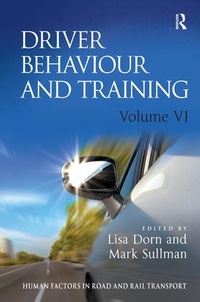
Driver Behaviour and Training: Volume VI
1st Edition
Published on 28. June 2013
Book
Hardback
336 pages
978-1-4724-1469-4 (ISBN)
Description
This volume is an outcome of the sixth International Conference in Driver Behaviour and Training. It focuses on how driver training must adapt to take into account individual differences in order to raise awareness of how these differences may contribute to unsafe driving behaviour.
Reviews / Votes
'This volume demonstrates the astonishing scale of the amount of work that is being done all over the world in the field of driver behaviour and training. Each contribution has something of interest for specialists in the field. Moreover, the editors have stamped their mark in what could have been an unwieldy collection of papers, giving a cohesive structure throughout.' The RoSPA Occupational Safety & Health Journal, October 2013More details
Language
English
Place of publication
London
United Kingdom
Publishing group
Taylor & Francis Ltd
Target group
College/higher education
Dimensions
Height: 234 mm
Width: 156 mm
Weight
754 gr
ISBN-13
978-1-4724-1469-4 (9781472414694)
Copyright in bibliographic data and cover images is held by Nielsen Book Services Limited or by the publishers or by their respective licensors: all rights reserved.
Schweitzer Classification
Other editions
Additional editions
Lisa Dorn
Driver Behaviour and Training: Volume VI
E-Book
12/2016
Routledge
€60.49
Available for download
Lisa Dorn
Driver Behaviour and Training: Volume VI
E-Book
12/2016
Routledge
€60.49
Available for download
Person
Dr Lisa Dorn is Director of the Driving Research Group at Cranfield University. She is President -Elect of the International Association of Applied Psychology: Traffic and Transportation Psychology Division and an Associate Fellow of the British Psychological Society, Chartered Psychologist and Member of the Institute of Ergonomics and Human Factors. Dr Dorn has published a number of journal papers on driver behaviour, driver stress and risk and is a regular contributor to the public debate at major conferences. Currently, Dr Dorn is working with global organisations to improve driver education and training.
Content
Part 1: Driver Education: The Role of Experience and Instruction 1. Anticipation, Neural Function and Mastering Driving 2. Does Driving Experience Delay Overload Threshold as a Function of Situation Complexity? 3. Risk Allostasis: A Simulator Study of Age Effects 4. Development and Evaluation of a Competence-based Exam for Prospective Driving Instructors Part 2: Driver Behaviour and Driver Training 5. Identifying the Characteristics of Risky Driving Behaviour 6. The Impact of Frustration on Visual Search and Hazard Sensitivity in Filmed Driving Situations 7. Anger and Prospective Memory While Driving: Do Future Intentions Affect Current Anger? 8. Emotion Regulation of Car Drivers by the Physical and Psychological Parameters of Music 9. The Relationship between Seat Belt Use and Distracted Driving 10. Self-evaluation Bias in Stopping Behaviour whilst Driving 11. Predicting the Future Driving Style of Novice Drivers: The Role of Self-evaluation and Instructors' Ratings following Driver Training 12. Improving Safety during Work-related Driving among Postal Van Drivers Part 3: Road Environment, In-Vehicle Technology and Driver Behaviour 13. Evaluation of Visual Overtaking Distance Using a Driver's Psycho-emotional Response 14. Cognitive Distractions and their Relationship with the Driver 15. Driver Fatigue Systems - How do they Change Drivers' Behaviour? 16. Ergonomics of Parking Brake Application: An Introduction 17. The Compatibility of Energy Efficiency with Pleasure of Driving in a Fully Electric Vehicle 18. Learning from Accidents: Using Technical and Subjective Information to Identify Accident Mechanisms and to Develop Driver Assistance Systems Part 4: Methodological Considerations in Measuring Driver Behaviour 19. The Consistency of Crash Involvement Recall across Time 20. Controlling for Self-reported Exposure in Traffic Accident Prediction Studies 21. The Wrong Tool for the Job? the Predictive Powers of the DBQ in a Sample of Queensland Motorists 22. Predictive Validity and Cross-cultural Differences in the Self-reported Driving Behaviour of Professional Driver Students in Ecuador 23. Psychometric Properties of the Driving Cognitions Questionnaire in a Polish Sample