

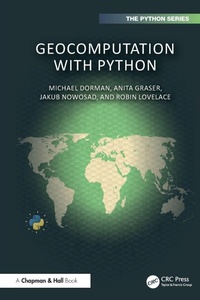
Geocomputation with Python
1st Edition
Published on 14. February 2025
Book
Paperback/Softback
344 pages
978-1-032-46065-9 (ISBN)
Description
Geocomputation with Python is a comprehensive resource for working with geographic data with the most popular programming language in the world. The book gives an overview of Python's capabilities for spatial data analysis, as well as dozens of worked-through examples covering the entire range of standard GIS operations. A unique selling point of the book is its cohesive and joined-up coverage of both vector and raster geographic data models and consistent learning curve. This book is an excellent starting point for those new to working with geographic data with Python, making it ideal for students and practitioners beginning their journey with Python.
Key features:
Showcases the integration of vector and raster datasets operations.
Provides explanation of each line of code in the book to minimize surprises.
Includes example datasets and meaningful operations to illustrate the applied nature of geographic research.
Another unique feature is that this book is part of a wider community. Geocomputation with Python is a sister project of Geocomputation with R (Lovelace, Nowosad, and Muenchow 2019), a book on geographic data analysis, visualization, and modeling using the R programming language that has numerous contributors and an active community.
The book teaches how to import, process, examine, transform, compute, and export spatial vector and raster datasets with Python, the most widely used language for data science and many other domains. Reading the book and running the reproducible code chunks within will make you a proficient user of key packages in the ecosystem, including shapely, geopandas, and rasterio. The book also demonstrates how to make use of dozens of additional packages for a wide range of tasks, from interactive map making to terrain modeling. Geocomputation with Python provides a firm foundation for more advanced topics, including spatial statistics, machine learning involving spatial data, and spatial network analysis, and a gateway into the vibrant and supportive community developing geographic tools in Python and beyond.
Key features:
Showcases the integration of vector and raster datasets operations.
Provides explanation of each line of code in the book to minimize surprises.
Includes example datasets and meaningful operations to illustrate the applied nature of geographic research.
Another unique feature is that this book is part of a wider community. Geocomputation with Python is a sister project of Geocomputation with R (Lovelace, Nowosad, and Muenchow 2019), a book on geographic data analysis, visualization, and modeling using the R programming language that has numerous contributors and an active community.
The book teaches how to import, process, examine, transform, compute, and export spatial vector and raster datasets with Python, the most widely used language for data science and many other domains. Reading the book and running the reproducible code chunks within will make you a proficient user of key packages in the ecosystem, including shapely, geopandas, and rasterio. The book also demonstrates how to make use of dozens of additional packages for a wide range of tasks, from interactive map making to terrain modeling. Geocomputation with Python provides a firm foundation for more advanced topics, including spatial statistics, machine learning involving spatial data, and spatial network analysis, and a gateway into the vibrant and supportive community developing geographic tools in Python and beyond.
More details
Series
Language
English
Place of publication
United Kingdom
Publishing group
Taylor & Francis Ltd
Target group
College/higher education
Postgraduate and Undergraduate Advanced
Illustrations
13 s/w Abbildungen, 133 farbige Abbildungen, 13 s/w Zeichnungen, 133 farbige Zeichnungen, 21 s/w Tabellen
21 Tables, black and white; 133 Line drawings, color; 13 Line drawings, black and white; 133 Illustrations, color; 13 Illustrations, black and white
Dimensions
Height: 234 mm
Width: 156 mm
Thickness: 17 mm
Weight
474 gr
ISBN-13
978-1-032-46065-9 (9781032460659)
Copyright in bibliographic data and cover images is held by Nielsen Book Services Limited or by the publishers or by their respective licensors: all rights reserved.
Schweitzer Classification
Other editions
Additional editions
Michael Dorman | Anita Graser | Jakub Nowosad
Geocomputation with Python
E-Book
02/2025
1st Edition
Chapman and Hall
€77.99
Available for download
Michael Dorman | Anita Graser | Jakub Nowosad
Geocomputation with Python
E-Book
02/2025
1st Edition
Chapman and Hall
€77.99
Available for download
Michael Dorman | Anita Graser | Jakub Nowosad
Geocomputation with Python
Book
02/2025
1st Edition
Chapman & Hall/CRC
€255.10
Shipment within 10-20 days
Persons
Michael Dorman, Ph.D. is a programmer and lecturer at The Department of Environmental, Geoinformatics and Urban Planning Sciences, Ben-Gurion University of the Negev. He is working with researchers and students to develop computational workflows for spatial analysis, mostly through programming in Python, R, and JavaScript, as well as teaching those subjects.
Anita Graser, Ph.D. is a Senior Scientist at the Austrian Institute of Technology (AIT), QGIS PSC member and lead developer of MovingPandas. Anita has published several books about QGIS, including "Learning QGIS" and "QGIS Map Design", teaches Python for QGIS, and writes a popular spatial data science blog.
Jakub Nowosad, Ph.D. is an Associate Professor at Adam Mickiewicz University in Poznan and a visiting scientist at the University of Muenster. Specializing in spatial pattern analysis in environmental studies, he combines research with a dedication to education and open science principles. Dr. Nowosad is committed to developing scientific software and fostering accessible knowledge through teaching and open-source contributions.
Robin Lovelace, Ph.D. is a Professor of Transport Data Science at the University of Leeds., He is the developer of high impact applications for more data-driven transport planning and policy. He has a decade's experience researching and teaching data science with geographic data and has developed numerous tools to support more data-driven policies, including the award-winning Propensity to Cycle Tool which has transformed the practice of strategic active travel network planning in the UK.
Anita Graser, Ph.D. is a Senior Scientist at the Austrian Institute of Technology (AIT), QGIS PSC member and lead developer of MovingPandas. Anita has published several books about QGIS, including "Learning QGIS" and "QGIS Map Design", teaches Python for QGIS, and writes a popular spatial data science blog.
Jakub Nowosad, Ph.D. is an Associate Professor at Adam Mickiewicz University in Poznan and a visiting scientist at the University of Muenster. Specializing in spatial pattern analysis in environmental studies, he combines research with a dedication to education and open science principles. Dr. Nowosad is committed to developing scientific software and fostering accessible knowledge through teaching and open-source contributions.
Robin Lovelace, Ph.D. is a Professor of Transport Data Science at the University of Leeds., He is the developer of high impact applications for more data-driven transport planning and policy. He has a decade's experience researching and teaching data science with geographic data and has developed numerous tools to support more data-driven policies, including the award-winning Propensity to Cycle Tool which has transformed the practice of strategic active travel network planning in the UK.
Content
Preface 1. Geographic data in Python 2. Attribute data operations 3. Spatial data operations 4. Geometry operations 5. Raster-vector interactions 6. Reprojecting geographic data 7. Geographic data I/O 8. Making maps with Python References