

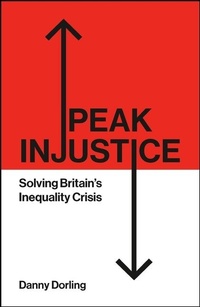
Peak Injustice
Solving Britain's Inequality Crisis
1st Edition
Published on 1. October 2024
Book
Paperback/Softback
480 pages
978-1-4473-7261-5 (ISBN)
Description
By 2024 a majority of parents in the UK with three or more children were going hungry to feed their families. Children in the UK are becoming shorter and childhood mortality has been rising. What part does living with high inequality play in understanding how we have got to the point of peak injustice, when surely the situation cannot become worse?
Although 2018 was a year of peak income and wealth inequality in the UK, absolute deprivation has continued to grow since then, especially after the pandemic.
Peak Injustice follows up the best-selling Peak Inequality (2018), offering a carefully curated selection of Danny Dorling's latest published writing with brand new content looking to the future, including challenges for a new government in 2024/25, the impact of Jeremy Corbyn's legacy, and the implications of Keir Starmer's many blind spots.
An essential addition to readers' Dorling collections.
Although 2018 was a year of peak income and wealth inequality in the UK, absolute deprivation has continued to grow since then, especially after the pandemic.
Peak Injustice follows up the best-selling Peak Inequality (2018), offering a carefully curated selection of Danny Dorling's latest published writing with brand new content looking to the future, including challenges for a new government in 2024/25, the impact of Jeremy Corbyn's legacy, and the implications of Keir Starmer's many blind spots.
An essential addition to readers' Dorling collections.
Reviews / Votes
"A lot of humanity... [with] basic solutions to the crisis." LabourHub "I hope we've not reached Peak Dorling - we need Danny's wisdom and knowledge to help us root out injustice and work towards a better world." Kate E. Pickett, University of York"A sobering and poignantly written wake-up call. With his trademark deployment of meticulous statistical evidence, Dorling catalogues the causes of Britain's decline and proposes solutions for real change and repair." David Olusoga, broadcaster and television producer "Danny Dorling charts the contours of our society with a self evident passion and creativity that not only explain its grotesque inequalities but inspire us to understand how we can radically change it." Rt Hon John McDonnell, MP for Hayes and Harlington
"An urgent, accessible analysis of the genuine peril the UK is in, and what needs to change to get our country back on track." Melissa Benn, writer and campaigner. "In this book, a world-class scholar of inequality convincingly makes the case that, despite everything, and not just perfunctorily, it's worth having hope." Marcos Gonzalez Hernando, UCL Social Research Institute and Universidad Diego Portales
"Danny Dorling embodies the conscience of the left in Britain, disappointed, angry but still hopeful. This book raises uneasy questions about prolonged social injustice. A new government should answer them." Guy Standing FAcSS, SOAS University of London
More details
Edition
First Edition
Language
English
Place of publication
Bristol
United Kingdom
Publishing group
Bristol University Press
Target group
Professional and scholarly
Product notice
Paperback (trade)
Unsewn / adhesive bound
Illustrations
99 s/w Abbildungen, 21 farbige Abbildungen, 6 s/w Tabellen
6 Tables, black and white; 21 Illustrations, color; 99 Illustrations, black and white
Dimensions
Height: 216 mm
Width: 140 mm
Thickness: 41 mm
Weight
590 gr
ISBN-13
978-1-4473-7261-5 (9781447372615)
Copyright in bibliographic data and cover images is held by Nielsen Book Services Limited or by the publishers or by their respective licensors: all rights reserved.
Schweitzer Classification
Other editions
Additional editions
E-Book
10/2024
1st Edition
Policy Press
€22.49
Available for download
E-Book
10/2024
1st Edition
Policy Press
€231.99
Available for download
Person
Danny Dorling is 1971 Professor of Geography at the University of Oxford and a Fellow of St Peter's College. He is a patron of RoadPeace, Comprehensive Future and Heeley City Farm. He has published over 50 books, including the best-selling Peak Inequality: Britain's Ticking Timebomb (2018) and Injustice: Why Social Inequality Still Persists (2014).
Content
Introduction - Britain's inequality crisis
Section 1: The politics of hope
The inequality crisis: how did you not see me?
1.1 On Jeremy Corbyn
1.2 Would you let Boris Johnson drive your daughter home?
1.3 The curve of inequality and the Brexit Way
1.4 So, how did we end up with this government?
1.5 Osborne, Johnson and Starmer: let them eat growth?
1.6 A tale of three elections: Sweden, Italy and England
1.7 What the UK in 1922 and in 2017 had in common
1.8 Are things about to get better?
Section 2: Poverty, destitution and happiness
Anxiety, satisfaction, worth and happiness
2.1 Who spends more wisely: individuals or government?
2.2 Dying quietly: English suburbs and the stiff upper lip
2.3 The wreckers who tore British society apart
2.4 Austerity, not influenza, caused the UK's health to deteriorate
2.5 The income shock of 2020: a jolt in the fall after peak inequality
2.6 The roundabout: class hate in England
2.7 Why Finland is still the happiest country in the world
2.8 Most people in the UK now share Robert Owen's views
2.9 A majority of people think the government does too little
2.10 The crises combine: austerity, the cost of living, jobs and pay
Section 3: Levelling across housing
We will finish what we started
3.1 When everyone you know buys art
3.2 Short cuts on homelessness
3.3 How to solve the housing crisis
3.4 Public spending in the UK and Europe
3.5 House prices: welcoming a crash
3.6 A letter from Helsinki
3.7 Liz Truss and autumn 2022
3.8 Labour and levelling up
Section 4: Eugenics and the fear of too many people
Eugenics and population control
4.1 The blank slate
4.2 When racism stopped being normal
4.3 About our schools
4.4 The birth of Baby Eight Billion
4.5 History repeating
Section 5: How austerity undermined our public health
Counting the cost of austerity
5.1 How austerity caused the NHS crisis
5.2 The Brexit vote, declining health and immigration
5.3 How many more will be dead by Christmas?
5.4 The decimation of the NHS
5.5 Falling down the global ranks
5.6 Our museum future
Section 6: Hope, the elite and change
Yesterday, tomorrow - and hope
6.1 What would it take to persuade Rishi Sunak to join the Patriotic Millionaires?
6.2 Kindness: rigour for British Geographers
6.3 The stones of the University of Oxford
6.4 Economics and compassion
6.5 Finland: how much better life can be
6.6 Dyslexia and the problem with pride
Conclusion: What ten things can we do?
Section 1: The politics of hope
The inequality crisis: how did you not see me?
1.1 On Jeremy Corbyn
1.2 Would you let Boris Johnson drive your daughter home?
1.3 The curve of inequality and the Brexit Way
1.4 So, how did we end up with this government?
1.5 Osborne, Johnson and Starmer: let them eat growth?
1.6 A tale of three elections: Sweden, Italy and England
1.7 What the UK in 1922 and in 2017 had in common
1.8 Are things about to get better?
Section 2: Poverty, destitution and happiness
Anxiety, satisfaction, worth and happiness
2.1 Who spends more wisely: individuals or government?
2.2 Dying quietly: English suburbs and the stiff upper lip
2.3 The wreckers who tore British society apart
2.4 Austerity, not influenza, caused the UK's health to deteriorate
2.5 The income shock of 2020: a jolt in the fall after peak inequality
2.6 The roundabout: class hate in England
2.7 Why Finland is still the happiest country in the world
2.8 Most people in the UK now share Robert Owen's views
2.9 A majority of people think the government does too little
2.10 The crises combine: austerity, the cost of living, jobs and pay
Section 3: Levelling across housing
We will finish what we started
3.1 When everyone you know buys art
3.2 Short cuts on homelessness
3.3 How to solve the housing crisis
3.4 Public spending in the UK and Europe
3.5 House prices: welcoming a crash
3.6 A letter from Helsinki
3.7 Liz Truss and autumn 2022
3.8 Labour and levelling up
Section 4: Eugenics and the fear of too many people
Eugenics and population control
4.1 The blank slate
4.2 When racism stopped being normal
4.3 About our schools
4.4 The birth of Baby Eight Billion
4.5 History repeating
Section 5: How austerity undermined our public health
Counting the cost of austerity
5.1 How austerity caused the NHS crisis
5.2 The Brexit vote, declining health and immigration
5.3 How many more will be dead by Christmas?
5.4 The decimation of the NHS
5.5 Falling down the global ranks
5.6 Our museum future
Section 6: Hope, the elite and change
Yesterday, tomorrow - and hope
6.1 What would it take to persuade Rishi Sunak to join the Patriotic Millionaires?
6.2 Kindness: rigour for British Geographers
6.3 The stones of the University of Oxford
6.4 Economics and compassion
6.5 Finland: how much better life can be
6.6 Dyslexia and the problem with pride
Conclusion: What ten things can we do?