

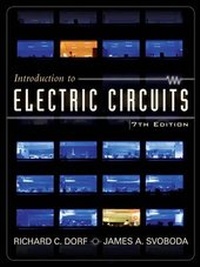
Introduction to Electric Circuits
7th Edition
Published on 1. December 2005
Book
Hardback
880 pages
978-0-471-73042-2 (ISBN)
Description
Build problem-solving skills for the real world
Revised with even more effective learning features, Dorf and Svoboda's Seventh Edition of Introduction to Electric Circuits introduces students to circuit analysis, and helps build strong problem-solving skills in a framework that is both engaging and accessible. Known for its practical emphasis on design, solid examples, and real-world problems, the text introduces students to the kinds of problems that electrical and computer engineers face in contemporary practice.
Interactive exercises and examples provide a rich learning environment
The book's website (www.wiley.com/college/dorf) provides resources to help students build confidence, and apply and learn the steps necessary to successfully complete homework problems.
* Interactive Examples show how to solve similar problems step-by-step.
* Interactive Exercises offer endless practice with immediate feedback.
* Interactive LearningWare helps students visualize difficult topics.
Also available
PSpice for Linear Circuits, 2E
James A. Svoboda, Clarkson University
0-471-78146-0, Paper, (c)2007
This introduction provides step-by-step instructions for using PSpice and Orcad Capture to analyze ac and dc circuits, circuits in the time domain to determine the complete response, and circuits in the frequency domain to determine the frequency response.
Revised with even more effective learning features, Dorf and Svoboda's Seventh Edition of Introduction to Electric Circuits introduces students to circuit analysis, and helps build strong problem-solving skills in a framework that is both engaging and accessible. Known for its practical emphasis on design, solid examples, and real-world problems, the text introduces students to the kinds of problems that electrical and computer engineers face in contemporary practice.
Interactive exercises and examples provide a rich learning environment
The book's website (www.wiley.com/college/dorf) provides resources to help students build confidence, and apply and learn the steps necessary to successfully complete homework problems.
* Interactive Examples show how to solve similar problems step-by-step.
* Interactive Exercises offer endless practice with immediate feedback.
* Interactive LearningWare helps students visualize difficult topics.
Also available
PSpice for Linear Circuits, 2E
James A. Svoboda, Clarkson University
0-471-78146-0, Paper, (c)2007
This introduction provides step-by-step instructions for using PSpice and Orcad Capture to analyze ac and dc circuits, circuits in the time domain to determine the complete response, and circuits in the frequency domain to determine the frequency response.
More details
Edition
7., Auflage
Language
English
Place of publication
New York
United States
Publishing group
John Wiley and Sons Ltd
Target group
Professional and scholarly
Edition type
Revised edition
Illustrations
Illustrations
Dimensions
Height: 26.3 cm
Width: 21.5 cm
Thickness: 34 mm
Weight
1637 gr
ISBN-13
978-0-471-73042-2 (9780471730422)
Schweitzer Classification
Other editions
New editions
Herbert W. Jackson
Introduction to Electrical Circuits
Book
08/2007
8th Edition
Oxford University Press, Canada
€97.79
Article not available
Previous edition

Book
10/2003
6th Edition
Wiley
€57.90
Article exhausted; check for reprint
Persons
Richard C. Dorf, professor of electrical and computer engineering at the University of California, Davis, teaches graduate and undergraduate courses in electrical engineering in the fields of circuits and control systems. He earned a Ph.D. in electrical engineering from the U.S. Naval Postgraduate School, an M.S. from the University of Colorado, and a B.S. from Clarkson University. Highly concerned with the discipline of electrical engineering and its wide value to social and economic needs, he has written and lectured internationally on the contributions and advances in electrical engineering.
Professor Dorf has extensive experience with education and industry and is professionally active in the fields of robotics, automation, electric circuits, and communications. He has served as a visiting professor at the University of Edinburgh, Scotland, the Massachusetts Institute of Technology, Stanford University, and the University of California at Berkeley.
A Fellow of the Institute of Electrical and Electronic Engineers and the American Society for Engineering Education, Dr. Dorf is widely known to the profession for his Modern Control Systems, tenth edition (Prentice Hall, 2004) and The International Encyclopedia of Robotics (Wiley, 1988). Dorf is also the coauthor of Circuits, Devices and Systems (with Ralph Smith), fifth edition (Wiley, 1992). Dr. Dorf edited the widely used Electrical Engineering Handbook, third edition (CRC Press and IEEE Press), published in 2005. His latest work is Technology Ventures (McGraw-Hill, 2005).
James A. Svoboda is an associate professor of electrical and computer engineering at Clarkson University, where he teaches courses on topics such as circuits, electronics, and computer programming. He earned a Ph.D. in electrical engineering from the University of Wisconsin at Madison, an M.S. from the University of Colorado, and a B.S. from General Motors Institute.
Sophomore Circuits is one of Professor Svoboda's favorite courses. He has taught this course to 4500 undergraduates at Clarkson University over the past 26 years. In 1986, he received Clarkson University's Distinguished Teaching Award.
Professor Svoboda has written several research papers describing the advantages of using nullors to model electric circuits for computer analysis. He is interests in the way technology affects engineering education and has developed several software packages for use in Sophomore Circuits. Professor Svoboda's email address is svoboda@clarkson.edu and the url of his web page is http://www.clarkson.edu/svoboda/.
Professor Dorf has extensive experience with education and industry and is professionally active in the fields of robotics, automation, electric circuits, and communications. He has served as a visiting professor at the University of Edinburgh, Scotland, the Massachusetts Institute of Technology, Stanford University, and the University of California at Berkeley.
A Fellow of the Institute of Electrical and Electronic Engineers and the American Society for Engineering Education, Dr. Dorf is widely known to the profession for his Modern Control Systems, tenth edition (Prentice Hall, 2004) and The International Encyclopedia of Robotics (Wiley, 1988). Dorf is also the coauthor of Circuits, Devices and Systems (with Ralph Smith), fifth edition (Wiley, 1992). Dr. Dorf edited the widely used Electrical Engineering Handbook, third edition (CRC Press and IEEE Press), published in 2005. His latest work is Technology Ventures (McGraw-Hill, 2005).
James A. Svoboda is an associate professor of electrical and computer engineering at Clarkson University, where he teaches courses on topics such as circuits, electronics, and computer programming. He earned a Ph.D. in electrical engineering from the University of Wisconsin at Madison, an M.S. from the University of Colorado, and a B.S. from General Motors Institute.
Sophomore Circuits is one of Professor Svoboda's favorite courses. He has taught this course to 4500 undergraduates at Clarkson University over the past 26 years. In 1986, he received Clarkson University's Distinguished Teaching Award.
Professor Svoboda has written several research papers describing the advantages of using nullors to model electric circuits for computer analysis. He is interests in the way technology affects engineering education and has developed several software packages for use in Sophomore Circuits. Professor Svoboda's email address is svoboda@clarkson.edu and the url of his web page is http://www.clarkson.edu/svoboda/.
Content
1 Electric Circuit Variables
2 Circuit Elements
3 Resistive Circuits
4 Methods of Analysis of Resistive Circuits
5 Circuit Theorems
6 The Operational Amplifier
7 Energy Storage Elements
8 The Complete Response of RL and RC Circuits
9 The Complete Response of Circuits with Two Energy Storage Elements
10 Sinusoidal Steady-State Analysis
11 AC Steady-State Power
12 Three-Phase Circuits
13 Frequency Response
14 The Laplace Transform
15 Fourier Series and Fourier Transform
16 Filter Circuits
17 Two-Port and Three-Port Networks
Appendix A Matrices, Determinants, and Cramer's Rule
Appendix B Complex Numbers
Appendix C Trigonometric Formulas
Appendix D Standard Resistor Color Code
References
Index
2 Circuit Elements
3 Resistive Circuits
4 Methods of Analysis of Resistive Circuits
5 Circuit Theorems
6 The Operational Amplifier
7 Energy Storage Elements
8 The Complete Response of RL and RC Circuits
9 The Complete Response of Circuits with Two Energy Storage Elements
10 Sinusoidal Steady-State Analysis
11 AC Steady-State Power
12 Three-Phase Circuits
13 Frequency Response
14 The Laplace Transform
15 Fourier Series and Fourier Transform
16 Filter Circuits
17 Two-Port and Three-Port Networks
Appendix A Matrices, Determinants, and Cramer's Rule
Appendix B Complex Numbers
Appendix C Trigonometric Formulas
Appendix D Standard Resistor Color Code
References
Index