

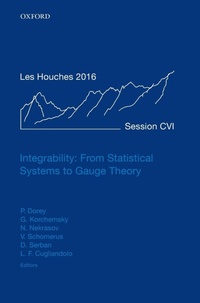
Integrability: From Statistical Systems to Gauge Theory
Lecture Notes of the Les Houches Summer School: Volume 106, June 2016
Published on 24. July 2019
Book
Hardback
574 pages
978-0-19-882815-0 (ISBN)
Description
This volume, 106 of the Les Houches Summer School series, brings together applications of integrability to supersymmetric gauge and string theory.
The book focuses on the application of integrability and problems in quantum field theory. Particular emphasis is given to the exact solution of planar N=4 super-Yang-Mills theory and its relation with string theory on the one hand, and the exact determination of the low-energy physics of N=2 super-Yang-Mills theories on the other; links with other domains are also explored.
The purpose of the Les Houches Summer School was to bring together young researchers and specialists from statistical physics, condensed matter physics, gauge and string theory, and mathematics, to stimulate discussion across these different research areas.
The book focuses on the application of integrability and problems in quantum field theory. Particular emphasis is given to the exact solution of planar N=4 super-Yang-Mills theory and its relation with string theory on the one hand, and the exact determination of the low-energy physics of N=2 super-Yang-Mills theories on the other; links with other domains are also explored.
The purpose of the Les Houches Summer School was to bring together young researchers and specialists from statistical physics, condensed matter physics, gauge and string theory, and mathematics, to stimulate discussion across these different research areas.
More details
Series
Language
English
Place of publication
Oxford
United Kingdom
Target group
Professional and scholarly
Illustrations
85 black and white figures/illustrations
Dimensions
Height: 250 mm
Width: 175 mm
Thickness: 35 mm
Weight
1157 gr
ISBN-13
978-0-19-882815-0 (9780198828150)
Copyright in bibliographic data and cover images is held by Nielsen Book Services Limited or by the publishers or by their respective licensors: all rights reserved.
Schweitzer Classification
Other editions
Additional editions
Patrick Dorey | Gregory Korchemsky | Nikita Nekrasov
Integrability: From Statistical Systems to Gauge Theory
Lecture Notes of the Les Houches Summer School: Volume 106, June 2016
E-Book
07/2019
1st Edition
OUP eBook
€70.99
Available for download
Persons
Patrick Dorey studied in Cambridge and Durham in the UK. He completed postdocs in Paris and CERN, before returning to Durham as a lecturer. His main research activity has been into exactly-solvable, or integrable, quantum field theories in 1+1 dimensions.
Gregory Korchemsky studied in Russia, in Rostov-on-Don and in Dubna. After postdocs in Parma and Stony Brook, he came to France as a CNRS researcher, first in Orsay and then in Saclay. His main research activity has been into integrability in gauge and string theory.
Nikita Nekrasov studied in Moscow and defended his PhD dissertation at Princeton University in 1996. He was a Junior fellow at Harvard, then permanent professor at the Institut des Hautes Etudes Scientifiques in France. Since 2013 he is a professor at the Simons Center for Geometry and Physics. He is known for his work on supersymmetric gauge theory and string theory: the Nekrasov partition function relates instantons in gauge theory, integrable systems and representation theory of infinite dimensional algebras.
Volker Schomerus holds a joint position as a Senior Researcher in the DESY Theory Group, and a Professor of Mathematical Physics at Universitaet Hamburg. His work focuses on string theory at the interface to high energy physics, mathematics and statistical physics, for which he has received several distinctions, including the Guy-Lussac-Humboldt award in 2010.
Didina Serban studied in Romania then in France, where she prepared her PhD in Theoretical Physics at the Service de Physique Theorique de Saclay. After a post-doctoral stay at the University of Cologne she joined, in 1998, the Service de Physique Theorique as a permanent researcher. The focus of her research is on exactly solvable models and the use of symmetries, with applications in condensed matter physics like magnetic one-dimensional models, Quantum Hall effect or phase transition in low-dimensional disordered systems. More recently, her research deals with exactly solvable gauge theories and their dualities to string theories.
Gregory Korchemsky studied in Russia, in Rostov-on-Don and in Dubna. After postdocs in Parma and Stony Brook, he came to France as a CNRS researcher, first in Orsay and then in Saclay. His main research activity has been into integrability in gauge and string theory.
Nikita Nekrasov studied in Moscow and defended his PhD dissertation at Princeton University in 1996. He was a Junior fellow at Harvard, then permanent professor at the Institut des Hautes Etudes Scientifiques in France. Since 2013 he is a professor at the Simons Center for Geometry and Physics. He is known for his work on supersymmetric gauge theory and string theory: the Nekrasov partition function relates instantons in gauge theory, integrable systems and representation theory of infinite dimensional algebras.
Volker Schomerus holds a joint position as a Senior Researcher in the DESY Theory Group, and a Professor of Mathematical Physics at Universitaet Hamburg. His work focuses on string theory at the interface to high energy physics, mathematics and statistical physics, for which he has received several distinctions, including the Guy-Lussac-Humboldt award in 2010.
Didina Serban studied in Romania then in France, where she prepared her PhD in Theoretical Physics at the Service de Physique Theorique de Saclay. After a post-doctoral stay at the University of Cologne she joined, in 1998, the Service de Physique Theorique as a permanent researcher. The focus of her research is on exactly solvable models and the use of symmetries, with applications in condensed matter physics like magnetic one-dimensional models, Quantum Hall effect or phase transition in low-dimensional disordered systems. More recently, her research deals with exactly solvable gauge theories and their dualities to string theories.
Editor
ProfessorProfessor, Department of Mathematical Sciences, Durham University
Senior researcherSenior researcher, Centre national de la recherche scientifique (CNRS)
ProfessorProfessor, Stony Brook University
Head of DESY Theory GroupHead of DESY Theory Group, University of Hamburg
Senior researcherSenior researcher, Institut de Physique Theorique Saclay
Professor at Sorbonnes UniversitesProfessor at Sorbonnes Universites, Universite Pierre et Marie Curie
Content
1: Jesper Lykke Jacobsen: Integrability in statistical systems and quantum spin chains
2: Joerg Teschner: A guide to two-dimensional conformal field theory
3: Gordon W. Semenoff: Lectures on the holographic duality of gauge fields and strings
4: David Kosower: Introduction to Scattering Amplitudes
5: Konstantin Zarembo: Integrability in Sigma-Models
6: Sergei L. Lukyanov and Alexander B. Zamolodchikov: Integrability in 2D fields theory/sigma models
7: Fabian H. L. Essler: Applications of Integrable Models in Condensed Matter and Cold Atom Physics
8: Marius de Leeuw, Asger C. Ipsen, Charlotte Kristjansen, and Matthias Wilhelm: Introduction to Integrability and One-point Functions in N = 4 SYM and its Defect Cousin
9: Nikolay Gromov: Spectrum of N=4 SYM and the Quantum Spectral Curve
10: Shota Komatsu: Three-point Functions in N = 4 Supersymmetric Yang-Mills Theory
11: Vesily Pestun: Localization and N=2 supersymmetric field theory
2: Joerg Teschner: A guide to two-dimensional conformal field theory
3: Gordon W. Semenoff: Lectures on the holographic duality of gauge fields and strings
4: David Kosower: Introduction to Scattering Amplitudes
5: Konstantin Zarembo: Integrability in Sigma-Models
6: Sergei L. Lukyanov and Alexander B. Zamolodchikov: Integrability in 2D fields theory/sigma models
7: Fabian H. L. Essler: Applications of Integrable Models in Condensed Matter and Cold Atom Physics
8: Marius de Leeuw, Asger C. Ipsen, Charlotte Kristjansen, and Matthias Wilhelm: Introduction to Integrability and One-point Functions in N = 4 SYM and its Defect Cousin
9: Nikolay Gromov: Spectrum of N=4 SYM and the Quantum Spectral Curve
10: Shota Komatsu: Three-point Functions in N = 4 Supersymmetric Yang-Mills Theory
11: Vesily Pestun: Localization and N=2 supersymmetric field theory