

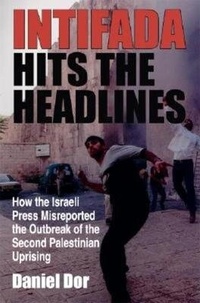
Intifada Hits the Headlines
How the Israeli Press Misreported the Outbreak of the Second Palestinian Uprising
Published on 1. January 2004
Book
Hardback
168 pages
978-0-253-34333-8 (ISBN)
Description
In this nuanced and detailed study of newspaper reports during the escalation of the second Intifada in the fall of 2000, Daniel Dor shows how reality is subject to distortion and manipulation by the media. In an analysis of the heart of Israel's media establishment - the newspapers Yediot Ahronot, Ma'ariv, and Ha'aretz - he finds a wide gap between the reality reported by field reporters and the eventual newspaper accounts framed by editors. Led by beliefs, opinions, and emotional responses rather than the facts provided by their reporters, these editors created a platform on which a new and fearful narrative for Israeli-Palestinian relations was built. As a result of these distortions, newspapers effectively suppressed certain elements of reality and systematically emphasized others to construct a new set of "facts" that have had fateful effects on Israel's responses to the Palestinians. By integrating a wide variety of critical approaches from linguistics and communication studies, Dor convincingly shows how the news is constructed. The distance between distortion and reality is often simply pages or even lines away.
Dor demonstrates how the positioning, graphic saliency, front-page reference, headline selection and framing, and the visual semiotics of news stories change the facts reported in the articles themselves. Headlines and photos may tell one story and a news analysis may tell another, but, as headline consumers, readers may receive only the most visible one. Dor's careful day-by-day investigation of reporting on the Intifada reveals how quickly newspapers were able to produce and participate in a new consensual narrative that effectively ended the peace process. But while Dor does demonstrate that the media construct the news rather than simply report it, his sophisticated analysis also shows that no one entity or person is responsible. Rather than a supreme authority, it is the influence of fear, anger, ignorance, and a desire to please and sell newspapers, Dor argues, that threaten the freedom of the press in a liberal democracy.
Dor demonstrates how the positioning, graphic saliency, front-page reference, headline selection and framing, and the visual semiotics of news stories change the facts reported in the articles themselves. Headlines and photos may tell one story and a news analysis may tell another, but, as headline consumers, readers may receive only the most visible one. Dor's careful day-by-day investigation of reporting on the Intifada reveals how quickly newspapers were able to produce and participate in a new consensual narrative that effectively ended the peace process. But while Dor does demonstrate that the media construct the news rather than simply report it, his sophisticated analysis also shows that no one entity or person is responsible. Rather than a supreme authority, it is the influence of fear, anger, ignorance, and a desire to please and sell newspapers, Dor argues, that threaten the freedom of the press in a liberal democracy.
More details
Series
Language
English
Place of publication
Bloomington, IN
United States
Target group
Adult education
Dimensions
Height: 234 mm
Width: 156 mm
ISBN-13
978-0-253-34333-8 (9780253343338)
Copyright in bibliographic data and cover images is held by Nielsen Book Services Limited or by the publishers or by their respective licensors: all rights reserved.
Schweitzer Classification
Content
Foreword; Acknowledgements 1. Introduction; 2. "Under Arafat's Baton"; 3. "Make No Mistake, Yasser"; 4. "The Limits of Restraint"; 5. "A Fifth Column"; 6. In All Their Murderous Ugliness"; 7. "We Have Turned Every Stone"; 8. Conclusion Notes; Bibliography; Index