

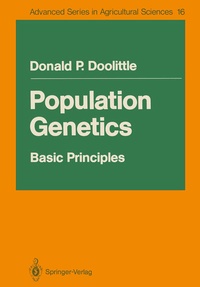
Population Genetics:
Basic Principles
1st Edition
Published on 26. February 1987
Book
Paperback/Softback
X, 264 pages
978-3-540-17326-7 (ISBN)
Description
I have for a number of years taught a course in population genetics for students interested in plant and animal breeding. The objective of the course has been to lay a foundation in population genetics for the concepts of quantitative genetics which are introduced in the last third of the course. I have not been able to find an appropriate text for this purpose. For a quarter of a century, Falconer's Introduction to Quantitative Genetics has been the standard, and excellent, text in that subject. For my purposes, however, this text is not sufficiently detailed in the population genetics basis for quantitative theory. A number of good texts in population genetics are available, of which Li's First Course in Population Genetics is didactically the best. But these texts are directed toward the genetics of natural populations, rather than domestic populations, breeding under human control. They also tend to treat quantitative genetics gingerly, if at all. I have therefore developed the present text from my teaching notes. The chapters of this book are labeled "Lectures". Each is intended to correspond approximately to the amount of material which can be covered in a 50-minute lecture. Divisions are, of course, dictated by the natural divisions of the subject matter, and the lectures are therefore not of uniform length. Nevertheless, in so far as possible, an attempt has been made to make the average length a lecture's worth.
More details
Series
Language
English
Place of publication
Berlin
Germany
Publishing group
Springer Berlin
Target group
Professional and scholarly
Research
Illustrations
X, 264 p.
Dimensions
Height: 244 mm
Width: 170 mm
Thickness: 16 mm
Weight
488 gr
ISBN-13
978-3-540-17326-7 (9783540173267)
DOI
10.1007/978-3-642-71734-5
Schweitzer Classification
Other editions
Additional editions
E-Book
12/2012
Springer
€96.29
Available for download
Content
I The Hardy-Weinberg Law.- 1. The Hardy-Weinberg Law.- 2. Conditions for Hardy-Weinberg Equilibrium.- 3. Applications of the Hardy-Weinberg Law.- 4. Snyder's Ratios.- II Constant Allele Frequencies.- 5. Multiple Alleles.- 6. Separate Sexes.- 7. Sex Linkage.- 8. Other Phenomena Associated with Sex.- 9. Linkage.- 10. Recombination Equilibrium.- 11. Polyploidy.- III Systematic Forces.- 12. Selection.- 13. The General Selection Equation.- 14. Equilibrium Under Selection.- 15. Mutation.- 16. Interaction of Mutation with Selection.- 17. Migration.- IV Dispersive Forces.- 18. The Finite Population Model.- 19. Inbreeding.- 20. The Development of Inbreeding.- 21. Genic Drift.- 22. Genotypic Drift.- 23. Effective Breeding Size.- 24. Interaction of Inbreeding with Systematic Forces.- 25. Coancestry.- 26. Applications of Coancestry.- 27. Tabular Calculation of Coancestry.- 28. Path Calculation of F.- 29. Systematic Inbreeding.- 30. Assortative Mating.- V Quantitative Inheritance.- 31. Metric Traits.- 32. Evidence for the Theory of Metric Inheritance.- 33. Phenotypic Value.- 34. The Single Locus Model.- 35. Breeding Values.- 36. Dominance Deviations.- 37. Multiple Loci.- 38. Causal Components of Variance.- 39. Analytical Components.- 40. Heritability.- 41. Realized Heritability.- 42. Other Estimates of h2.- 43. Environmental Variance.- 44. Repeatability.- Appendix I Exercise Solutions.- Appendix II Review Lectures.- R1. Basic Genetics.- R2. Probability.- R3. Statistical Methods.- References.