

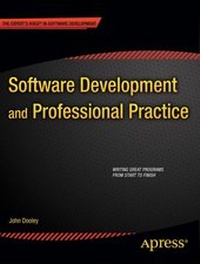
Software Development and Professional Practice
Published on 15. July 2011
Book
Paperback/Softback
XVIII, 260 pages
978-1-4302-3801-0 (ISBN)
Description
Software Development and Professional Practice reveals how to design and code great software. What factors do you take into account? What makes a good design? What methods and processes are out there for designing software? Is designing small programs different than designing large ones? How can you tell a good design from a bad one? You'll learn the principles of good software design, and how to turn those principles back into great code.
Software Development and Professional Practice is also about code construction-how to write great programs and make them work. What, you say? You've already written eight gazillion programs! Of course I know how to write code! Well, in this book you'll re-examine what you already do, and you'll investigate ways to improve. Using the Java language, you'll look deeply into coding standards, debugging, unit testing, modularity, and other characteristics of good programs. You'll also talk about reading code. How do you read code? What makes a program readable? Can good, readable code replace documentation? How much documentation do you really need?
This book introduces you to software engineering-the application of engineering principles to the development of software. What are these engineering principles? First, all engineering efforts follow a defined process. So, you'll be spending a bit of time talking about how you run a software development project and the different phases of a project. Secondly, all engineering work has a basis in the application of science and mathematics to real-world problems. And so does software development! You'll therefore take the time to examine how to design and implement programs that solve specific problems.
Finally, this book is also about human-computer interaction and user interface design issues. A poor user interface can ruin any desire to actually use a program; in this book, you'll figure out why and how to avoid those errors.
Software Development and Professional Practice covers many of the topics described for the ACM Computing Curricula 2001 course C292c Software Development and Professional Practice. It is designed to be both a textbook and a manual for the working professional.
Software Development and Professional Practice is also about code construction-how to write great programs and make them work. What, you say? You've already written eight gazillion programs! Of course I know how to write code! Well, in this book you'll re-examine what you already do, and you'll investigate ways to improve. Using the Java language, you'll look deeply into coding standards, debugging, unit testing, modularity, and other characteristics of good programs. You'll also talk about reading code. How do you read code? What makes a program readable? Can good, readable code replace documentation? How much documentation do you really need?
This book introduces you to software engineering-the application of engineering principles to the development of software. What are these engineering principles? First, all engineering efforts follow a defined process. So, you'll be spending a bit of time talking about how you run a software development project and the different phases of a project. Secondly, all engineering work has a basis in the application of science and mathematics to real-world problems. And so does software development! You'll therefore take the time to examine how to design and implement programs that solve specific problems.
Finally, this book is also about human-computer interaction and user interface design issues. A poor user interface can ruin any desire to actually use a program; in this book, you'll figure out why and how to avoid those errors.
Software Development and Professional Practice covers many of the topics described for the ACM Computing Curricula 2001 course C292c Software Development and Professional Practice. It is designed to be both a textbook and a manual for the working professional.
More details
Edition
1st ed.
Language
English
Place of publication
CA
United States
Target group
Professional and scholarly
Popular/general
Illustrations
XVIII, 260 p.
Dimensions
Height: 25.4 cm
Width: 17.8 cm
Weight
500 gr
ISBN-13
978-1-4302-3801-0 (9781430238010)
DOI
10.1007/978-1-4302-3802-7
Schweitzer Classification
Other editions
New editions
John F. Dooley | Vera A. Kazakova
Software Development, Design, and Coding
With Patterns, Debugging, Unit Testing, and Refactoring
Book
06/2024
3rd Edition
APress
€64.19
Shipment within 10-15 days

John F. Dooley
Software Development, Design and Coding
With Patterns, Debugging, Unit Testing, and Refactoring
Book
11/2017
2nd Edition
Apress
€69.54
Article exhausted; check for reprint
Additional editions
John Dooley
Software Development and Professional Practice
E-Book
10/2011
APress
€54.99
Available for download
Person
John F. Dooley is professor and chair of the Computer Science Department at Knox College in Galesburg, Illinois. Before returning to teaching in 2001, Dooley spent nearly 20 years in the software industry as a developer, designer, and manager, working for companies such as Bell Telephone Laboratories, McDonnell Douglas, IBM, and Motorola. He has nearly two dozen professional journal publications to his credit, along with numerous presentations. He has been a reviewer for the Association for Computing Machinery Special Interest Group on Computer Science Education (SIGCSE) Technical Symposium for the last 28 years, and reviews papers for the IEEE Transactions on Education, the ACM Innovation and Technology in Computer Science Education (ITiCSE) Conference, and other professional conferences. He has also developed short courses in software development as well as three separate software engineering courses at the advanced undergraduate level. While in industry, Dooley wrote user applications, operating system software and embedded applications for several different platforms. He also supervised teams of developers ranging in size from four to 30 members, and led successful efforts to move development organizations to SEI Levels 2 and 3. Writing is an integral part of many of John s classes at Knox. One of Knox's graduation requirements is a writing-intensive course in the major; John has taught this course every year for the last five years. He s also taught in Knox s First Year Preceptorial program, a discussion and writing course that serves as an introduction to the liberal arts for first-year students.
Content
- Introduction to Software Development
- Process Life Cycle Models
- Project Management Essentials
- Requirements
- Software Architecture
- Design Principles
- Structured Design
- Object-Oriented Analysis & Design-An Overview
- Object-Oriented Analysis & Design-A Play in Several Acts
- Object-Oriented Design Principles
- Design Patterns
- Code Construction
- Debugging
- Unit Testing
- Walkthroughs, Code Reviews and Inspections
- Wrapping it All Up