

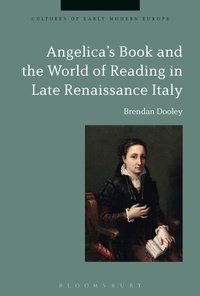
Angelica's Book and the World of Reading in Late Renaissance Italy
Published on 19. April 2018
Book
Paperback/Softback
216 pages
978-1-350-06713-4 (ISBN)
Description
Through the lens of a history of material culture mediated by an object, Angelica's Book and the World of Reading in Late Renaissance Italy investigates aspects of women's lives, culture, ideas and the history of the book in early modern Italy.
Inside a badly damaged copy of Straparola's 16th-century work, Piacevoli Notti, acquired in a Florentine antique shop in 2010, an inscription is found, attributing ownership to a certain Angelica Baldachini. The discovery sets in motion a series of inquiries, deploying knowledge about calligraphy, orthography, linguistics, dialectology and the socio-psychology of writing, to reveal the person behind the name. Focusing as much on the possible owner as upon the thing owned, Angelica's Book examines the genesis of the Piacevoli Notti and its many editions, including the one in question. The intertwined stories of the book and its owner are set against the backdrop of a Renaissance world, still imperfectly understood, in which literature and reading were subject to regimes of control; and the new information throws aspects of this world into further relief, especially in regard to women's involvement with reading, books and knowledge. The inquiry yields unexpected insights concerning the logic of accidental discovery, the nature of evidence, and the mission of the humanities in a time of global crisis.
Angelica's Book and the World of Reading in Late Renaissance Italy is a thought-provoking read for any scholar of early modern Europe and its culture.
Inside a badly damaged copy of Straparola's 16th-century work, Piacevoli Notti, acquired in a Florentine antique shop in 2010, an inscription is found, attributing ownership to a certain Angelica Baldachini. The discovery sets in motion a series of inquiries, deploying knowledge about calligraphy, orthography, linguistics, dialectology and the socio-psychology of writing, to reveal the person behind the name. Focusing as much on the possible owner as upon the thing owned, Angelica's Book examines the genesis of the Piacevoli Notti and its many editions, including the one in question. The intertwined stories of the book and its owner are set against the backdrop of a Renaissance world, still imperfectly understood, in which literature and reading were subject to regimes of control; and the new information throws aspects of this world into further relief, especially in regard to women's involvement with reading, books and knowledge. The inquiry yields unexpected insights concerning the logic of accidental discovery, the nature of evidence, and the mission of the humanities in a time of global crisis.
Angelica's Book and the World of Reading in Late Renaissance Italy is a thought-provoking read for any scholar of early modern Europe and its culture.
Reviews / Votes
Angelica's Book has considerable charm, and may lure that wide audience of educated but nonspecialist readers that scholarly books seek but often miss ... the prose has a freshness that academic histories tend to lack ... an intriguing and provocative narrative. * Renaissance Quarterly * Through the common thread that lies between a book and its reader, Dooley artfully takes us into a dusty, hidden world. (Bloomsbury Translation) * Corriere della Sera * This book adds a most precious chapter to the history of books and reading in the early modern period. Dooley has the very rare virtue of combining scholarly exactitude and methodological intelligence with narrative entertainment. Angelica's Book represents not just a splendid piece of research and a riveting account, but helps everyone to understand the crucial importance of the humanities in our world. * Nicola Gardini, University of Oxford, UK * Angelica's Book approaches the discipline of book history as a path rather than a territory, using a single book artefact to offer close views of the lives and places it touched. Author and owner are joined by a rich cast of printers, censors, merchants, tutors, critics, literary inspirations, powerful patrons, and feuding princes, whose intertwining stories combine to show the rich fabric of Renaissance life. With its vivid authorial presence and prose more tender than clinical, Angelica's Book presents a double narrative of the parallel encounters with a book experienced by the Renaissance world on the one hand, and a modern scholar on the other. Yet it is also deeply engaged with context, providing a richer understanding of the intricate world which the book's meandering encounters demonstrate. Dooley shows how the simple acts of owning and reading were affected by period approaches to sexuality, education, religion, gender, honor, and the many kinds of power, institutional and intellectual, at play in the deceptively simple arena of the Renaissance printed page. * Ada Palmer, University of Chicago, USA * Ambitiously inspired ... [The] world of reading in Renaissance Italy ... is deftly fleshed out by informed treatments of topics like the circulation of news, women's book ownership, mnemonic techniques, storytelling practices, and censorship. * Renaissance and Reformation * Illuminating ... Dooley offers fascinating insights. * Isis Journal *More details
Series
Language
English
Place of publication
London
United Kingdom
Publishing group
Bloomsbury Publishing PLC
Target group
College/higher education
Adult education
Illustrations
12 BW Illus
Dimensions
Height: 234 mm
Width: 156 mm
Thickness: 12 mm
Weight
330 gr
ISBN-13
978-1-350-06713-4 (9781350067134)
Copyright in bibliographic data and cover images is held by Nielsen Book Services Limited or by the publishers or by their respective licensors: all rights reserved.
Schweitzer Classification
Other editions
Additional editions
E-Book
10/2016
1st Edition
Bloomsbury Academic
€39.99
Available for download
E-Book
10/2016
1st Edition
Bloomsbury Academic
€39.99
Available for download
Person
Brendan Dooley is Professor of Renaissance Studies at University College Cork, Ireland. His numerous publications include A Mattress Maker's Daughter: The Renaissance Romance of Don Giovanni de' Medici and Livia Vernazza (2014), Morandi's Last Prophecy and the End of Renaissance Politics (2002) and, as author/ editor, The Dissemination of News and the Emergence of Contemporaneity in Early Modern Europe (2010).
Content
List of Illustrations
Preface
Introduction
1. Straparola and Late Renaissance Publishing
2. The Trials of Literature in an Age of Censorship
3. A Woman's Hand
4. Angelica and her Book
5. Reading and Gender
6. Book Conservation and the Digital Turn
Conclusion
Notes
Select Bibliography
Index
Preface
Introduction
1. Straparola and Late Renaissance Publishing
2. The Trials of Literature in an Age of Censorship
3. A Woman's Hand
4. Angelica and her Book
5. Reading and Gender
6. Book Conservation and the Digital Turn
Conclusion
Notes
Select Bibliography
Index