

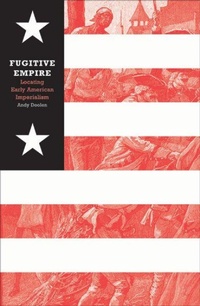
Fugitive Empire
Locating Early American Imperialism
Published on 10. November 2005
Book
Paperback/Softback
288 pages
978-0-8166-4454-4 (ISBN)
Description
In Fugitive Empire, Andy Doolen investigates the relationships among race, nation, and empire in colonial and early national America, revealing how whiteness and American identity were conflated to stabilize racial hierarchy and to repulse challenges to national policies of slavery, war, and continental expansion.
Fugitive Empire begins not in 1776 but in 1741 with the New York Conspiracy trials. Linking them to the British conflict with the Spanish in the West Indies, Doolen describes how white colonists were led to suspect all foreigners, particularly slaves, as insurgents. He shows how this protonational story resonated later in the suppression of resistance to the Fugitive Slave Law of 1793. In addition to examining the only extant record of the New York Conspiracy trials, Doolen catalogs the rampant fear of aliens in Charles Brockden Brown's novels; places James Fenimore Cooper's The Pioneers in the context of early efforts to relocate African-Americans to Liberia; and considers Pequot writer William Apess, whose writing on Native rights landed him in jail. Bridging the gap between the British Empire and the new United States, Doolen concludes that imperial authority lies at the heart of American republicanism, an unstable mixture of idealism, force, and pragmatism, wielded in the name of freedom even today.
Andy Doolen is assistant professor of American literature and American studies at the University of Kentucky.
Fugitive Empire begins not in 1776 but in 1741 with the New York Conspiracy trials. Linking them to the British conflict with the Spanish in the West Indies, Doolen describes how white colonists were led to suspect all foreigners, particularly slaves, as insurgents. He shows how this protonational story resonated later in the suppression of resistance to the Fugitive Slave Law of 1793. In addition to examining the only extant record of the New York Conspiracy trials, Doolen catalogs the rampant fear of aliens in Charles Brockden Brown's novels; places James Fenimore Cooper's The Pioneers in the context of early efforts to relocate African-Americans to Liberia; and considers Pequot writer William Apess, whose writing on Native rights landed him in jail. Bridging the gap between the British Empire and the new United States, Doolen concludes that imperial authority lies at the heart of American republicanism, an unstable mixture of idealism, force, and pragmatism, wielded in the name of freedom even today.
Andy Doolen is assistant professor of American literature and American studies at the University of Kentucky.
More details
Language
English
Place of publication
Minnesota
United States
Target group
College/higher education
Dimensions
Height: 154 mm
Width: 230 mm
Thickness: 16 mm
Weight
386 gr
ISBN-13
978-0-8166-4454-4 (9780816644544)
Copyright in bibliographic data and cover images is held by Nielsen Book Services Limited or by the publishers or by their respective licensors: all rights reserved.
Schweitzer Classification
Person
Andy Doolen is assistant professor of American literature and American studies at the University of Kentucky.