

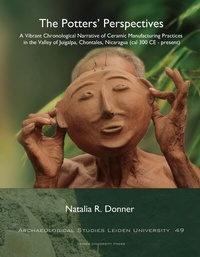
The Potters' Perspectives
A Vibrant Chronological Narrative of Ceramic Manufacturing Practices in the Valley of Juigalpa, Chontales, Nicaragua (cal 300 CE-present)
Published on 9. March 2020
Book
Paperback/Softback
452 pages
978-90-8728-351-3 (ISBN)
Description
The work of Fernand Braudel (1949) should have revolutionized the way archaeology conceptualizes temporal scales and builds chronological narratives. Even though Braudel's general views did impact archaeological theory deeply, his three different time-scales, together with insights into duration as the inner dialectic between different temporalities, remain neglected in archaeological practice.
More details
Series
Thesis
Doctoral thesis
2020
Leiden University
Language
English
Place of publication
Amsterdam
Netherlands
Target group
Professional and scholarly
Illustrations
116 Illustrations, color; 111 Illustrations, black and white
Dimensions
Height: 273 mm
Width: 210 mm
ISBN-13
978-90-8728-351-3 (9789087283513)
Copyright in bibliographic data and cover images is held by Nielsen Book Services Limited or by the publishers or by their respective licensors: all rights reserved.
Schweitzer Classification
Person
Natalia Donner (PhD, Leiden University) is an Argentinian-Mexican archaeologist, whose work questions the epistemological and colonial foundations of Archaeology. She is lecturer at the Faculty of Humanities (Leiden University) and co-director of the project Darien Profundo, (Panama) which explores the deep history of the land bridge of the Americas.
Content
Contents
1 Central Nicaragua: when the center is the periphery
1.1 Goals
1.2 Research questions
1.3 Outline
1.4 From past to present
2 Narratives of place(s) and time(s)
2.1 Narratives of place(s)
2.2 Narratives of the past and past narratives
3 Just a matter of time?
3.1 Time, archaeology, and oblivion
3.2 How the present became the past: things as palimpsests
3.3 Incorporated histories
3.4 Towards vibrant chronologies
4 Fieldwork methods
4.1 Sampling strategies in the field
5 Spatiotemporal dataset
5.1 Surface survey results
5.2 Mound recording results
5.3 Excavated contexts
5.4 Radiocarbon dates
6 Laboratory methods and techniques for ceramic analysis
6.1 Cleaning and storage of materials
6.2 Macrofabric grouping
6.3 Technological analysis of macroscopic traces
6.4 Archaeometric analysis
6.5 Morpho-stylistic groups
6.6 Integration of approaches
6.7 Dating techniques
7 Ceramic technologies in the valley of Juigalpa
7.1 Alberto Obando
7.2 Aguas Buenas
7.3 JOR
7.4 Oporta
7.5 Barillas
7.6 Rosa Dolores Oporta
7.7 La Aventura
7.8 Contemporary ceramic manufacturing practices
8 From traces on sherds to the vitality of human experience
8.1 Challenges of composing vibrant chronologies
8.2 The vitality of the valley of Juigalpa (cal 300 CE - present)
8.3 Shaking what was taken for granted
8.4 Thoughts regarding AMS dating in central Nicaragua
8.5 Future research: itineraries in context
8.6 Concluding remarks
Acknowledgements
Appendices
Bibliography
1 Central Nicaragua: when the center is the periphery
1.1 Goals
1.2 Research questions
1.3 Outline
1.4 From past to present
2 Narratives of place(s) and time(s)
2.1 Narratives of place(s)
2.2 Narratives of the past and past narratives
3 Just a matter of time?
3.1 Time, archaeology, and oblivion
3.2 How the present became the past: things as palimpsests
3.3 Incorporated histories
3.4 Towards vibrant chronologies
4 Fieldwork methods
4.1 Sampling strategies in the field
5 Spatiotemporal dataset
5.1 Surface survey results
5.2 Mound recording results
5.3 Excavated contexts
5.4 Radiocarbon dates
6 Laboratory methods and techniques for ceramic analysis
6.1 Cleaning and storage of materials
6.2 Macrofabric grouping
6.3 Technological analysis of macroscopic traces
6.4 Archaeometric analysis
6.5 Morpho-stylistic groups
6.6 Integration of approaches
6.7 Dating techniques
7 Ceramic technologies in the valley of Juigalpa
7.1 Alberto Obando
7.2 Aguas Buenas
7.3 JOR
7.4 Oporta
7.5 Barillas
7.6 Rosa Dolores Oporta
7.7 La Aventura
7.8 Contemporary ceramic manufacturing practices
8 From traces on sherds to the vitality of human experience
8.1 Challenges of composing vibrant chronologies
8.2 The vitality of the valley of Juigalpa (cal 300 CE - present)
8.3 Shaking what was taken for granted
8.4 Thoughts regarding AMS dating in central Nicaragua
8.5 Future research: itineraries in context
8.6 Concluding remarks
Acknowledgements
Appendices
Bibliography