

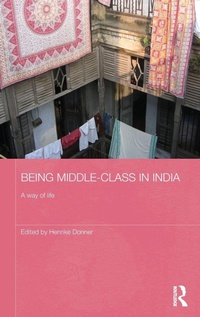
Being Middle-class in India
A Way of Life
1st Edition
Published on 30. November 2011
Book
Hardback
218 pages
978-0-415-67167-5 (ISBN)
Description
Hailed as the beneficiary, driving force and result of globalisation, India's middle-class is puzzling in its diversity, as a multitude of traditions, social formations and political constellations manifest contribute to this project. This book looks at Indian middle-class lifestyles through a number of case studies, ranging from a historical account detailing the making of a savvy middle-class consumer in the late colonial period, to saving clubs among women in Delhi's upmarket colonies and the dilemmas of entrepreneurial families in Tamil Nadu's industrial towns.
The book pays tribute to the diversity of regional, caste, rural and urban origins that shape middle- class lifestyles in contemporary India and highlights common themes, such as the quest for upward mobility, common consumption practices, the importance of family values, gender relations and educational trajectories. It unpacks the notion that the Indian middle-class can be understood in terms of public performances, surveys and economic markers, and emphasises how the study of middle-class culture needs to be based on detailed studies, as everyday practices and private lives create the distinctive sub-cultures and cultural politics that characterise the Indian middle class today. With its focus on private domains middleclassness appears as a carefully orchestrated and complex way of life and presents a fascinating way to understand South Asian cultures and communities through the prism of social class.
The book pays tribute to the diversity of regional, caste, rural and urban origins that shape middle- class lifestyles in contemporary India and highlights common themes, such as the quest for upward mobility, common consumption practices, the importance of family values, gender relations and educational trajectories. It unpacks the notion that the Indian middle-class can be understood in terms of public performances, surveys and economic markers, and emphasises how the study of middle-class culture needs to be based on detailed studies, as everyday practices and private lives create the distinctive sub-cultures and cultural politics that characterise the Indian middle class today. With its focus on private domains middleclassness appears as a carefully orchestrated and complex way of life and presents a fascinating way to understand South Asian cultures and communities through the prism of social class.
More details
Series
Language
English
Place of publication
London
United Kingdom
Publishing group
Taylor & Francis Ltd
Target group
College/higher education
Illustrations
4 s/w Photographien bzw. Rasterbilder
4 Halftones, black and white
Dimensions
Height: 240 mm
Width: 161 mm
Thickness: 17 mm
Weight
517 gr
ISBN-13
978-0-415-67167-5 (9780415671675)
Copyright in bibliographic data and cover images is held by Nielsen Book Services Limited or by the publishers or by their respective licensors: all rights reserved.
Schweitzer Classification
Other editions
Additional editions
Book
11/2013
1st Edition
Routledge
€93.10
Shipment within 15-20 days
E-Book
06/2012
1st Edition
Routledge
€77.99
Available for download
E-Book
06/2012
1st Edition
Routledge
€77.99
Available for download
Person
Henrike Donner is currently Professor for Indian Society and Culture at the Centre for Modern Indian Studies, Georg-August Universitaet, Goettingen, Germany. Her research interests include urban anthropology, gender and kinship.
Content
1. Introduction Henrike Donner 2. Masculinity, advertising and the reproduction of the middle-class family in Western India, 1918-1940 Douglas E. Haynes 3. Gendered bodies, domestic work and perfect families: new regimes of gender and food in Bengali middle-class lifestyles Henrike Donner 4. 'Keeping it in the family': Work, education and gender hierarchies among Tiruppur's industrial capitalists Geert De Neve 5. Cultural contractions and intergenerational relations: the construction of selfhood among middle class youth in Baroda Margit van Wessel 6. Globalisation, neoliberalism, and middle-class cultural politics in Kolkata Timothy J. Scrase and Ruchira Ganguly-Scrase 7. The social transformation of the medical profession in urban Kerala: doctors, social mobility and the middle classes Caroline Wilson 8. Kitty-parties and middle-class femininity in New Delhi Anne Waldrop 9. Zara hatke ('Somewhat different'): the new middle classes and the changing forms of Hindi cinema Rachel Dwyer