

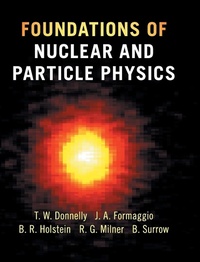
Foundations of Nuclear and Particle Physics
Published on 1. February 2017
Book
Hardback
658 pages
978-0-521-76511-4 (ISBN)
Description
This textbook brings together nuclear and particle physics, presenting a balanced overview of both fields as well as the interplay between the two. The theoretical as well as the experimental foundations are covered, providing students with a deep understanding of the subject. In-chapter exercises ranging from basic experimental to sophisticated theoretical questions provide an important tool for students to solidify their knowledge. Suitable for upper undergraduate courses in nuclear and particle physics as well as more advanced courses, the book includes road maps guiding instructors on tailoring the content to their course. Online resources including color figures, tables, and a solutions manual complete the teaching package. This textbook will be essential for students preparing for further study or a career in the field who require a solid grasp of both nuclear and particle physics.
Reviews / Votes
'This textbook is a long-awaited modern treatment of the subject of nuclear physics, with up-to-date material including the remarkable progress in the field over the last 2-3 decades. Written by accomplished researchers in nuclear physics, this comprehensive treatment will likely become the new standard textbook in the field for many years to come.' Robert McKeown, Deputy Director for Science at the Thomas Jefferson National Accelerator Facility and Governor's Distinguished CEBAF Professor, College of William and Mary, Virginia 'A valuable graduate-level text that provides a comprehensive coverage of nuclear and particle physics and their important intersections along with an up-to-date status of the experimental results in these fields.' Art McDonald, Co-winner of the 2015 Nobel Prize in Physics This textbook comes at a very opportune time. Not only does it carefully cover the pedagogical basics for the overlapping needs of the HEP and NP communities but it also specifically addresses the particular challenges of the rapidly growing study of neutrino nucleus scattering. Whether employing neutrino nucleus scattering to understand the role of the weak current in these interactions or to study the nature of the neutrino itself with neutrino oscillations, this comprehensive textbook is the single most complete reference any NP or HEP neutrino physicist would need. The neutrino scattering community has formed a collaboration 'Neutrino Scattering Theory Experiment Collaboration' to bring NP and HEP physicists together to address common neutrino scattering challenges and organize regular schools to teach both NP and HEP physicists the fundamentals. The use of this textbook, with its carefully structured exercises, will contribute significantly to the success of these schools. Jorge G. Morfin, Fermilab Senior Scientist, Neutrino Scattering Theory Experiment Collaboration co-spokesperson 'Foundations of Nuclear and Particle Physics is a comprehensive textbook for particle and nuclear physics. It is one for which those working in the physics of lepton interactions with nuclei have been waiting for many years. The authors have collected and presented well-established knowledge, with emphasis on recent methods in modelling nuclei in scattering. The textbook could be easily used for teaching undergraduate courses in advanced particle physics or nuclear physics. ... Although the book offers a reasonable transition from particle physics to nuclear physics, the authors propose two roadmaps depending on whether the book is used for teaching and learning particle or nuclear physics. ... In conclusion, this is an excellent textbook for teaching advanced particle and nuclear-physics courses and should be extremely useful for people starting research in lepton-nucleus scattering physics.' Jaroslaw Nowak, The Observatory 'A timely and important addition to the collection of texts available to lecturers and practitioners in a broad area of scientific research ... The book fills an important role in the current research landscape. The text will be particularly interesting to students and postdoctoral researchers active in research fields that bridge nuclear, particle, and astro-physics ... All of these topics are addressed in this new book, providing an excellent single source of information and starting points for researchers ... the material is well organized, and the theoretical foundations provided at the start of the different sections are well written and easy to follow.' Allen Caldwell, Nuclear Physics NewsMore details
Language
English
Place of publication
Cambridge
United Kingdom
Target group
Professional and scholarly
College/higher education
Product notice
sewn/stitched
Cloth over boards
Dimensions
Height: 260 mm
Width: 208 mm
Thickness: 40 mm
Weight
1621 gr
ISBN-13
978-0-521-76511-4 (9780521765114)
Copyright in bibliographic data and cover images is held by Nielsen Book Services Limited or by the publishers or by their respective licensors: all rights reserved.
Schweitzer Classification
Other editions
Additional editions
T. William Donnelly | Joseph A. Formaggio | Barry R. Holstein
Foundations of Nuclear and Particle Physics
E-Book
02/2017
Cambridge University Press
€78.49
Available for download
T. William Donnelly
Foundations of Nuclear and Particle Physics
E-Book
02/2017
Cambridge University Press
€66.49
Available for download
Persons
T. William Donnelly is a Senior Research Scientist in the Department of Physics at the Massachusetts Institute of Technology. His research is centered on theoretical studies of electroweak interactions with nuclei. Joseph A. Formaggio is an Associate Professor of Physics at the Massachusetts Institute of Technology. His research focuses on understanding the fundamental properties of neutrinos. Barry R. Holstein is an Emeritus Professor at the University of Massachusetts, Amherst. His research is in the area of theoretical physics, especially the particle/nuclear physics interface. Richard G. Milner is a Professor of Physics at the Massachusetts Institute of Technology. His research focuses on the experimental study of hadrons using electron scattering together with polarized beams and targets. Bernd Surrow is an Associate Professor of Physics at Temple University, Philadelphia. His research is centered on high-energy QCD collider physics and novel micro-pattern detector development.
Content
1. Introduction; 2. Symmetries; 3. Building hadrons from quarks; 4. The standard model; 5. QCD and confinement; 6. Chiral symmetry and QCD; 7. Introduction to lepton scattering; 8. Elastic electron scattering from the nucleon; 9. Hadron structure via lepton-nucleon scattering; 10. High-energy QCD; 11. The nucleon-nucleon interaction; 12. The structure and properties of few-body nuclei; 13. Overview of many-body nuclei; 14. Models of many-body nuclei; 15. Electron scattering from discrete states; 16. Electroexcitation of high-lying excitations of the nucleus; 17. Beta decay; 18. Neutrino physics; 19. The physics of relativistic heavy-ions; 20. Astrophysics; 21. Beyond the standard model physics; Appendix A. Useful information; Appendix B. Quantum theory.