

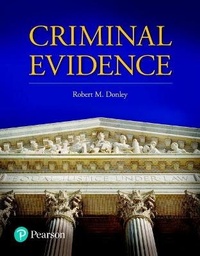
Criminal Evidence
Published on 30. March 2017
Book
Paperback/Softback
504 pages
978-0-13-289906-2 (ISBN)
Description
This book provides college students in Legal Studies, Criminal Justice, and other law or forensic-related fields with a detailed understanding of evidence law.
A detailed, hands-on introduction to evidence law
Criminal Evidence uses clear writing and real-world examples to provide students with a comprehensive understanding of the laws that determine what make evidence admissible in court, and the factors that make it credible to a jury. Concise but thorough explanations of the legal system, trial processes, and principles of constitutional and criminal law are carefully tailored to provide background on the role of evidence law. Coverage then continues to the rules of evidence and statutory and case law which form the law of evidence in a logical progression, from the attributes which make evidence admissible, to those which make relevant evidence inadmissible. Throughout, practice tips, sample trial transcripts, court opinions, and critical-thinking questions help students develop and retain their understanding. The appendix includes an annotated transcript of testimony taken at an actual criminal trial to give students a look at how evidence law is applied in practice. With its hands-on approach to evidence law, Criminal Evidence clearly explains the law of evidence and the context of that law in a manner that is accessible to students studying criminal justice as well as those studying law.
A detailed, hands-on introduction to evidence law
Criminal Evidence uses clear writing and real-world examples to provide students with a comprehensive understanding of the laws that determine what make evidence admissible in court, and the factors that make it credible to a jury. Concise but thorough explanations of the legal system, trial processes, and principles of constitutional and criminal law are carefully tailored to provide background on the role of evidence law. Coverage then continues to the rules of evidence and statutory and case law which form the law of evidence in a logical progression, from the attributes which make evidence admissible, to those which make relevant evidence inadmissible. Throughout, practice tips, sample trial transcripts, court opinions, and critical-thinking questions help students develop and retain their understanding. The appendix includes an annotated transcript of testimony taken at an actual criminal trial to give students a look at how evidence law is applied in practice. With its hands-on approach to evidence law, Criminal Evidence clearly explains the law of evidence and the context of that law in a manner that is accessible to students studying criminal justice as well as those studying law.
More details
Person
Professor Robert M. Donley has taught in the legal studies and criminal justice programs at Central Penn College since 2002. Before beginning his teaching career, he practiced law for twelve years. He is a 1990 graduate of Temple University School of Law, where he wrote for the Temple Law Review on the subject of juvenile justice. He is also a certified mediator and teaches in the fields of alternative dispute resolution and conflict management.
Robert lives in Lebanon, Pennsylvania, with his wife of 24 years, Melissa. His daughter, Katelyn, attends Central Penn College as a legal studies major, and hopes to follow in his footsteps as a lawyer.
Robert lives in Lebanon, Pennsylvania, with his wife of 24 years, Melissa. His daughter, Katelyn, attends Central Penn College as a legal studies major, and hopes to follow in his footsteps as a lawyer.
Content
PART I: The Criminal Legal System
1: The American Legal System
2: Criminal Law
3: Criminal Trial Process
4: Types and Forms of Evidence
5: Admissibility and Weight of Evidence
6: Evidence and the Constitution
PART II: The Law of Evidence
7: Competence
8: Authenticity and the Best Evidence Rule
9: Relevance
10: Relevance Exceptions: Prejudice, Cumulativeness, and Public Policy
11: Hearsay
12: Privilege
13: Witnesses: Credibility and Impeachment
APPENDICES
A. The Federal Rules of Evidence
B. Annotated trial transcript
GLOSSARY
1: The American Legal System
2: Criminal Law
3: Criminal Trial Process
4: Types and Forms of Evidence
5: Admissibility and Weight of Evidence
6: Evidence and the Constitution
PART II: The Law of Evidence
7: Competence
8: Authenticity and the Best Evidence Rule
9: Relevance
10: Relevance Exceptions: Prejudice, Cumulativeness, and Public Policy
11: Hearsay
12: Privilege
13: Witnesses: Credibility and Impeachment
APPENDICES
A. The Federal Rules of Evidence
B. Annotated trial transcript
GLOSSARY