

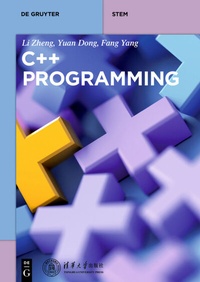
C++ Programming
1st Edition
Published on 19. February 2019
Book
Paperback/Softback
XVIII, 486 pages
978-3-11-046943-1 (ISBN)
Description
This book begins by explaining key concepts in programming, and elaborates on characteristic of class, including inheritance, derivation and polymorphism. It also introduces generic programming and Standard Template Library, I/O Stream Library and Exception Handling. The concepts and methods are illustrated via examples step by step, making the book an essential reading for beginners to C++ programming.
More details
Series
Language
English
Place of publication
Berlin/Boston
Germany
Target group
Professional and scholarly
US School Grade: College Graduate Student
Product notice
Klappenbroschur
Illustrations
21 s/w Tabellen, 94 Abbildungen
94 ill., 21 tbl.
Dimensions
Height: 240 mm
Width: 170 mm
Thickness: 28 mm
Weight
847 gr
ISBN-13
978-3-11-046943-1 (9783110469431)
Schweitzer Classification
Other editions
Additional editions
Yuan Dong | Fang Yang | Li Zheng
C++ Programming
E-Book
02/2019
1st Edition
De Gruyter
€99.95
Available for download
Yuan Dong | Fang Yang | Li Zheng
C++ Programming
Create robust enterprise software for Linux and Unix-based operating systems
E-Book
02/2019
1st Edition
De Gruyter
€99.95
Available for download
Persons
Content
Chapter 1 Introduction
1. 1 The Development of Computer Programming Language
1.2 Object-oriented Method
1.3 Object-oriented Software Development
1.4 Representation and Storage of Information
1.5 The Development Process of Programs
Summary
Exercises
Chapter 2 Elementary C++ Programming
2.1 An Overview of C++ Language
2.2 Basic Data Types and Expressions
2.3 Data Input and Output
2.4 The Fundamental Control Structures of Algorithms
2.5 User-Defined Data Type
Summary
Exercises
Chapter 3 Functions
3.1 Definition and Use of Function
3.2 Inline Functions
3.3 Default Formal Parameters in Functions
3.4 Function Overloading
3.5 Using C++ System Functions
Summary
Exercises
Chapter 4 Class and Object
4.1 Basic Features of Object-Oriented Design
4.2 Class and Object
4.3 Constructor and Destructor
4.4 Combination of Classes
4.5 UML
4.6 Example - Personnel Information Management Programme
Summary
Exercises
Chapter 5 Data Sharing and Protecting
5.1 Scope and Visibility of Identifiers
5.2 Lifetime of Object
5.3 Static Members of Class
5.4 Friend of Class
5.4 Protection of Shared Data
5.6 Multi-file Structure and Compilation Preprocessing Directives
5.7 Example - Personnel Information Management Programme
Summary
Exercises
Chapter 6 Arrays, Pointers and Strings
6.1 Arrays
6.2 Pointers
6.3 Dynamic memory Allocation
6.4 Deep Copy and Shallow Copy
6.5 Strings
6.6 Example - Personnel Information Management Programme
Summary
Exercises
Chapter 7 Inheritance and Derivation
7.1 Inheritance and Derivation of Class
7.2 Access Control
7.3 Type Compatible Rule
7.4 Constructor and Destructor of Derived Class
7.5 Identification and Access of Derived-Class Member
7.6 Example - Solving Linear equation by Gaussian Elimination Method
Summary
Exercises
Chapter 8 Polymorphism
8.1 An Overview of Polymorphism
8.2 Operator Overload
8.3 Virtual Function
8.4 Abstract Class
8.5 Example - Variable Stepwise Trapezoid Method to Calculate Functional Definite Integral
8.6 Example - Improvement to Staff Information Management System in a Small Cooperation
Summary
Exercises
Chapter 9 Collections and Their Organization
9.1 Function Template and Class Template
9.2 Linear Collection
9.3 Organizing Data in Linear Collection
9.4 Application - Improving the HR Management Programme in a Small Cooperation
Summary
Exercises
Chapter 10 Generic Programming and STL
10.1 Generic Programming
10.2 Containers in STL
10.3 Iterators
10.4 Algorithms in STL
10.5 Function Objects
10.6 Application - Improving the HR Management Programme in a Small Cooperation
Summary
Exercises
Chapter 11 The I/O Stream Library and Input/Output
11.1 the Concept of I/O Stream and the Structure of Stream Library
11.2 Output Stream
11.3 Input Stream
11.4 Input/Output Stream
11.5 Example - Improving Employee Information Management System
Summary
Exercises
Chapter 12 Exception Handling
12.1 Basic Concept of Exception Handling
12.2 Implementation of Exception Handling in C++
12.3 Destruction and Construction in Exception Handling
12.4 Exception Handling of Standard Library
12.5 Example - Improvement to Personal Information Administration Programme in a Small Cooperation
Summary
Exercises
1. 1 The Development of Computer Programming Language
1.2 Object-oriented Method
1.3 Object-oriented Software Development
1.4 Representation and Storage of Information
1.5 The Development Process of Programs
Summary
Exercises
Chapter 2 Elementary C++ Programming
2.1 An Overview of C++ Language
2.2 Basic Data Types and Expressions
2.3 Data Input and Output
2.4 The Fundamental Control Structures of Algorithms
2.5 User-Defined Data Type
Summary
Exercises
Chapter 3 Functions
3.1 Definition and Use of Function
3.2 Inline Functions
3.3 Default Formal Parameters in Functions
3.4 Function Overloading
3.5 Using C++ System Functions
Summary
Exercises
Chapter 4 Class and Object
4.1 Basic Features of Object-Oriented Design
4.2 Class and Object
4.3 Constructor and Destructor
4.4 Combination of Classes
4.5 UML
4.6 Example - Personnel Information Management Programme
Summary
Exercises
Chapter 5 Data Sharing and Protecting
5.1 Scope and Visibility of Identifiers
5.2 Lifetime of Object
5.3 Static Members of Class
5.4 Friend of Class
5.4 Protection of Shared Data
5.6 Multi-file Structure and Compilation Preprocessing Directives
5.7 Example - Personnel Information Management Programme
Summary
Exercises
Chapter 6 Arrays, Pointers and Strings
6.1 Arrays
6.2 Pointers
6.3 Dynamic memory Allocation
6.4 Deep Copy and Shallow Copy
6.5 Strings
6.6 Example - Personnel Information Management Programme
Summary
Exercises
Chapter 7 Inheritance and Derivation
7.1 Inheritance and Derivation of Class
7.2 Access Control
7.3 Type Compatible Rule
7.4 Constructor and Destructor of Derived Class
7.5 Identification and Access of Derived-Class Member
7.6 Example - Solving Linear equation by Gaussian Elimination Method
Summary
Exercises
Chapter 8 Polymorphism
8.1 An Overview of Polymorphism
8.2 Operator Overload
8.3 Virtual Function
8.4 Abstract Class
8.5 Example - Variable Stepwise Trapezoid Method to Calculate Functional Definite Integral
8.6 Example - Improvement to Staff Information Management System in a Small Cooperation
Summary
Exercises
Chapter 9 Collections and Their Organization
9.1 Function Template and Class Template
9.2 Linear Collection
9.3 Organizing Data in Linear Collection
9.4 Application - Improving the HR Management Programme in a Small Cooperation
Summary
Exercises
Chapter 10 Generic Programming and STL
10.1 Generic Programming
10.2 Containers in STL
10.3 Iterators
10.4 Algorithms in STL
10.5 Function Objects
10.6 Application - Improving the HR Management Programme in a Small Cooperation
Summary
Exercises
Chapter 11 The I/O Stream Library and Input/Output
11.1 the Concept of I/O Stream and the Structure of Stream Library
11.2 Output Stream
11.3 Input Stream
11.4 Input/Output Stream
11.5 Example - Improving Employee Information Management System
Summary
Exercises
Chapter 12 Exception Handling
12.1 Basic Concept of Exception Handling
12.2 Implementation of Exception Handling in C++
12.3 Destruction and Construction in Exception Handling
12.4 Exception Handling of Standard Library
12.5 Example - Improvement to Personal Information Administration Programme in a Small Cooperation
Summary
Exercises