

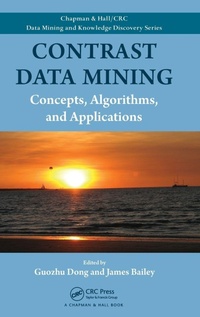
Contrast Data Mining
Concepts, Algorithms, and Applications
1st Edition
Published on 7. September 2012
Book
Hardback
434 pages
978-1-4398-5432-7 (ISBN)
Description
A Fruitful Field for Researching Data Mining Methodology and for Solving Real-Life ProblemsContrast Data Mining: Concepts, Algorithms, and Applications collects recent results from this specialized area of data mining that have previously been scattered in the literature, making them more accessible to researchers and developers in data mining and other fields. The book not only presents concepts and techniques for contrast data mining, but also explores the use of contrast mining to solve challenging problems in various scientific, medical, and business domains.
Learn from Real Case Studies of Contrast Mining ApplicationsIn this volume, researchers from around the world specializing in architecture engineering, bioinformatics, computer science, medicine, and systems engineering focus on the mining and use of contrast patterns. They demonstrate many useful and powerful capabilities of a variety of contrast mining techniques and algorithms, including tree-based structures, zero-suppressed binary decision diagrams, data cube representations, and clustering algorithms. They also examine how contrast mining is used in leukemia characterization, discriminative gene transfer and microarray analysis, computational toxicology, spatial and image data classification, voting analysis, heart disease prediction, crime analysis, understanding customer behavior, genetic algorithms, and network security.
Learn from Real Case Studies of Contrast Mining ApplicationsIn this volume, researchers from around the world specializing in architecture engineering, bioinformatics, computer science, medicine, and systems engineering focus on the mining and use of contrast patterns. They demonstrate many useful and powerful capabilities of a variety of contrast mining techniques and algorithms, including tree-based structures, zero-suppressed binary decision diagrams, data cube representations, and clustering algorithms. They also examine how contrast mining is used in leukemia characterization, discriminative gene transfer and microarray analysis, computational toxicology, spatial and image data classification, voting analysis, heart disease prediction, crime analysis, understanding customer behavior, genetic algorithms, and network security.
Reviews / Votes
This book, edited by two leading researchers on contrast mining, Professors Guozhu Dong and James Bailey, and contributed to by over 40 data mining researchers and application scientists, is a comprehensive and authoritative treatment of this research theme. It presents a systematic introduction and a thorough overview of the state of the art for contrast data mining, including concepts, methodologies, algorithms, and applications. ... the book will appeal to a wide range of readers, including data mining researchers and developers who want to be informed about recent progress in this exciting and fruitful area of research, scientific researchers who seek to find new tools to solve challenging problems in their own research domains, and graduate students who want to be inspired on problem solving techniques and who want to get help with identifying and solving novel data mining research problems in various domains.-From the Foreword by Jiawei Han, University of Illinois, Urbana-Champaign, USA
More details
Series
Language
English
Place of publication
Oxford
United States
Publishing group
Taylor & Francis Inc
Target group
College/higher education
Researchers and graduate students in data mining, artificial intelligence, statistics, biology, and medicine.
Illustrations
78 s/w Abbildungen, 76 s/w Tabellen
76 Tables, black and white; 78 Illustrations, black and white
Dimensions
Height: 240 mm
Width: 161 mm
Thickness: 28 mm
Weight
816 gr
ISBN-13
978-1-4398-5432-7 (9781439854327)
Copyright in bibliographic data and cover images is held by Nielsen Book Services Limited or by the publishers or by their respective licensors: all rights reserved.
Schweitzer Classification
Other editions
Additional editions
E-Book
04/2016
Chapman & Hall/CRC
€73.49
Available for download
Persons
Guozhu Dong is a professor at Wright State University. A senior member of the IEEE and ACM, Dr. Dong holds four U.S. patents and has authored over 130 articles on databases, data mining, and bioinformatics; co-authored Sequence Data Mining; and co-edited Contrast Data Mining and Applications. His research focuses on contrast/emerging pattern mining and applications as well as first-order incremental view maintenance. He has a PhD in computer science from the University of Southern California.
James Bailey is an Australian Research Council Future Fellow in the Department of Computing and Information Systems at the University of Melbourne. Dr. Bailey has authored over 100 articles and is an associate editor of IEEE Transactions on Knowledge and Data Engineering and Knowledge and Information Systems: An International Journal. His research focuses on fundamental topics in data mining and machine learning, such as contrast pattern mining and data clustering, as well as application aspects in areas, including health informatics and bioinformatics. He has a PhD in computer science from the University of Melbourne.
James Bailey is an Australian Research Council Future Fellow in the Department of Computing and Information Systems at the University of Melbourne. Dr. Bailey has authored over 100 articles and is an associate editor of IEEE Transactions on Knowledge and Data Engineering and Knowledge and Information Systems: An International Journal. His research focuses on fundamental topics in data mining and machine learning, such as contrast pattern mining and data clustering, as well as application aspects in areas, including health informatics and bioinformatics. He has a PhD in computer science from the University of Melbourne.
Content
Preliminaries and Statistical Contrast Measures. Contrast Mining Algorithms. Generalized Contrasts, Emerging Data Cubes, and Rough Sets. Contrast Mining for Classification and Clustering. Contrast Mining for Bioinformatics and Chemoinformatics. Contrast Mining for Special Domains. Survey of Other Papers. Bibliography. Index.