

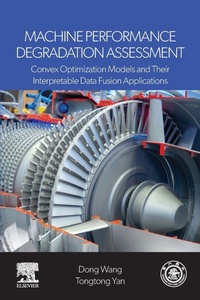
Machine Performance Degradation Assessment
Convex Optimization Models and Their Interpretable Data Fusion Applications
Published on 24. October 2025
Book
Paperback/Softback
152 pages
978-0-443-44007-6 (ISBN)
Description
Machine Performance Degradation Assessment: Convex Optimization Models and Their Interpretable Data Fusion Applications is an essential resource for industry professionals and researchers seeking to understand the latest trends in performance degradation assessment technologies. This comprehensive guide delves into the fundamental theories of convex optimization models while exploring cutting-edge research methods. Readers will gain valuable insights into interpretable data fusion models and their applications, providing practical and theoretical knowledge to advance their understanding of machine performance degradation. In addition to the core mathematical elements, the book includes advanced techniques for formulating degradation properties into convex optimization models for health index construction.
Real-world applications and examples demonstrate how these innovative methods can be applied in practice. By presenting novel concepts and analytical frameworks, this book offers fresh perspectives to help readers navigate the complexities of machine performance degradation assessment.
Real-world applications and examples demonstrate how these innovative methods can be applied in practice. By presenting novel concepts and analytical frameworks, this book offers fresh perspectives to help readers navigate the complexities of machine performance degradation assessment.
More details
Language
English
Place of publication
Philadelphia
United States
Target group
Professional and scholarly
Dimensions
Height: 229 mm
Width: 152 mm
Weight
260 gr
ISBN-13
978-0-443-44007-6 (9780443440076)
Copyright in bibliographic data and cover images is held by Nielsen Book Services Limited or by the publishers or by their respective licensors: all rights reserved.
Schweitzer Classification
Other editions
Additional editions
Dong Wang | Tongtong Yan B. E.
Machine Performance Degradation Assessment
Convex Optimization Models and Their Interpretable Data Fusion Applications
E-Book
10/2025
Elsevier
€158.99
Available for download
Persons
Dr. Dong Wang is based at the Department of Industrial Engineering and Management, School of Mechanical Engineering, Shanghai Jiao Tong University, China. Dr Wang has over 15 years' research experience on machine condition monitoring and fault diagnosis. Dr Wang's research focuses on the theoretical foundations of fault feature extraction and their applications to machine condition monitoring, fault diagnosis and prognostics Tongtong Yan received her B.E. degree from Central South University in Changsha, China, in 2019. She is currently pursuing her Ph.D. in the Department of Industrial Engineering and Management and in the State Key Laboratory of Mechanical System and Vibration, Shanghai Jiao Tong University, China. Her research interests include interpretable convex optimization modeling, machine learning, statistical learning, machine condition monitoring, performance degradation assessment, and fault diagnosis
Content
1. Machine performance degradation assessment
2. Fundamentals of convex optimization
3. Machine degradation processes related mathematical properties
4. Generalized health index weight optimization models based on degradation properties and amplitude fusion in the frequency domain
5. Generalized health index weight optimization models based on fault feature sparsity and amplitude fusion in the envelope spectral domain
6. Conclusions
2. Fundamentals of convex optimization
3. Machine degradation processes related mathematical properties
4. Generalized health index weight optimization models based on degradation properties and amplitude fusion in the frequency domain
5. Generalized health index weight optimization models based on fault feature sparsity and amplitude fusion in the envelope spectral domain
6. Conclusions