

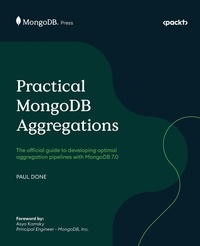
Practical MongoDB Aggregations
The official guide to developing optimal aggregation pipelines with MongoDB 7.0
Published on 7. September 2023
Book
Paperback/Softback
312 pages
978-1-83508-064-1 (ISBN)
Description
Begin your journey toward efficient data manipulation with this robust technical guide and enhance your aggregation skills while building efficient pipelines for a variety of tasks
Key Features
Build effective aggregation pipelines for increased productivity and performance
Solve common data manipulation and analysis problems with the help of practical examples
Learn essential strategies to aggregate time series data in financial datasets and IoT
Purchase of the print or Kindle book includes a free PDF eBook
Book DescriptionOfficially endorsed by MongoDB, Inc., Practical MongoDB Aggregations helps you unlock the full potential of the MongoDB aggregation framework, including the latest features of MongoDB 7.0. This book provides practical, easy-to-digest principles and approaches for increasing your effectiveness in developing aggregation pipelines, supported by examples for building pipelines to solve complex data manipulation and analytical tasks.
This book is customized for developers, architects, data analysts, data engineers, and data scientists with some familiarity with the aggregation framework. It begins by explaining the framework's architecture and then shows you how to build pipelines optimized for productivity and scale.
Given the critical role arrays play in MongoDB's document model, the book delves into best practices for optimally manipulating arrays. The latter part of the book equips you with examples to solve common data processing challenges so you can apply the lessons you've learned to practical situations. By the end of this MongoDB book, you'll have learned how to utilize the MongoDB aggregation framework to streamline your data analysis and manipulation processes effectively.What you will learn
Develop dynamic aggregation pipelines tailored to changing business requirements
Master essential techniques to optimize aggregation pipelines for rapid data processing
Achieve optimal efficiency for applying aggregations to vast datasets with effective sharding strategies
Eliminate the performance penalties of processing data externally by filtering, grouping, and calculating aggregated values directly within the database
Use pipelines to help you secure your data access and distribution
Who this book is forThis book is for intermediate-level developers, architects, analysts, engineers, and data scientists who are interested in learning about aggregation capabilities in MongoDB. Working knowledge of MongoDB is needed to get the most out of this book.
Key Features
Build effective aggregation pipelines for increased productivity and performance
Solve common data manipulation and analysis problems with the help of practical examples
Learn essential strategies to aggregate time series data in financial datasets and IoT
Purchase of the print or Kindle book includes a free PDF eBook
Book DescriptionOfficially endorsed by MongoDB, Inc., Practical MongoDB Aggregations helps you unlock the full potential of the MongoDB aggregation framework, including the latest features of MongoDB 7.0. This book provides practical, easy-to-digest principles and approaches for increasing your effectiveness in developing aggregation pipelines, supported by examples for building pipelines to solve complex data manipulation and analytical tasks.
This book is customized for developers, architects, data analysts, data engineers, and data scientists with some familiarity with the aggregation framework. It begins by explaining the framework's architecture and then shows you how to build pipelines optimized for productivity and scale.
Given the critical role arrays play in MongoDB's document model, the book delves into best practices for optimally manipulating arrays. The latter part of the book equips you with examples to solve common data processing challenges so you can apply the lessons you've learned to practical situations. By the end of this MongoDB book, you'll have learned how to utilize the MongoDB aggregation framework to streamline your data analysis and manipulation processes effectively.What you will learn
Develop dynamic aggregation pipelines tailored to changing business requirements
Master essential techniques to optimize aggregation pipelines for rapid data processing
Achieve optimal efficiency for applying aggregations to vast datasets with effective sharding strategies
Eliminate the performance penalties of processing data externally by filtering, grouping, and calculating aggregated values directly within the database
Use pipelines to help you secure your data access and distribution
Who this book is forThis book is for intermediate-level developers, architects, analysts, engineers, and data scientists who are interested in learning about aggregation capabilities in MongoDB. Working knowledge of MongoDB is needed to get the most out of this book.
More details
Language
English
Place of publication
Birmingham
United Kingdom
Target group
Professional and scholarly
US School Grade: College Graduate Student
Dimensions
Height: 235 mm
Width: 191 mm
Thickness: 21 mm
Weight
866 gr
ISBN-13
978-1-83508-064-1 (9781835080641)
Copyright in bibliographic data and cover images is held by Nielsen Book Services Limited or by the publishers or by their respective licensors: all rights reserved.
Schweitzer Classification
Other editions
Additional editions
Paul Done
Practical MongoDB Aggregations
The official guide to developing optimal aggregation pipelines with MongoDB 7.0
E-Book
09/2024
Packt Publishing
from
€53.99
Available for download
Person
Paul Done is a Field CTO at MongoDB Inc., having been a Solutions Architect for the past decade at MongoDB. He has previously held roles in various software disciplines, including engineering, consulting, and pre-sales, at companies like Oracle, Novell, and BEA Systems. Paul specializes in databases and middleware, focusing on resiliency, scalability, transactions, event processing, and applying evolvable data model approaches. He spent most of the early 2000s building Java EE (J2EE) transactional systems on WebLogic, integrated with relational databases like Oracle RAC and messaging systems like MQ Series.
Content
Table of Contents
MongoDB Aggregations Explained
Optimizing Pipelines for Productivity
Optimizing Pipelines for Performance
Harnessing the Power of Expressions
Optimizing Pipelines for Sharded Clusters
Foundational Examples: Filtering, Grouping, and Unwinding
Joining Data Examples
Fixing and Generating Data Examples
Trend Analysis Examples
Securing Data Examples
Time-Series Examples
Array Manipulation Examples
Full-Text Search Examples
MongoDB Aggregations Explained
Optimizing Pipelines for Productivity
Optimizing Pipelines for Performance
Harnessing the Power of Expressions
Optimizing Pipelines for Sharded Clusters
Foundational Examples: Filtering, Grouping, and Unwinding
Joining Data Examples
Fixing and Generating Data Examples
Trend Analysis Examples
Securing Data Examples
Time-Series Examples
Array Manipulation Examples
Full-Text Search Examples