

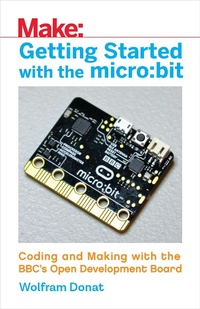
Getting Started with the Micro: Bit
Coding and Making with the BBC's Open Development Board
Will be published approx. on 25. September 2017
Book
Paperback/Softback
160 pages
978-1-68045-302-7 (ISBN)
Description
The micro:bit, a tiny computer being distributed by the BBC to students all over the UK, is now available for anyone to purchase and play with. Its small size and low power requirements make it an ideal project platform for hobbyists and makers. You don't have to be limited by the web-based programming solutions, however: the hardware on the board is deceptively powerful, and this book will teach you how to really harness the power of the micro:bit. You'll learn about sensors, Bluetooth communications, and embedded operating systems, and along the way you'll develop an understanding of the next big thing in computers: the Internet of Things.
More details
Language
English
Place of publication
Sebastopol
United States
Publishing group
O'Reilly Media
Target group
Professional and scholarly
Product notice
Paperback (trade)
Unsewn / adhesive bound
Dimensions
Height: 217 mm
Width: 141 mm
Thickness: 17 mm
Weight
259 gr
ISBN-13
978-1-68045-302-7 (9781680453027)
Copyright in bibliographic data and cover images is held by Nielsen Book Services Limited or by the publishers or by their respective licensors: all rights reserved.
Schweitzer Classification
Other editions
Additional editions
Wolfram Donat
Getting Started with the micro:bit
Coding and Making with the BBC''s Open Development Board
E-Book
08/2017
1st Edition
Make Community LLC
€16.49
Available for download
Wolfram Donat
Getting Started with the micro:bit
Coding and Making with the BBC's Open Development Board
E-Book
08/2017
1st Edition
Make Community, LLC
€16.49
Available for download
Person
Wolfram Donat is a graduate of the University of Alaska Anchorage, with a B.S. degree in Computer Engineering. Along with an interest in robotics, computer vision, and embedded systems, his general technological interests and Internet expertise serve to make him an extremely eclectic programmer. He specializes in C and C++, with additional skills in Java, Python, and C#/.NET. He is the author of several books and has received funding from NASA for his work in autonomous submersibles.