


For Positivist Organization Theory
1st Edition
Published on 6. August 1996
Book
Paperback/Softback
200 pages
978-0-7619-5227-5 (ISBN)
Description
Organization theory is presently dominated by theories of strategic choice and politics. Managers are seen as exercising a wide choice and maximizing their personal self-interest through complex power struggles.
This stimulating volume challenges these views, arguing instead that managerial decisions are determined by the situation and serve the interests of the whole organization. Showing that organizations follow laws which generalize across organizations of many different kinds in many different national cultures, the book rejects the model of organizational configurations or types.
The author offers a critical assessment of leading organization theorists such as Henry Mintzberg, John Child, Michael Hannan and Danny Miller - and also of the satirist Northcote Parkinson.
This stimulating volume challenges these views, arguing instead that managerial decisions are determined by the situation and serve the interests of the whole organization. Showing that organizations follow laws which generalize across organizations of many different kinds in many different national cultures, the book rejects the model of organizational configurations or types.
The author offers a critical assessment of leading organization theorists such as Henry Mintzberg, John Child, Michael Hannan and Danny Miller - and also of the satirist Northcote Parkinson.
Reviews / Votes
`Organizations need to develop learning strategies to survive and develop in increasingly uncertain and changing markets. In this book, researchers from both Europe and the United States explore theories of strategic management and organzational behaviour to establish a link between learning processes and competitive advantage, within a variety of organizational settings. The book is organized in three main parts: learning processes and competitive advantages; organizational learning and strategic capability; and strategic change and organizational learning. Charts and tables clarify the theories and an excellent bibliography completes the work' - International Review of Administrative SciencesMore details
Language
English
Place of publication
Thousand Oaks
United States
Target group
College/higher education
Professional and scholarly
Dimensions
Height: 234 mm
Width: 156 mm
Thickness: 11 mm
Weight
319 gr
ISBN-13
978-0-7619-5227-5 (9780761952275)
Copyright in bibliographic data and cover images is held by Nielsen Book Services Limited or by the publishers or by their respective licensors: all rights reserved.
Schweitzer Classification
Other editions
Additional editions
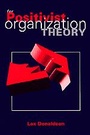
Lex Donaldson
For Positivist Organization Theory
Book
08/1996
1st Edition
SAGE Publications Inc
€224.33
Article exhausted; check different version
Lex Donaldson
For Positivist Organization Theory
E-Book
08/1996
1st Edition
SAGE Publications Ltd
from
€44.69
Available for download
Person
Lex Donaldson is Professor of Organizational Design at the Australian Graduate School of Management, University of New South Wales. His publications include American Anti-Management Theories of Organization: A Critique of Paradigm Proliferation (1995) and In Defence of Organization Theory: A Reply to the Critics (1985).
Content
Positivist Organization Theory
For Determinism
Against Strategic Choice
For Determinism
Subjective Factors in Strategic Choice
For Functionalism
Against Politics and `Parkinson's Law'
For Functionalism
The Validity of Blau's Theory
For Cartesianism
Against Organization Types and Quantum Jumps
For Generalization in Positivist Organization Theory
For Generalization of Organizational Size
Conclusions
For Determinism
Against Strategic Choice
For Determinism
Subjective Factors in Strategic Choice
For Functionalism
Against Politics and `Parkinson's Law'
For Functionalism
The Validity of Blau's Theory
For Cartesianism
Against Organization Types and Quantum Jumps
For Generalization in Positivist Organization Theory
For Generalization of Organizational Size
Conclusions