

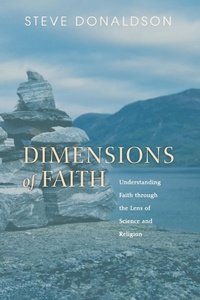
Dimensions of Faith
Understanding Faith Through the Lens of Science and Religion
Published on 28. July 2015
Book
Paperback/Softback
300 pages
978-1-4982-2005-7 (ISBN)
Description
In Dimensions of Faith, cognitive scientist Steve Donaldson takes readers on a journey from the world of assumptions, set minds, widely varying beliefs, and popular misconceptions to an understanding of the true essence and role of faith as the natural and inevitable product of brains. Using numerous illustrations and examples, Donaldson shows how faith is necessitated by a variety of unavoidable limitations, exposes the myth of a divide between faith and critical thinking, provides practical advice for crafting coherent beliefs, and explains why there can never be such a place as "Factland." Along the way he takes a special look at religious faith--evaluating its attributes, exploring its relation to other manifestations of faith, investigating whether God has done his job well enough to warrant the faith placed in him, and pondering how truth seekers can sometimes end up in very different places.
More details
Language
English
Place of publication
Eugene
United States
Product notice
Paperback (trade)
Unsewn / adhesive bound
Dimensions
Height: 229 mm
Width: 152 mm
Thickness: 18 mm
Weight
493 gr
ISBN-13
978-1-4982-2005-7 (9781498220057)
Copyright in bibliographic data and cover images is held by Nielsen Book Services Limited or by the publishers or by their respective licensors: all rights reserved.
Schweitzer Classification
Other editions
Additional editions
E-Book
07/2015
Wipf and Stock Publishers
€34.99
Available for download
Person
Steve Donaldson, PhD, is Professor and Computer Science Program Director at Samford University in Birmingham, Alabama. He also codirects the Computational Biology program, teaches in the Science and Religion and University Fellows Honors programs, and is one of the cofounders of the Samford Center for Science and Religion. His research interests include cognition, models of intelligence, autonomous systems, self-organization and emergence, and the interface of science and religion.