

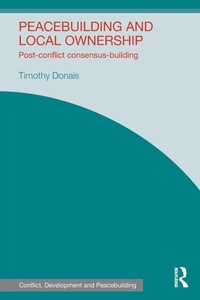
Peacebuilding and Local Ownership
Post-Conflict Consensus-Building
1st Edition
Published on 11. November 2013
Book
Paperback/Softback
192 pages
978-0-415-74113-2 (ISBN)
Description
This book explores the meaning of local ownership in peacebuilding and examines the ways in which it has been, and could be, operationalized in post-conflict environments.
In the context of post-conflict peacebuilding, the idea of local ownership is based upon the premise that no peace process is sustainable in the absence of a meaningful degree of local involvement. Despite growing recognition of the importance of local ownership, however, relatively little attention has been paid to specifying what precisely the concept means or how it might be implemented.
This volume contributes to the ongoing debate on the future of liberal peacebuilding through a critical investigation of the notion of local ownership, and challenges conventional assumptions about who the relevant locals are and what they are expected to own. Drawing on case studies from Bosnia, Afghanistan and Haiti, the text argues that local ownership can only be fostered through a long-term consensus-building process, which involves all levels of the conflict-affected society.
This book will be of great interest to students of peacebuilding, peace and conflict studies, development studies, security studies and IR.
In the context of post-conflict peacebuilding, the idea of local ownership is based upon the premise that no peace process is sustainable in the absence of a meaningful degree of local involvement. Despite growing recognition of the importance of local ownership, however, relatively little attention has been paid to specifying what precisely the concept means or how it might be implemented.
This volume contributes to the ongoing debate on the future of liberal peacebuilding through a critical investigation of the notion of local ownership, and challenges conventional assumptions about who the relevant locals are and what they are expected to own. Drawing on case studies from Bosnia, Afghanistan and Haiti, the text argues that local ownership can only be fostered through a long-term consensus-building process, which involves all levels of the conflict-affected society.
This book will be of great interest to students of peacebuilding, peace and conflict studies, development studies, security studies and IR.
More details
Series
Language
English
Place of publication
London
United Kingdom
Publishing group
Taylor & Francis Ltd
Target group
College/higher education
Professional and scholarly
Illustrations
3 s/w Zeichnungen
3 Line drawings, black and white
Dimensions
Height: 234 mm
Width: 156 mm
Weight
294 gr
ISBN-13
978-0-415-74113-2 (9780415741132)
Copyright in bibliographic data and cover images is held by Nielsen Book Services Limited or by the publishers or by their respective licensors: all rights reserved.
Schweitzer Classification
Other editions
Additional editions
E-Book
10/2012
1st Edition
Routledge
€64.49
Available for download
E-Book
10/2012
1st Edition
Routledge
€64.49
Available for download
Book
04/2012
1st Edition
Routledge
€231.30
Shipment within 15-20 days
Person
Timothy Donais is Associate Professor of Global Studies at Wilfrid Laurier University in Waterloo, Canada. His current research focuses on post-conflict peacebuilding. He is the author of The Political Economy of Peacebuilding in Post-Dayton Bosnia (Routledge, 2005) and, more recently, the editor of Local Ownership and Security Sector Reform (Lit Verlag, 2008).
Content
1. Making Sense of Local Ownership in Peacebuilding Contexts 2. The Liberal Peace and the Ownership Question 3. Elite Ownership: Elections and Beyond 4. Civil Society as Societal Ownership 5. Bosnia: Ownership through Imposition? 6. Afghanistan: Peacebuilding, Political Culture, and the Limits of Social Engineering 7. Haiti: Ownership and the Political Economy of Peacebuilding 8. Conclusion: Towards Peacebuilding as Consensus-Building