

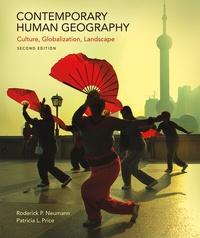
Contemporary Human Geography
Description
More than any other book for the introductory human geography course, Contemporary Human Geography shows what geographers actually do - how they conduct research, develop new insights, teach us about the world from a geographer's perspective, and apply their skills in a wide range of academic and professional pursuits.
With each chapter organized by five themes (region, mobility, globalization, nature-culture, cultural landscape), Contemporary Human Geography introduces students to geography concepts through fascinating topics such as the distribution of college sports, the relationship of beauty pageants and cultural identity, texting and language modification, and more, continually reinforcing geographers' contributions to our understanding of how we live in a globalized, modern world. The authors frame this coverage using specific learning objectives to help students focus on essential concepts and prepare for class discussions, assignments, and exams.
Contemporary Human Geography is now supported in Achieve, Macmillan's new online learning platform. Achieve is the culmination of years of development work put toward creating the most powerful online learning tool for Geography students. It houses all of our renowned assessments, multimedia assets, e-books, and instructor resources in a powerful new platform.More details
Persons
Roderick P. Neumann is a professor of geography in the Department of Global and Sociocultural Studies at Florida International University. He earned his Ph.D. at the University of California, Berkeley. He studies the complex interactions of culture and nature through a specific focus on national parks and natural resources. In his research, he combines the analytical tools of cultural and political ecology with landscape studies.
Patricia L. Price is associate professor of geography at Florida International University. She earned her Ph.D. at the University of Washington. Connecting the long-standing theme of humanistic scholarship in geography to more recent critical approaches best describes her ongoing intellectual project. From her initial field research in Mexico, she has extended her focus to the border between Mexico and the United States and, most recently, to south Florida as a borderland of sorts.