

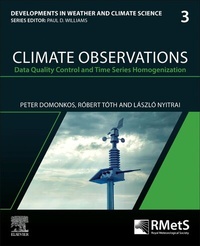
Climate Observations: Volume 3
Data Quality Control and Time Series Homogenization
Published on 17. November 2022
Book
Paperback/Softback
302 pages
978-0-323-90487-2 (ISBN)
Description
Climate Observations: Data Quality Control and Time Series Homogenization pulls together the different phases of the production of high-quality climatic datasets, allowing interested readers to obtain a coherent picture on the complexity and importance of this task. There are several new methods of time series homogenization, each very complex and fast developing. The thematic discussion of the production of high quality climatic datasets provides the opportunity to reduce errors, including the careful installation of meteorological instruments, the application of strict observing rules and inspections, and the use of sophistically developed statistical software to detect and remove errors or biases.
This book is intended for professionals working on climate data management at the national meteorological services, for the users of observed climatic data, and for students and researchers studying atmospheric and climate science.
Members of the Royal Meteorological Society are eligible for a 35% discount on all Developments in Weather and Climate Science series titles. See the RMetS member dashboard for the discount code.
This book is intended for professionals working on climate data management at the national meteorological services, for the users of observed climatic data, and for students and researchers studying atmospheric and climate science.
Members of the Royal Meteorological Society are eligible for a 35% discount on all Developments in Weather and Climate Science series titles. See the RMetS member dashboard for the discount code.
More details
Series
Language
English
Place of publication
Philadelphia
United States
Target group
Professional and scholarly
Professional meteorologists and climatologists; Students and researchers in atmospheric science and climate science
Illustrations
50 illustrations; Illustrations
Dimensions
Height: 235 mm
Width: 191 mm
Weight
620 gr
ISBN-13
978-0-323-90487-2 (9780323904872)
Copyright in bibliographic data and cover images is held by Nielsen Book Services Limited or by the publishers or by their respective licensors: all rights reserved.
Schweitzer Classification
Other editions
Additional editions

Peter Domonkos | Róbert Tóth | László Nyitrai
Climate Observations
Data Quality Control and Time Series Homogenization
E-Book
11/2022
Elsevier
€130.00
Available for download
Persons
Peter Domonkos is a Hungarian climatologist living in Spain since 2009. He is expert on statistical climatology, analysis of extreme climatic events, data quality control and time series homogenization. He is member of the Hungarian Meteorological Society and secretary of ESPERE (Environmental Science for Everybody Round the Earth). Between 2009 - 2015 Dr. Domonkos was a researcher of the University Rovira i Virgili (Tarragona, Spain), and is a free researcher since then. He has been developed an automatic homogenization method (ACMANT), which was found to be one of the most accurate methods by various international test experiments. Between 2013 and 2015 he led 4 international trainings on time series homogenization, sponsored by the World Meteorological Organization. He has 104 printed scientific publications. Robert Toth is an experienced meteorologist with a demonstrated history of working in the environmental services industry. Skilled in meteorological measurements, international agreements on air quality protection, sustainable development, environmental compliance and emergency management. Strong research professional with a Master's Degree focused in Public Administration from University of Economy, Budapest. Now Head of Unit for Data Quality Control at Hungarian Meteorological Service since 2020. Responsible for the conventional precipitation monitoring network. Deputy Editor in Chief of Legkoer (quarterly journal of Hungarian Meteorological Service and Hungarian Meteorological Society). In 2008-2009 president of UNEP Montreal Protocol Bureau. He gave lectures on meteorological observation and instruments at Eoetvoes Lorand University, Budapest in the 90s. Laszlo Nyitrai is a certified meteorologist, he graduated from meteorology at Eoetvoes Lorand University in Budapest in 1985. He has worked for Hungarian Meteorological Service in the field of meteorological measurements, data archiving and climate tables. In addition, he dealt with the aspects of ionospheric physics affecting radio wave propagation, he collected records of ionospheric conditions for shortwave radio signal transport, and corresponded internationally in this topic.
He investigated the global trends, completeness and deficiencies of meteorological tropospheric and stratospheric upper air measurements and their presumed economic background in relation to the WMO member countries. He made attempts to calculate atmospheric moisture transport from radiosonde observations, and presented his studies in international conferences
He investigated the global trends, completeness and deficiencies of meteorological tropospheric and stratospheric upper air measurements and their presumed economic background in relation to the WMO member countries. He made attempts to calculate atmospheric moisture transport from radiosonde observations, and presented his studies in international conferences
Content
1. Land surface observations
2. Upper air observation and remote sensing
3. Data quality control and dataset development
4. Homogenization task and its principal approaches
5. Relative homogenization: The basis
6. Relative homogenization: Optional tools
7. Relative homogenization: Special problems
8. A selection of statistical homogenization methods
9. Accuracy of homogenization results
10. Use of quality controlled and homogenized data
Appendix: Basic statistical concepts
2. Upper air observation and remote sensing
3. Data quality control and dataset development
4. Homogenization task and its principal approaches
5. Relative homogenization: The basis
6. Relative homogenization: Optional tools
7. Relative homogenization: Special problems
8. A selection of statistical homogenization methods
9. Accuracy of homogenization results
10. Use of quality controlled and homogenized data
Appendix: Basic statistical concepts