

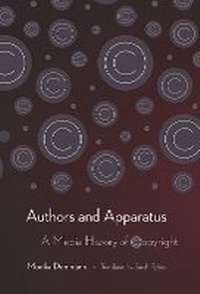
Authors and Apparatus
A Media History of Copyright
Published on 15. March 2019
Book
Hardback
282 pages
978-1-5017-0992-0 (ISBN)
Description
Copyright is under siege. From file sharing to vast library scanning projects, new technologies, actors, and attitudes toward intellectual property threaten the value of creative work. However, while digital media and the Internet have made making and sharing perfect copies of original works almost effortless, debates about protecting authors' rights are nothing new. In this sweeping account of the evolution of copyright law since the mid-nineteenth century, Monika Dommann explores how radical media changes-from sheet music and phonographs to photocopiers and networked information systems-have challenged and transformed legal and cultural concept of authors' rights.
Dommann provides a critical transatlantic perspective on developments in copyright law and mechanical reproduction of words and music, charting how artists, media companies, and lawmakers in the United States and western Europe approached the complex tangle of technological innovation, intellectual property, and consumer interests. From the seemingly innocuous music box, invented around 1800, to BASF's magnetic tapes and Xerox machines, she demonstrates how copyright has been continuously destabilized by emerging technologies, requiring new legal norms to regulate commercial and private copying practices. Without minimizing digital media's radical disruption to notions of intellectual property, Dommann uncovers the deep historical roots of the conflict between copyright and media-a story that can inform present-day debates over the legal protection of authorship.
Dommann provides a critical transatlantic perspective on developments in copyright law and mechanical reproduction of words and music, charting how artists, media companies, and lawmakers in the United States and western Europe approached the complex tangle of technological innovation, intellectual property, and consumer interests. From the seemingly innocuous music box, invented around 1800, to BASF's magnetic tapes and Xerox machines, she demonstrates how copyright has been continuously destabilized by emerging technologies, requiring new legal norms to regulate commercial and private copying practices. Without minimizing digital media's radical disruption to notions of intellectual property, Dommann uncovers the deep historical roots of the conflict between copyright and media-a story that can inform present-day debates over the legal protection of authorship.
Reviews / Votes
An intrinsically fascinating and meticulously presented history of copyright in relationship to the ever advancing progress of the technologies affecting the intellectual property rights of authors (and their publishers!), Authors and Apparatus: A Media History of Copyright is ably translated from the original German into English for an American readership by Sarah Pybus.(Midwest Book Review) An elegant entree into the law of copyright and the history of media.
(Technology and Culture) Recent legal and historical research on intellectual property right has underscored the embedded instability of modern copyright law, and this book enriches the ongoing discussion by identifying the medium-based exclusive authorship as the fundamental source of this instability. Intriguingly, while this book emphasizes the new reproduction technologies as the main drives... scholars and students of media history and legal history will learn a great deal from it.
(AMERICAN HISTORICAL REVIEW) [A] thoughtful and imaginative book that provides a welcome new perspective on our copyright conundrums.
(Journal of Modern History) Monika Dommann adopts a novel interdisciplinary approach to the history of copyright that attempts to meld the history of communications media with the history of legal norms surrounding such media. [The book's] later parts provide a riveting economic and institutional history of some of the key organizationally influenced organs of the global copyright system, and the extent to which these entities interacted with (and often generated) new norms of use, reproduction, and control. In narrating this history, the book does an excellent job, and its transnational comparisons are particularly insightful.
(HARVARD LAW REVIEW)
More details
Language
English
Place of publication
Ithaca
United States
Target group
Professional and scholarly
Product notice
Paper over boards
Illustrations
33 b&w halftones - 33 Halftones, black and white
Dimensions
Height: 229 mm
Width: 152 mm
Thickness: 25 mm
Weight
907 gr
ISBN-13
978-1-5017-0992-0 (9781501709920)
Copyright in bibliographic data and cover images is held by Nielsen Book Services Limited or by the publishers or by their respective licensors: all rights reserved.
Schweitzer Classification
Other editions
Additional editions
E-Book
03/2019
Cornell University Press
€34.99
Available for download
E-Book
03/2019
1st Edition
Cornell University Press
€162.99
Available for download
Persons
Monika Dommann is Professor of Modern History at the University of Zurich.
Sarah Pybus translates fiction and nonfiction from German to English, and was awarded first place in the inaugural Geisteswissenschaften International Nonfiction Translation (GINT) Prize.
Sarah Pybus translates fiction and nonfiction from German to English, and was awarded first place in the inaugural Geisteswissenschaften International Nonfiction Translation (GINT) Prize.
Content
List of Illustrations
Acknowledgments
List of Abbreviations
Introduction: A Media History of Legal Norms
Part I: Writing and Recording
1. Sheet Music
2. Images of Books
3. Voice Recorders
4. Canned Music
Part II: Collecting Agencies and Research Materials
5. Collecting Collectives
6. Celluloid Circulations
7. Performing Artists
Part III: Private Copies and Universal Standards
8. Fees for Devices
9. Flow of Information
10. Authors of Tradition
Conclusion: Legal Histories of Media Transformation
Further Reading: Bibliographic Essay
Notes
Bibliography
Index
Acknowledgments
List of Abbreviations
Introduction: A Media History of Legal Norms
Part I: Writing and Recording
1. Sheet Music
2. Images of Books
3. Voice Recorders
4. Canned Music
Part II: Collecting Agencies and Research Materials
5. Collecting Collectives
6. Celluloid Circulations
7. Performing Artists
Part III: Private Copies and Universal Standards
8. Fees for Devices
9. Flow of Information
10. Authors of Tradition
Conclusion: Legal Histories of Media Transformation
Further Reading: Bibliographic Essay
Notes
Bibliography
Index