

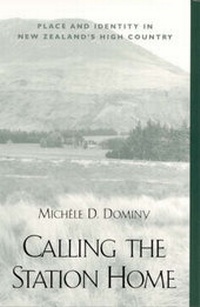
Calling the Station Home
Place and Identity in New Zealand's High Country
Published on 22. November 2000
Book
Paperback/Softback
328 pages
978-0-7425-0952-8 (ISBN)
Description
A challenging addition to the contentious discourse on cultural identity, indigeneity and land ownership,Calling the Station Home examines the social, spatial, and property practices of New Zealand's high country. This engaging study combines historical, literary, and ethnographic approaches to draw a fine-grained portrait of tussock-grassland and mountain land families whose material culture, social arrangements, geographic knowledge, and sociolinguistic features speak directly to debates about land use and sustainability in the white settlement colonies of the British diaspora. In the midst of national and international disputes on authenticity, legitimacy, land rights, and resource management,Calling the Station Home provides a methodology for articulating the specificity of attachment to place. It examines the relation of habitation and identity within the context of competing claims by environment and recreation lobbies, government and conservation agencies, overseas developers, and the indigenous South Island Ngai Tahu. Calling the Station Home is especially timely in its refocusing of attention to settler-descendant expressions of belonging and indigeneity at a moment when precolonial populations are asserting land restitution claims. In doing so, the volume contributes to postcolonial cultural analysis in ways that reverse traditional scholarship, turning the lens on the colonizers rather than the colonized, opening new ways of understanding place, culture and home.
Reviews / Votes
Dominy uses classical and contemporary ethnographic skills to maximum effect. Calling the Station Home is soundly researched and attractively presented. Michele Dominy has done an excellent job and provides an interpretation which is critically informed, sensitive and perceptive. Destined to achieve classic status. * Journal of Historical Geography * In this book I discovered the virtue of anthropology as an academic discipline, searching for realities among appearances, sifting what people say and do for cultural patterns and thereby enabling others to catch a glimpse of the depth and complexity of relationships among high-country people and between these people and landscape. -- Robyn McPhail, Editor * Rural Network News * Calling the Station Home is an important contribution to debates about identity and indigeneity in the Pacific, today and in the past. It will resonate in discussions far beyond the high country, and contribute to new understandings of very difficult issues. -- R. Gerard Ward * Journal of Pacific History * This is an important and thoughtful book which must be read by anyone interested in rural New Zealand, the pursuit of sustainable forms of land use, an our ongoing search for a more distinctive national identity. -- Tom Brooking * New Zealand Journal Of History * Dominy's sympathetic intelligence and astute ethnographic skills have yielded a fascinating and important work, rich in detail, perceptive in judgment and well worth the attention of those interested in the social construction of space, the spatiality of society, and such issues as cultural legitimacy, indigenous land claims, environmental management and the "complex, dynamic and diachronic interplay of cultural and environmental systems". * Pacific Affairs * A ground-breaking and scholarly ethnographic study of Pakeha New Zealanders. * Oceana * Dominy provides a sensitive account of gender as it relates to everyday work, the homestead and surrounds, and, especially, generational succession. * American Ethnologist * Dominy's research provides a very detailed and absorbing account of the processes by which the high country settler descendants establish a self-defining indigeneity...I hope that the book attracts the attention it deserves so that the relationship of Pakeha to the land become a more widely accepted subject for research and political debate. * Oceana * Dominy's book provides a stimulating addition to the growing body of work examining the contours of post-colonial European identities in Aotearoa/New Zealand, not in a spirit of denouncement, but rather in hope of a reflective understanding that starts to explore the myriad relations and fractures characterizing such identities. In this sense, the book's wider importance lies in the understandings it can bring to the construction of settler identities in a post-colonial world. * Cultural Geographies * This is an important and courageous book that deserves a wide readership. * American Anthropologist * Dominy's book is useful for complementing anthropological work on indigenous people's relationship with their environs with a description of what are, after all, commercial pastoralists in a capitalist society. * Royal Anthropological Institute Of Great Britain and Ireland * This ethnography would make a fine addition to any applied anthropology syllabus, and will reward all readers with an interest in exploring the ways in which an environment is known and valued by those who have learnt to call it home. * Anthropological Forum *More details
Language
English
Place of publication
United States
Publishing group
Bloomsbury Publishing Plc
Target group
College/higher education
Professional and scholarly
Dimensions
Height: 227 mm
Width: 160 mm
Thickness: 17 mm
Weight
426 gr
ISBN-13
978-0-7425-0952-8 (9780742509528)
Copyright in bibliographic data and cover images is held by Nielsen Book Services Limited or by the publishers or by their respective licensors: all rights reserved.
Schweitzer Classification
Person
Michele Dominy is Professor of Anthropology at Bard College in Annandale-on-Hudson, New York.
Content
Chapter 1 Illustrations Chapter 2 Acknowledgments Chapter 3 Introduction: Up the Gorge Part 4 Myths Chapter 5 High-Country Mystiques Chapter 6 Compositions of Country Part 7 Family Chapter 8 Homesteads and the Domestic Landscape Chapter 9 Family, Farm, and Property Transfer Part 10 Country Chapter 11 "Knowing this Place": Toponymy and Topographic Language Chapter 12 "Getting on with It": Mustering, Shearing, and Lambing Part 13 Contexts Chapter 14 Asserting a Native Status Chapter 15 Legislating a Sustainable Land Ethic Chapter 16 Epilogue: Calling the Expanse a Home Chapter 17 Glossary Chapter 18 References Chapter 19 Index