

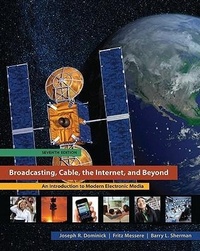
Broadcasting, Cable, the Internet, and Beyond: An Introduction to Modern Electronic Media
7th Edition
Published on 16. April 2011
Book
Paperback/Softback
352 pages
978-0-07-351203-7 (ISBN)
Description
This survey of the field of modern electronic media includes the new technologies, regulations, programming, and competition that affect our world and the broadcasting industry. The text conveys the excitement of the industry in a highly accessible style that makes even the most difficult information understandable.
More details
Edition
7th edition
Language
English
Place of publication
London
United States
Publishing group
McGraw-Hill Education - Europe
Target group
College/higher education
Product notice
Paperback (trade)
Unsewn / adhesive bound
Illustrations
51 Illustrations
Dimensions
Height: 249 mm
Width: 203 mm
Thickness: 15 mm
Weight
612 gr
ISBN-13
978-0-07-351203-7 (9780073512037)
Copyright in bibliographic data and cover images is held by Nielsen Book Services Limited or by the publishers or by their respective licensors: all rights reserved.
Schweitzer Classification
Persons
Joseph R. Dominick received his undergraduate degree from the University of Illinois and his Ph.D. from Michigan State University in 1970. He taught for four years at Queens College of the City University of New York before coming to the College of Journalism and Mass Communication at the University of Georgia where, from 1980 to 1985, he served as head of the Radio-TV-Film Sequence. Dr. Dominick is the author of three books in addition to The Dynamics of Mass Communication and has published more than thirty articles in scholarly journals. From 1976 to 1980, Dr. Dominick served as editor of the Journal of Broadcasting. He has received research grants from the National Association of Broadcasters and from the American Broadcasting Company and has consulted for such organizations as the Robert Wood Johnson Foundation and the American Chemical Society.
Barry L. Sherman is Lambdin Kay Professor and Director of the George Foster Peabody Awards at the Grady College of Journalism and Mass Communication, University of Georgia. Chairman of the Department and Associate Director of the Peabody Awards from 1986 to 1991, he was founding Director of the Dowden Center for Telecommunication Studies. In 1995, he was named Frank Stanton Fellow by the International Radio & Television Society in recognition of "outstanding contributions to electronic media education." He has also been a Fellow at the National Cable Television Center and Museum in Denver and the Freedom Forum Media Studies Center in New York. A graduate of Queens College, the City University of Anew York (B.A.., 1974; M.A., 1975), and Penn State (Ph.D., 1979) Dr. Sherman teaches and conducts research in the areas of broadcast and cable management and audience behavior. His research and consulting clients have included CapCities/ABC, The Canadian Broadcasting Company, the National Association of broadcasters, Paragon, among others. He writings have appeared in a variety of professional and trade publications, including Journal of Communication, Journal of Broadcasting and Electronic Media, Communication Education, Journalism Quarterly, and Channels.
Fitz J. Messere is Associate Professor, Communications Stujdies at SUNY Oswego. He has worked extensively int he field and is an Annenberg Faculty Fellow.
Barry L. Sherman is Lambdin Kay Professor and Director of the George Foster Peabody Awards at the Grady College of Journalism and Mass Communication, University of Georgia. Chairman of the Department and Associate Director of the Peabody Awards from 1986 to 1991, he was founding Director of the Dowden Center for Telecommunication Studies. In 1995, he was named Frank Stanton Fellow by the International Radio & Television Society in recognition of "outstanding contributions to electronic media education." He has also been a Fellow at the National Cable Television Center and Museum in Denver and the Freedom Forum Media Studies Center in New York. A graduate of Queens College, the City University of Anew York (B.A.., 1974; M.A., 1975), and Penn State (Ph.D., 1979) Dr. Sherman teaches and conducts research in the areas of broadcast and cable management and audience behavior. His research and consulting clients have included CapCities/ABC, The Canadian Broadcasting Company, the National Association of broadcasters, Paragon, among others. He writings have appeared in a variety of professional and trade publications, including Journal of Communication, Journal of Broadcasting and Electronic Media, Communication Education, Journalism Quarterly, and Channels.
Fitz J. Messere is Associate Professor, Communications Stujdies at SUNY Oswego. He has worked extensively int he field and is an Annenberg Faculty Fellow.
Content
Part One: FoundationsIntroduction 1 History of Broadcast Media 2 History of Cable, Home Video, and theInternet 23 Audio and Video Technology
Part Two: How It Is4 Radio Today5 Broadcast and Cable/Satellite TV Today6 The Internet, Web Audio, and Web Video
Part Three: How It's Done7 The Business of Broadcasting, Cable, and New Media 8 Radio Programming 9 TV Programming
Part Four: How It's Controlled10 Rules and Regulations 11 Self-Regulation and Ethics
Part Five: What It Does12 Ratings and Audience Feedback 13 Effects
Glossary
Credits
Index
Part Two: How It Is4 Radio Today5 Broadcast and Cable/Satellite TV Today6 The Internet, Web Audio, and Web Video
Part Three: How It's Done7 The Business of Broadcasting, Cable, and New Media 8 Radio Programming 9 TV Programming
Part Four: How It's Controlled10 Rules and Regulations 11 Self-Regulation and Ethics
Part Five: What It Does12 Ratings and Audience Feedback 13 Effects
Glossary
Credits
Index