

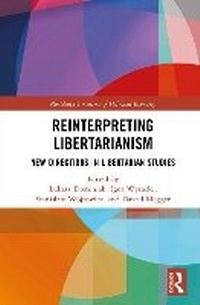
Reinterpreting Libertarianism
New Directions in Libertarian Studies
1st Edition
Published on 6. November 2025
Book
Hardback
246 pages
978-1-032-95549-0 (ISBN)
Description
This volume provides a thorough reconsideration of libertarian theory, offering novel perspectives that challenge established assumptions and initiate new directions for philosophical, legal and economic investigation.
By tackling such topics as voluntariness, dignity and inalienability of rights, game theory, healthcare, and the political relevance of monarchy, the chapters provide readers with novel analytical instruments for delving more deeply into libertarianism. Through detailed examinations of such issues as fraud, blackmail, slavery, liability, and technological disruption, contributors reconsider the foundations of libertarian principles while demonstrating how they apply to pressing contemporary practical problems. The book offers critical reassessments of established doctrines and constructive proposals for reformulating libertarianism, while trying to remedy its theoretical weaknesses. In doing so, it furnishes its readers with a framework that helps to understand both the theoretical coherence and the practical adaptability of libertarian ideas, ensuring its relevance for philosophers, legal theorists, economists, and policymakers alike.
The book will be of great interest to political economists, political philosophers, political scientists, ethicists, and everyone in libertarianism in all its forms.
By tackling such topics as voluntariness, dignity and inalienability of rights, game theory, healthcare, and the political relevance of monarchy, the chapters provide readers with novel analytical instruments for delving more deeply into libertarianism. Through detailed examinations of such issues as fraud, blackmail, slavery, liability, and technological disruption, contributors reconsider the foundations of libertarian principles while demonstrating how they apply to pressing contemporary practical problems. The book offers critical reassessments of established doctrines and constructive proposals for reformulating libertarianism, while trying to remedy its theoretical weaknesses. In doing so, it furnishes its readers with a framework that helps to understand both the theoretical coherence and the practical adaptability of libertarian ideas, ensuring its relevance for philosophers, legal theorists, economists, and policymakers alike.
The book will be of great interest to political economists, political philosophers, political scientists, ethicists, and everyone in libertarianism in all its forms.
More details
Series
Language
English
Place of publication
London
United Kingdom
Publishing group
Taylor & Francis Ltd
Target group
College/higher education
Postgraduate
Illustrations
1 s/w Abbildung, 1 s/w Photographie bzw. Rasterbild, 7 s/w Tabellen
7 Tables, black and white; 1 Halftones, black and white; 1 Illustrations, black and white
Dimensions
Height: 240 mm
Width: 161 mm
Thickness: 18 mm
Weight
552 gr
ISBN-13
978-1-032-95549-0 (9781032955490)
Copyright in bibliographic data and cover images is held by Nielsen Book Services Limited or by the publishers or by their respective licensors: all rights reserved.
Schweitzer Classification
Other editions
Additional editions
Lukasz Dominiak | Igor Wysocki | Stanislaw Wojtowicz
Reinterpreting Libertarianism
New Directions in Libertarian Studies
E-Book
11/2025
Routledge
€60.49
Available for download
Lukasz Dominiak | Igor Wysocki | Stanislaw Wojtowicz
Reinterpreting Libertarianism
New Directions in Libertarian Studies
E-Book
11/2025
Routledge
€60.49
Available for download
Persons
Lukasz Dominiak is an Associate Professor at the Department of Social Philosophy, Institute of Philosophy, Faculty of Philosophy and Social Sciences, Nicolaus Copernicus University in Torun, Poland and a Fellow of the Ludwig von Mises Institute, Auburn, Alabama, United States.
Igor Wysocki is a Ph.D candidate affiliated with Nicolaus Copernicus University in Torun, Poland. His main interests revolve around philosophy of economics, rights theory, and libertarianism. His contribution to libertarian scholarship mainly involve the papers probing the moralized notion of voluntariness, as understood in libertarianism. He also boasts several papers co-authored with Walter Block.
Stanislaw Wojtowicz has a doctorate in literary studies. He is currently a PhD candidate in philosophy at the Doctoral School of Humanities, Theology and Arts at the Nicolaus Copernicus University in Torun. His research interests include political libertarianism and the economic theory of the state and stateless orders.
Dawid Megger is an Assistant Professor at the Nicolaus Copernicus University in Torun, where he teaches microeconomics and public choice theory, among others. His research interests revolve around economic theory, methodology, and political economy.
Igor Wysocki is a Ph.D candidate affiliated with Nicolaus Copernicus University in Torun, Poland. His main interests revolve around philosophy of economics, rights theory, and libertarianism. His contribution to libertarian scholarship mainly involve the papers probing the moralized notion of voluntariness, as understood in libertarianism. He also boasts several papers co-authored with Walter Block.
Stanislaw Wojtowicz has a doctorate in literary studies. He is currently a PhD candidate in philosophy at the Doctoral School of Humanities, Theology and Arts at the Nicolaus Copernicus University in Torun. His research interests include political libertarianism and the economic theory of the state and stateless orders.
Dawid Megger is an Assistant Professor at the Nicolaus Copernicus University in Torun, where he teaches microeconomics and public choice theory, among others. His research interests revolve around economic theory, methodology, and political economy.
Content
Introduction. Polish Libertarian Scholarship and New Directions in the Libertarian Research (Lukasz Dominiak, Stanislaw Wojtowicz, Igor Wysocki) Principle of voluntary transfer and its surprising consequences for the libertarian theory of justice (Lukasz Dominiak) An economic analysis of the libertarian legal system (Igor Wysocki) Libertarianism, Thomism and atomism: social ontology, legal institutions, and economic outcomes (Dawid Megger) Weakly absolute rights, minimising infringements, and the minimal state (Stanislaw Wojtowicz) Towards libertarian dignitarianism (Pawel Nowakowski) Strict liability, fault principle, and libertarianism: towards a reformulation of the Rothbardian theory of legal liability (Halina Simo) Against libertarian slavery (Patryk Trzcionka) Nonaggression, Freedom, and Argumentation Ethics: Avoiding Circularity (Norbert Slenzok) Should Big Tech be regulated? Arguments from social harms and a commonsense rebuttal (Bartlomiej Chomanski) Anarcho-capitalism, monarchy, and the Problem of Libertarian Political Strategy (Lukasz Swiecicki) Methods of recognizing private law societies in diplomatic relations (Jakub Juszczak) Evolutionary game theory, the social contract, and libertarianism (Milosz Slepowronski) Fully private health care - an attempt at an outline (Stanislaw Wojtowicz, Kamil Rozynek) Index