

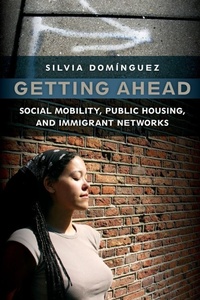
Getting Ahead
Social Mobility, Public Housing, and Immigrant Networks
Published on 1. December 2013
Book
Paperback/Softback
278 pages
978-0-8147-2078-3 (ISBN)
Description
Honorable Mention, 2014 Distinguished Contribution to Research Award presented by the Latina/o Sociology Section of the American Sociological Association
Getting Ahead tells the compelling stories of Latin-American immigrant women living in public housing in two Boston-area neighborhoods. Silvia Dominguez argues that these immigrant women parlay social ties that provide support and leverage to develop networks and achieve social positioning to get ahead. Through a rich ethnographic account and in-depth interviews, the strong voices of these women demonstrate how they successfully negotiate the world and achieve social mobility through their own individual agency, skillfully navigating both constraints and opportunities.
Dominguez makes it clear that many immigrant women are able to develop the social support needed for a rich social life, and leverage ties that open options for them to develop their social and human capital. However, she also shows that factors such as neighborhood and domestic violence and the unavailability of social services leave many women without the ability to strategize towards social mobility. Ultimately, Dominguez makes important local and international policy recommendations on issue ranging from public housing to world labor visas, demonstrating how policy can help to improve the lives of these and other low-income people.
Getting Ahead tells the compelling stories of Latin-American immigrant women living in public housing in two Boston-area neighborhoods. Silvia Dominguez argues that these immigrant women parlay social ties that provide support and leverage to develop networks and achieve social positioning to get ahead. Through a rich ethnographic account and in-depth interviews, the strong voices of these women demonstrate how they successfully negotiate the world and achieve social mobility through their own individual agency, skillfully navigating both constraints and opportunities.
Dominguez makes it clear that many immigrant women are able to develop the social support needed for a rich social life, and leverage ties that open options for them to develop their social and human capital. However, she also shows that factors such as neighborhood and domestic violence and the unavailability of social services leave many women without the ability to strategize towards social mobility. Ultimately, Dominguez makes important local and international policy recommendations on issue ranging from public housing to world labor visas, demonstrating how policy can help to improve the lives of these and other low-income people.
Reviews / Votes
"Getting Ahead by Silvia Dominguez makes an important contribution to the urban poverty literature by investigating the well being of low-income Latin American immigrants and their children in the post-welfare reform era. . . I urge readers to purchase this excellent book." - David Varady,Teachers College Record "A valuable contribution to the understanding of Latin American immigrants in the U.S." - Roberta Villalon,author of Violence Against Latina Immigrants: Citizenship, Inequality, and CommunityMore details
Language
English
Place of publication
New York
United States
Target group
Professional and scholarly
Product notice
Paperback (trade)
Dimensions
Height: 229 mm
Width: 152 mm
Thickness: 16 mm
Weight
413 gr
ISBN-13
978-0-8147-2078-3 (9780814720783)
Copyright in bibliographic data and cover images is held by Nielsen Book Services Limited or by the publishers or by their respective licensors: all rights reserved.
Schweitzer Classification
Other editions
Additional editions
E-Book
12/2010
New York University Press
€0.00
Available for download
E-Book
12/2010
1st Edition
New York University Press
€142.99
Available for download
Person
Silvia Dominguez is assistant professor of sociology at Northeastern University in Boston, Massachusetts.
Content
Acknowledgments Introduction 1 Social Flow 2 The Neighborhoods 3 Social Support and Family Life 4 Leverage-Based Social Positioning 5 Family and Work Support 6 When Social Positioning Is Not Enough 7 When Intervention Is Necessary 8 Immigrant Networks Notes References Index About the Author