

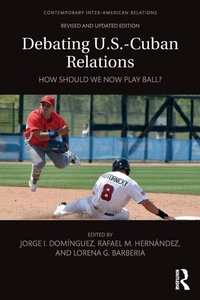
Debating U.S.-Cuban Relations
How Should We Now Play Ball?
2nd Edition
Published on 30. January 2017
Book
Paperback/Softback
304 pages
978-1-138-28124-0 (ISBN)
Description
The boundary between Cuba and the United States has become more and more porous, as have those with Latin America and the Caribbean. Never in the past half-century has Cuba's leadership or its social and political fabric been so exposed to the influence of the outside world. In this book, an all-star cast of experts critically address the recent past and present in U.S.-Cuban relations in their full complexity and subtlety to develop a perspective on the evolution of the conflict and an inventory of forms of cooperation. This much needed approach provides a way to answer the questions "what has been . . .?" and "what is . . .?" while also thinking seriously about "what if . . .?"
To illustrate the most significant areas of U.S.-Cuban relations in the contemporary era, this newly updated edition of Debating U.S.-Cuban Relations adds six more themes to the study of this complex relation: political, security, economic, and cultural/academic issues; the triangular relations of the United States, Cuba, and Europe; and the politics of Cuban migration/emigration. Each topic is represented by perspectives from both Cuban and non-Cuban scholars, leading to a resource rich in insight and a model of transnational dialogue.
The future course of U.S.-Cuban relations will likely be more complex than in the past, not only because of the matrix of factors involved but also because of the number of actors. Such a multiplicity of domestic, regional, and global factors is unique; it includes the rise to power of new administrations in both countries since 2008. Raul Castro became president of Cuba in February 2008 and Barack Obama was inaugurated president of the United States in January 2009. And it will feature the inauguration of a new president of the United States in January 2017 and a new president of Cuba, likely in February 2018.
To illustrate the most significant areas of U.S.-Cuban relations in the contemporary era, this newly updated edition of Debating U.S.-Cuban Relations adds six more themes to the study of this complex relation: political, security, economic, and cultural/academic issues; the triangular relations of the United States, Cuba, and Europe; and the politics of Cuban migration/emigration. Each topic is represented by perspectives from both Cuban and non-Cuban scholars, leading to a resource rich in insight and a model of transnational dialogue.
The future course of U.S.-Cuban relations will likely be more complex than in the past, not only because of the matrix of factors involved but also because of the number of actors. Such a multiplicity of domestic, regional, and global factors is unique; it includes the rise to power of new administrations in both countries since 2008. Raul Castro became president of Cuba in February 2008 and Barack Obama was inaugurated president of the United States in January 2009. And it will feature the inauguration of a new president of the United States in January 2017 and a new president of Cuba, likely in February 2018.
Reviews / Votes
'For the third time, Dominguez, Hernandez, and Barberia have reassembled their all-star team of Cuban and U.S. scholars to reflect on the dynamics of bilateral relations leading up to and following the December 17, 2014 decision to normalize U.S.-Cuban relations.' - William Leogrande, American University, USA'The editors have assembled a five-star cast of analysts, both Cuban and non-Cuban, to explore and update the long-term dynamics of U.S./Cuban relations. Given the recent improvement in those relations, these analyses can be seen as a significant resource in both policy-making and the larger public arenas.' - H. Michael Erisman, Indiana State University, USA
'Wise old Solomon got it wrong. There is something new under the sun, and it's called U.S.-Cuban relations in the 21st century. The first edition of this classic book appeared in the midst of bitter Cold War and the real threat of armed conflict between Cuba and the U.S. Full Stop. Fast forward to 2017. Surreally, Cuba and the U.S. have normalized relations. The American and Cuban presidents have gone to a baseball game together in Havana and eaten popcorn from the same box. It's a whole new ball game! The editors and authors of this new edition are our very best guides as to how the game should be played under the new circumstances.' -James G. Blight, Balsille School of International Affairs, Canada
'The updated edition of Debating U.S.-Cuban Relations comes at a propitious moment for students and policy makers to appreciate the complexity of normalization between the United States and Cuba since they re-established diplomatic relations. As with the excellent first edition, this volume enables readers in both countries to engage key issues empathetically, because the authors are among the most knowledgeable in each country. The book provides both cogent broad analyses and useful current information about both countries' policies and interests.' - Philip Brenner, American University "For the third time, Dominguez, Hernandez, and Barberia have reassembled their all-star team of Cuban and U.S. scholars to reflect on the dynamics of bilateral relations leading up to and following the December 17, 2014 decision to normalize U.S.-Cuban relations." - William Leogrande, American University, USA
"The editors have assembled a five-star cast of analysts, both Cuban and non-Cuban, to explore and update the long-term dynamics of U.S./Cuban relations. Given the recent improvement in those relations, these analyses can be seen as a significant resource in both policy-making and the larger public arenas." - H. Michael Erisman, Indiana State University, USA
"Wise old Solomon got it wrong. There is something new under the sun, and it's called U.S.-Cuban relations in the 21st century. The first edition of this classic book appeared in the midst of bitter Cold War and the real threat of armed conflict between Cuba and the U.S. Full Stop. Fast forward to 2017. Surreally, Cuba and the U.S. have normalized relations. The American and Cuban presidents have gone to a baseball game together in Havana and eaten popcorn from the same box. It's a whole new ball game! The editors and authors of this new edition are our very best guides as to how the game should be played under the new circumstances." -James G. Blight, Balsille School of International Affairs, Canada
"The updated edition of Debating U.S.-Cuban Relations comes at a propitious moment for students and policy makers to appreciate the complexity of normalization between the United States and Cuba since they re-established diplomatic relations. As with the excellent first edition, this volume enables readers in both countries to engage key issues empathetically, because the authors are among the most knowledgeable in each country. The book provides both cogent broad analyses and useful current information about both countries' policies and interests." - Philip Brenner, American University, USA
More details
Series
Edition
2nd edition
Language
English
Place of publication
London
United Kingdom
Publishing group
Taylor & Francis Ltd
Target group
College/higher education
Undergraduate
Illustrations
1 s/w Abbildung, 1 s/w Zeichnung, 12 s/w Tabellen
12 Tables, black and white; 1 Line drawings, black and white; 1 Illustrations, black and white
Dimensions
Height: 229 mm
Width: 152 mm
Thickness: 18 mm
Weight
474 gr
ISBN-13
978-1-138-28124-0 (9781138281240)
Copyright in bibliographic data and cover images is held by Nielsen Book Services Limited or by the publishers or by their respective licensors: all rights reserved.
Schweitzer Classification
Other editions
Additional editions
Jorge I. Dominguez | Rafael M. Hernandez | Lorena G. Barberia
Debating U.S.-Cuban Relations
How Should We Now Play Ball?
Book
01/2017
2nd Edition
Routledge
€242.40
Shipment within 10-20 days
Jorge I. Dominguez | Rafael M. Hernandez | Lorena G. Barberia
Debating U.S.-Cuban Relations
How Should We Now Play Ball?
E-Book
01/2017
2nd Edition
Routledge
€65.99
Available for download
Jorge I. Dominguez | Rafael M. Hernandez | Lorena G. Barberia
Debating U.S.-Cuban Relations
How Should We Now Play Ball?
E-Book
01/2017
2nd Edition
Routledge
€65.99
Available for download
Previous edition
Jorge I. Dominguez | Rafael M. Hernandez | Lorena G. Barberia
Debating U.S.-Cuban Relations
Shall We Play Ball?
Book
09/2011
1st Edition
Routledge
€62.08
Article exhausted; check for reprint
Persons
Jorge I. Dominguez is the Antonio Madero Professor for the Study of Mexico and former Vice Provost for International Affairs at Harvard University. He is a past President of the Latin American Studies Association.
Rafael M. Hernandez is the Chief Editor of Temas, Cuba's leading magazine in the social sciences. He has been Professor at the University of Havana; Director of U.S. studies at the Centro de Estudios sobre America; and a Senior Research Fellow at the Instituto "Juan Marinello" in Havana (1996-2008). He has published on Cuban and U.S. policies, inter-American relations, international security, migration, and Cuban culture, civil society, and politics.
Lorena G. Barberia is an Associate Professor in the Department of Political Science at the University of Sao Paulo, Brazil. Her primary research and teaching interests are political economy, comparative politics, and political methodology. Much of her recent work is aimed at analyzing redistributive politics in Latin America.
Rafael M. Hernandez is the Chief Editor of Temas, Cuba's leading magazine in the social sciences. He has been Professor at the University of Havana; Director of U.S. studies at the Centro de Estudios sobre America; and a Senior Research Fellow at the Instituto "Juan Marinello" in Havana (1996-2008). He has published on Cuban and U.S. policies, inter-American relations, international security, migration, and Cuban culture, civil society, and politics.
Lorena G. Barberia is an Associate Professor in the Department of Political Science at the University of Sao Paulo, Brazil. Her primary research and teaching interests are political economy, comparative politics, and political methodology. Much of her recent work is aimed at analyzing redistributive politics in Latin America.
Content
Table of Contents
List of Figures
List of Tables
List of Contributors
List of Abbreviations and Acronyms
Chapter 1: Introduction: A Baseball Game
Jorge I. Dominguez and Rafael M. Hernandez
Chapter 2: Intimate Enemies: Paradoxes in the Conflict between the United States and
Cuba
Rafael M. Hernandez
Chapter 3: Reshaping the Relations between the United States and Cuba
Jorge I. Dominguez
Chapter 4: Cuba's National Security vis-a-vis the United States: Conflict or Cooperation?
Carlos Alzugaray Treto
Chapter 5: Cuban-United States Cooperation in the Defence and Security Fields: Where
Are We? Where Might We Be Able to Go?
Hal Klepak
Chapter 6: Terrorism and the Anti-Hijacking Accord in Cuba's Relations with the United
States
Peter Kornbluh
Chapter 7: The European Union and U.S.-Cuban Relations
Eduardo Perera Gomez
Chapter 8: European Union Policy in the Cuba-U.S.-Spain Triangle
Susanne Gratius
Chapter 9: U.S.-Cuba Relations: The Potential Economic Implications of Normalization
Archibald R. M. Ritter
Chapter 10: United States-Cuba Economic Relations: The Pending Normalization
Jorge Mario Sanchez Egozcue
Chapter 11: Cuba, Its Immigration and U.S.-Cuba Relations
Lorena G. Barberia
Chapter 12: U.S.-Cuba: Emigration and Bilateral Relations
Antonio Aja Diaz
Chapter 13: The Subject(s) of Academic and Cultural Exchange: Paradigms, Powers, and
Possibilities
Sheryl Lutjens
Chapter 14: Academic Diplomacy: Cultural Exchange between Cuba and the United
States
Milagros Martinez Reinosa
Appendix: Table of Contents, U.S.-Cuban Relations in the 1990s (Westview Press, 1989)
Index
List of Figures
List of Tables
List of Contributors
List of Abbreviations and Acronyms
Chapter 1: Introduction: A Baseball Game
Jorge I. Dominguez and Rafael M. Hernandez
Chapter 2: Intimate Enemies: Paradoxes in the Conflict between the United States and
Cuba
Rafael M. Hernandez
Chapter 3: Reshaping the Relations between the United States and Cuba
Jorge I. Dominguez
Chapter 4: Cuba's National Security vis-a-vis the United States: Conflict or Cooperation?
Carlos Alzugaray Treto
Chapter 5: Cuban-United States Cooperation in the Defence and Security Fields: Where
Are We? Where Might We Be Able to Go?
Hal Klepak
Chapter 6: Terrorism and the Anti-Hijacking Accord in Cuba's Relations with the United
States
Peter Kornbluh
Chapter 7: The European Union and U.S.-Cuban Relations
Eduardo Perera Gomez
Chapter 8: European Union Policy in the Cuba-U.S.-Spain Triangle
Susanne Gratius
Chapter 9: U.S.-Cuba Relations: The Potential Economic Implications of Normalization
Archibald R. M. Ritter
Chapter 10: United States-Cuba Economic Relations: The Pending Normalization
Jorge Mario Sanchez Egozcue
Chapter 11: Cuba, Its Immigration and U.S.-Cuba Relations
Lorena G. Barberia
Chapter 12: U.S.-Cuba: Emigration and Bilateral Relations
Antonio Aja Diaz
Chapter 13: The Subject(s) of Academic and Cultural Exchange: Paradigms, Powers, and
Possibilities
Sheryl Lutjens
Chapter 14: Academic Diplomacy: Cultural Exchange between Cuba and the United
States
Milagros Martinez Reinosa
Appendix: Table of Contents, U.S.-Cuban Relations in the 1990s (Westview Press, 1989)
Index