

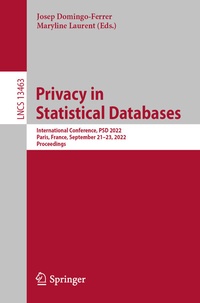
Privacy in Statistical Databases
International Conference, PSD 2022, Paris, France, September 21-23, 2022, Proceedings
Published on 5. August 2022
Book
Paperback/Softback
XI, 376 pages
978-3-031-13944-4 (ISBN)
Description
This book constitutes the refereed proceedings of the International Conference on Privacy in Statistical Databases, PSD 2022, held in Paris, France, during September 21-23, 2022.
The 25 papers presented in this volume were carefully reviewed and selected from 45 submissions. They were organized in topical sections as follows: Privacy models; tabular data; disclosure risk assessment and record linkage; privacy-preserving protocols; unstructured and mobility data; synthetic data; machine learning and privacy; and case studies.
The 25 papers presented in this volume were carefully reviewed and selected from 45 submissions. They were organized in topical sections as follows: Privacy models; tabular data; disclosure risk assessment and record linkage; privacy-preserving protocols; unstructured and mobility data; synthetic data; machine learning and privacy; and case studies.
More details
Series
Edition
1st ed. 2022
Language
English
Place of publication
Cham
Switzerland
Publishing group
Springer International Publishing
Target group
Professional and scholarly
Illustrations
66 farbige Abbildungen, 32 s/w Abbildungen
XI, 376 p. 98 illus., 66 illus. in color.
Dimensions
Height: 235 mm
Width: 155 mm
Thickness: 21 mm
Weight
587 gr
ISBN-13
978-3-031-13944-4 (9783031139444)
DOI
10.1007/978-3-031-13945-1
Schweitzer Classification
Other editions
Additional editions
Josep Domingo-Ferrer | Maryline Laurent
Privacy in Statistical Databases
International Conference, PSD 2022, Paris, France, September 21-23, 2022, Proceedings
E-Book
09/2022
Springer
€53.49
Available for download
Content
Privacy models.-
An optimization-based decomposition heuristic for the microaggregation problem.- Privacy Analysis with a Distributed Transition System and a data-wise metric.- Multivariate Mean Comparison under Differential Privacy.- Asking The Proper Question: Adjusting Queries To Statistical Procedures UnderDifferential Privacy.- Towards integrally private clustering: overlapping clusters for high privacy guarantees.-
Tabular data.-
Perspectives for Tabular Data Protection - How About Synthetic Data?.- On Privacy of Multidimensional Data Against Aggregate Knowledge Attacks.- Synthetic Decimal Numbers as a Flexible Tool for Suppression of Post-published Tabular Data.-
Disclosure risk assessment and record linkage.-
The risk of disclosure when reporting commonly used univariate statistics.-
Privacy-Preserving protocols.-
Tit-for-Tat Disclosure of a Binding Sequence of User Analysesin Safe Data Access Centers.- Secure and non-interactive k-NN classifier using symmetric fully homomorphic encryption.-
Unstructured and mobility data.-
Automatic evaluation of disclosure risks of text anonymization methods.- Generation of Synthetic Trajectory Microdata from Language Models.-
Synthetic data.-
Synthetic Individual Income Tax Data: Methodology, Utility, and Privacy Implications.- On integrating the number of synthetic data sets m into the a priori synthesis approach .- Challenges in Measuring Utility for Fully Synthetic Data.- Comparing the Utility and Disclosure Risk of Synthetic Data with Samples of Microdata.- Utility and Disclosure Risk for Differentially Private Synthetic Categorical Data.-
Machine learning and privacy.-
Membership Inference Attack Against Principal Component Analysis.- When Machine Learning Models Leak: An Exploration of Synthetic Training Data.-
Case studies.-
A Note on the Misinterpretation of the US Census Re-identification Attack.- A Re-examination of the Census Bureau Reconstruction and Reidentification Attack.- Quality Assessment of the 2014 to 2019 National Survey on Drug Use and Health (NSDUH) Public Use Files.- Privacy in Practice: Latest Achievements of the EUSTAT SDC group.- How Adversarial Assumptions Influence Re- identification Risk Measures: A COVID-19 Case Study.