

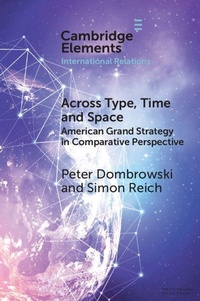
Across Type, Time and Space
American Grand Strategy in Comparative Perspective
Published on 12. August 2021
Book
Paperback/Softback
92 pages
978-1-108-97290-1 (ISBN)
Description
The field of grand strategy is exceptionally American-centric theoretically, methodologically and empirically. Indeed, many scholars treat the United States as a unique case, and thus incomparable. This Element addresses the shortcomings of this approach by developing a novel framework for the purpose of systematic comparison, both within and among different countries. Using the United States as a benchmark, three dimensions are considered in which grand strategy can be compared: first, attributes of the major types commonly discussed in the literature; second, similarities and differences in the implementation of grand strategies over time, using US strategic relations with contemporary Russia as an example; and finally, across space, properties of the grand strategies that are interactively employed by other major powers in relation to the United States in the Indo-Pacific. The Element can be used by scholars and students alike to expand analysis beyond the confines that currently dominate the field.
More details
Series
Language
English
Place of publication
Cambridge
United Kingdom
Target group
Professional and scholarly
Product notice
Paperback (trade)
Illustrations
Worked examples or Exercises
Dimensions
Height: 229 mm
Width: 152 mm
Thickness: 5 mm
Weight
148 gr
ISBN-13
978-1-108-97290-1 (9781108972901)
Copyright in bibliographic data and cover images is held by Nielsen Book Services Limited or by the publishers or by their respective licensors: all rights reserved.
Schweitzer Classification
Other editions
Additional editions
E-Book
08/2021
Cambridge University Press
€14.49
Available for download
Persons
Content
1. Grand Strategy: Comparing across Time, Type and Space; 2. Contrasting Assumptions and a Comparative Framework; 3. Types of Grand Strategy; 4. Comparing Administrations over Time: Continuity and Change; 5. Grand Strategies in the Indo-Pacific; 6. A Brief Conclusion.