

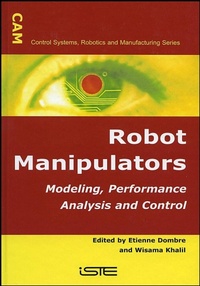
Robot Manipulators
Modeling, Performance Analysis and Control
1st Edition
Published on 14. January 2007
Book
Hardback
398 pages
978-1-905209-10-1 (ISBN)
Description
This book presents the most recent research results on modeling and control of robot manipulators.
Chapter 1 gives unified tools to derive direct and inverse geometric, kinematic and dynamic models of serial robots and addresses the issue of identification of the geometric and dynamic parameters of these models.
Chapter 2 describes the main features of serial robots, the different architectures and the methods used to obtain direct and inverse geometric, kinematic and dynamic models, paying special attention to singularity analysis.
Chapter 3 introduces global and local tools for performance analysis of serial robots.
Chapter 4 presents an original optimization technique for point-to-point trajectory generation accounting for robot dynamics.
Chapter 5 presents standard control techniques in the joint space and task space for free motion (PID, computed torque, adaptive dynamic control and variable structure control) and constrained motion (compliant force-position control).
In Chapter 6, the concept of vision-based control is developed and Chapter 7 is devoted to specific issue of robots with flexible links. Efficient recursive Newton-Euler algorithms for both inverse and direct modeling are presented, as well as control methods ensuring position setting and vibration damping.
Chapter 1 gives unified tools to derive direct and inverse geometric, kinematic and dynamic models of serial robots and addresses the issue of identification of the geometric and dynamic parameters of these models.
Chapter 2 describes the main features of serial robots, the different architectures and the methods used to obtain direct and inverse geometric, kinematic and dynamic models, paying special attention to singularity analysis.
Chapter 3 introduces global and local tools for performance analysis of serial robots.
Chapter 4 presents an original optimization technique for point-to-point trajectory generation accounting for robot dynamics.
Chapter 5 presents standard control techniques in the joint space and task space for free motion (PID, computed torque, adaptive dynamic control and variable structure control) and constrained motion (compliant force-position control).
In Chapter 6, the concept of vision-based control is developed and Chapter 7 is devoted to specific issue of robots with flexible links. Efficient recursive Newton-Euler algorithms for both inverse and direct modeling are presented, as well as control methods ensuring position setting and vibration damping.
More details
Language
English
Place of publication
London
United Kingdom
Target group
Professional and scholarly
Product notice
sewn/stitched
Paper over boards
Dimensions
Height: 240 mm
Width: 161 mm
Thickness: 27 mm
Weight
744 gr
ISBN-13
978-1-905209-10-1 (9781905209101)
Copyright in bibliographic data and cover images is held by Nielsen Book Services Limited or by the publishers or by their respective licensors: all rights reserved.
Schweitzer Classification
Other editions
Additional editions
E-Book
03/2013
Wiley-ISTE
€266.99
Available for download
E-Book
01/2010
Wiley-ISTE
€266.99
Available for download
Persons
Etienne Dombre is Director of Research at the National Centre for Scientific Research (CNRS) and is a researcher within the Laboratoire de Recherche en 'Informatique, Robotique et Microelectronique de Montpellier at the University of Montpellier, France. Wisama Khalil is Professor at the Ecole Centrale de Nantes, France, and is a researcher at the Institute of Research in
Communication and Cybernetics.
Communication and Cybernetics.
Content
Chapter 1. Modeling and Identification of Serial Robots (Wisama KHALIL and Etienne DOMBRE). 1.1. Introduction.
1.2. Geometric modeling.
1.3. Kinematic modeling.
1.4. Calibration of geometric parameters.
1.5. Dynamic modeling.
1.6. Identification of dynamic parameters.
1.7. Conclusion.
1.8. Bibliography.
Chapter 2. Modeling of Parallel Robots (Jean-Pierre MERLET and Francois PIERROT).
2.1. Introduction.
2.2. Machine types.
2.3. Inverse geometric and kinematic models.
2.4. Direct geometric model.
2.5. Bibliography.
Chapter 3. Performance Analysis of Robots (Philippe WENGER).
3.1. Introduction.
3.2. Accessibility.
3.3. Workspace of a robot manipulator.
3.4. Concept of aspect.
3.5. Concept of connectivity.
3.6. Local performances.
3.7. Conclusion.
3.8. Bibliography.
Chapter 4. Trajectory Generation (Moussa HADDAD, Taha CHETTIBI, Wisama KHALIL and Halim LEHTIHET).
4.1. Introduction.
4.2. Point-to-point trajectory in the joint space under kinematic constraints.
4.3. Point-to-point trajectory in the task-space under kinematic constraints.
4.4. Trajectory generation under kinodynamic constraints.
.4.5. Examples.
.4.6. Conclusion.
4.7. Bibliography.
Appendix: Stochastic Optimization Techniques.
Chapter 5. Position and Force Control of a Robot in a Free or Constrained Space (Pierre DAUCHEZ and Philippe FRAISSE).
5.1. Introduction.
5.2. Free space control.
5.3. Control in a constrained space.
5.4. Conclusion.
5.5. Bibliography.
Chapter 6. Visual Servoing (Francois CHAUMETTE).
6.1. Introduction.
6.2. Modeling visual features.
6.3. Task function and control scheme.
6.4. Other exteroceptive sensors.
6.5. Conclusion.
6.6. Bibliography.
Chapter 7. Modeling and Control of Flexible Robots (Frederic BOYER, Wisama KHALIL, Mouhacine BENOSMAN and George LEVEY).
7.1. Introduction.
7.2. Modeling of flexible robots.
7.3. Control of flexible robot manipulators.
7.4. Conclusion.
7.5. Bibliography.
List of Authors.
Index.
1.2. Geometric modeling.
1.3. Kinematic modeling.
1.4. Calibration of geometric parameters.
1.5. Dynamic modeling.
1.6. Identification of dynamic parameters.
1.7. Conclusion.
1.8. Bibliography.
Chapter 2. Modeling of Parallel Robots (Jean-Pierre MERLET and Francois PIERROT).
2.1. Introduction.
2.2. Machine types.
2.3. Inverse geometric and kinematic models.
2.4. Direct geometric model.
2.5. Bibliography.
Chapter 3. Performance Analysis of Robots (Philippe WENGER).
3.1. Introduction.
3.2. Accessibility.
3.3. Workspace of a robot manipulator.
3.4. Concept of aspect.
3.5. Concept of connectivity.
3.6. Local performances.
3.7. Conclusion.
3.8. Bibliography.
Chapter 4. Trajectory Generation (Moussa HADDAD, Taha CHETTIBI, Wisama KHALIL and Halim LEHTIHET).
4.1. Introduction.
4.2. Point-to-point trajectory in the joint space under kinematic constraints.
4.3. Point-to-point trajectory in the task-space under kinematic constraints.
4.4. Trajectory generation under kinodynamic constraints.
.4.5. Examples.
.4.6. Conclusion.
4.7. Bibliography.
Appendix: Stochastic Optimization Techniques.
Chapter 5. Position and Force Control of a Robot in a Free or Constrained Space (Pierre DAUCHEZ and Philippe FRAISSE).
5.1. Introduction.
5.2. Free space control.
5.3. Control in a constrained space.
5.4. Conclusion.
5.5. Bibliography.
Chapter 6. Visual Servoing (Francois CHAUMETTE).
6.1. Introduction.
6.2. Modeling visual features.
6.3. Task function and control scheme.
6.4. Other exteroceptive sensors.
6.5. Conclusion.
6.6. Bibliography.
Chapter 7. Modeling and Control of Flexible Robots (Frederic BOYER, Wisama KHALIL, Mouhacine BENOSMAN and George LEVEY).
7.1. Introduction.
7.2. Modeling of flexible robots.
7.3. Control of flexible robot manipulators.
7.4. Conclusion.
7.5. Bibliography.
List of Authors.
Index.