

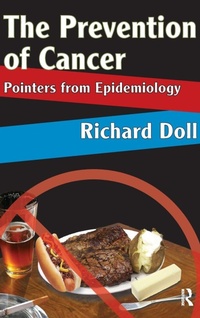
The Prevention of Cancer
Pointers from Epidemiology
1st Edition
Published on 26. July 2017
Book
Hardback
144 pages
978-1-138-53778-1 (ISBN)
Description
Epidemiological studies show that cancer incidence is far more dependent on the conditions of life than previously supposed. Classically, cancers occurred with heavy exposure to a specific occupational hazard, or were associated with habits. In some instances, research shows, the incidence of cancer falls when the method of work or the associated habit is changed. In short, variation in incidence is now known to be the rule rather than the exception in cancer. No cancer that occurs with even moderate frequency, occurs everywhere and always to the same extent. Sometimes it is even epidemic, similar in scale to an epidemic of infectious disease, but modified by the fact that the induction period may be as much as thirty years.
Prevention of cancer is now coming to be regarded as a practicable alternative to its cure. We remain almost totally ignorant of how cancer is produced at the cellular level and, until we know this, our methods of prevention are liable to be cumbersome and inefficient. Ethical considerations and the time scale of the disease make it impossible to obtain experimental evidence in man and what action to take has been determined from observing nature's experiments and by analogy from experiments in animals.
The evidence from epidemiological studies is of particular interest. Such studies suggest relationships that would never be thought of in the ordinary course of laboratory work and results that are directly relevant to the problems of human disease. The large numbers at risk and the intensity of the medical care to which people with cancer are subjected, make it possible to recognize relatively small improvements. Such practical decisions, based on information thus obtained, have largely eliminated the risk of cancer due to occupational hazards in several industries.
Prevention of cancer is now coming to be regarded as a practicable alternative to its cure. We remain almost totally ignorant of how cancer is produced at the cellular level and, until we know this, our methods of prevention are liable to be cumbersome and inefficient. Ethical considerations and the time scale of the disease make it impossible to obtain experimental evidence in man and what action to take has been determined from observing nature's experiments and by analogy from experiments in animals.
The evidence from epidemiological studies is of particular interest. Such studies suggest relationships that would never be thought of in the ordinary course of laboratory work and results that are directly relevant to the problems of human disease. The large numbers at risk and the intensity of the medical care to which people with cancer are subjected, make it possible to recognize relatively small improvements. Such practical decisions, based on information thus obtained, have largely eliminated the risk of cancer due to occupational hazards in several industries.
More details
Language
English
Place of publication
London
United Kingdom
Publishing group
Taylor & Francis Ltd
Target group
College/higher education
Dimensions
Height: 235 mm
Width: 157 mm
Thickness: 13 mm
Weight
370 gr
ISBN-13
978-1-138-53778-1 (9781138537781)
Copyright in bibliographic data and cover images is held by Nielsen Book Services Limited or by the publishers or by their respective licensors: all rights reserved.
Schweitzer Classification
Other editions
Additional editions
E-Book
07/2017
Routledge
€64.49
Available for download
E-Book
07/2017
Routledge
€64.49
Available for download
Book
07/2008
1st Edition
AldineTransaction
€71.10
Shipment within 10-15 days
Person
Richard Doll
Content
1: Introduction; 2: The Nature of Epidemiological Evidence; 3: The Geographical and Temporal Distribution; 4: Aetiological Factors; 5: The Dose-Response Relationship; 6: Variation in Individual Susceptibility; 7: The Cancer Process; 8: Practical Steps to Prevention; Epilogue