

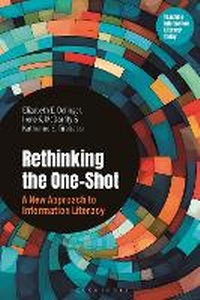
Rethinking the One-Shot
A New Approach to Information Literacy
Will be published approx. on 27. November 2025
Book
Paperback/Softback
136 pages
978-1-4408-7705-6 (ISBN)
Description
Moving beyond the one-shot, this forward-thinking manual teaches librarians and instructors how to teach information literacy through the disciplines.
The ACRL Framework for Information Literacy highlights the contextual nature of information literacy and calls for librarians to develop teaching and learning models that more fully integrate information literacy throughout the undergraduate curriculum. This requires librarians to use their expertise to collaborate with teaching faculty from various disciplinary contexts to develop information literacy curriculum.
Rethinking the One-Shot teaches librarians and instructors to fully integrate information literacy into their courses through collaboratively designed activities and assignments. It provides librarians with background, activities, workshop outlines, and other materials aimed at engaging faculty in discussions about information literacy through the lens of their specific disciplines. These activities and materials serve as models that librarians can adapt to their own institutional contexts and use to begin discussions, run workshops for faculty, and cultivate collaborations and information literacy curriculum development with teaching faculty.
The ACRL Framework for Information Literacy highlights the contextual nature of information literacy and calls for librarians to develop teaching and learning models that more fully integrate information literacy throughout the undergraduate curriculum. This requires librarians to use their expertise to collaborate with teaching faculty from various disciplinary contexts to develop information literacy curriculum.
Rethinking the One-Shot teaches librarians and instructors to fully integrate information literacy into their courses through collaboratively designed activities and assignments. It provides librarians with background, activities, workshop outlines, and other materials aimed at engaging faculty in discussions about information literacy through the lens of their specific disciplines. These activities and materials serve as models that librarians can adapt to their own institutional contexts and use to begin discussions, run workshops for faculty, and cultivate collaborations and information literacy curriculum development with teaching faculty.
More details
Series
Language
English
Place of publication
United States
Publishing group
Bloomsbury Publishing Plc
Target group
College/higher education
Professional and scholarly
Dimensions
Height: 235 mm
Width: 156 mm
ISBN-13
978-1-4408-7705-6 (9781440877056)
Copyright in bibliographic data and cover images is held by Nielsen Book Services Limited or by the publishers or by their respective licensors: all rights reserved.
Schweitzer Classification
Persons
Elizabeth Dolinger is an Associate Professor and information literacy librarian in the Mason Library at Keene State College, USA.
Katherine E. Tirabassi is the Director of the Center for Research & Writing, Professor of Communication, and Affiliate Faculty in English at Keene State College, USA.
Irene McGarrity is Head of Research Services at Mount Holyoke College, USA, guiding the vision, design, and delivery of library services essential to teaching, learning, and research.
Katherine E. Tirabassi is the Director of the Center for Research & Writing, Professor of Communication, and Affiliate Faculty in English at Keene State College, USA.
Irene McGarrity is Head of Research Services at Mount Holyoke College, USA, guiding the vision, design, and delivery of library services essential to teaching, learning, and research.
Content
Part 1: The Rise and Fall of the One-Shot: The Dominant Model We Love to Hate
1. How Did We Get Here? A Short Reflection on History
2. Questioning the Status Quo: Why We Sought a New Way
3. Bolstered by the Framework for Information Literacy: Why We Focus on Faculty
4. Research on Faculty Expectations and Assignments
Part 2: They're Still Seeking One-Shots: Finding Other Ways to Say "Yes"
5. Changing the Conversation with Faculty
6. Being Prepared to Change: Alternative Models That Support Information Literacy
Part 3. Focusing on Faculty: Defining Information Literacy Outside of the Library
7. How Librarians Are Engaging Faculty
8. Defining Information Literacy Workshops: Preparing, Process, and Communication to Campus
9. Conclusion
Index
1. How Did We Get Here? A Short Reflection on History
2. Questioning the Status Quo: Why We Sought a New Way
3. Bolstered by the Framework for Information Literacy: Why We Focus on Faculty
4. Research on Faculty Expectations and Assignments
Part 2: They're Still Seeking One-Shots: Finding Other Ways to Say "Yes"
5. Changing the Conversation with Faculty
6. Being Prepared to Change: Alternative Models That Support Information Literacy
Part 3. Focusing on Faculty: Defining Information Literacy Outside of the Library
7. How Librarians Are Engaging Faculty
8. Defining Information Literacy Workshops: Preparing, Process, and Communication to Campus
9. Conclusion
Index