

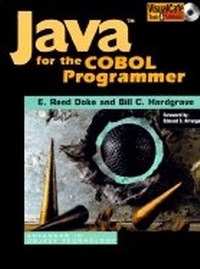
Java for the COBOL Programmer
Published on 13. August 1999
Book
Paperback/Softback
384 pages
978-0-521-65892-8 (ISBN)
Description
When the Y2K crisis winds down, COBOL programmers will look for new ways to apply their skills. Drawing upon the numerous similarities between COBOL and Java, this book teaches Java to professional COBOL programmers. To simplify the transition, the authors describe the features and syntax of Java while contrasting them with their parallels in COBOL. The book is completely modular, allowing a reader to skip back and forth from one chapter to another. With each example, the authors present a COBOL program that performs a certain function and develop a Java program that accomplishes the same task. Sample programs are available from a website, and an accompanying CD-ROM contains all of the Java programs developed in the book. It also contains a TrialWare copy of Symantec's Visual Cafe Database Edition 3.0. A running case study evolves with increased functionality as new material is presented in subsequent chapters.
Reviews / Votes
'I would ... recommend this book to COBOL programmers who want, or need, to know something about Java.' Peter S. Tiller, The Journal of the ACCUMore details
Series
Language
English
Place of publication
Cambridge
United Kingdom
Target group
Professional and scholarly
Product notice
Paperback (trade)
Dimensions
Height: 236 mm
Width: 179 mm
Thickness: 21 mm
Weight
649 gr
ISBN-13
978-0-521-65892-8 (9780521658928)
Copyright in bibliographic data and cover images is held by Nielsen Book Services Limited or by the publishers or by their respective licensors: all rights reserved.
Schweitzer Classification
Other editions
New editions
E. Reed Doke | Bill C. Hardgrave | Richard A. Johnson
COBOL Programmers Swing with Java
Book
12/2004
2nd Edition
Cambridge University Press
€81.30
Shipment within 15-20 days
Persons
Content
1. Why you should learn Java; 2. An introduction to object-oriented programming; 3. Program format and structure; 4. Defining data; 5. Arithmetic operations; 6. Decision making; 7. Looping; 8. Tables and arrays; 9. Input and output; 10. Additional Java topics.