

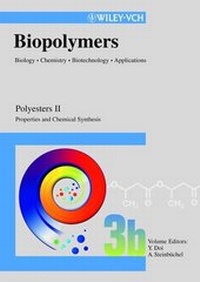
Biopolymers
Vol. 3b: Polyesters II - Properties and Chemical Synthesis
Published on 15. January 2002
Book
Hardback
XII, 468 pages
978-3-527-30219-2 (ISBN)
Description
Volumes 3a, b and 4 focus on polyesters synthesized by bacteria and eukaryotic organisms as well as all aspects of the biosynthesis and metabolism of these biopolymers together with their production and isolation. In addition, these volumes treat various synthetic polyesters and related polymers synthesized by the chemical industry for the manufacture of biodegradable materials. Topics include: polyhydroxyalkanoates, pha granules, non-storage phas, poly(malic acid), cutin, suberin, polyphosphate, polylactides, polyglycolide, polyanhydrides, polyesteramides, aliphatic organic polyesters and related polymers, in vitro synthesis of polyesters, chemical synthesis, biotechnological production by fermentation, isolation from plants, production in transgenic plants, biodegradation.
Biopolymers sind die häufigsten organischen Verbindungen in der Biosphäre und die Hauptbestandteile von Zellen. Sie werden nach ihrer chemischen Struktur in sieben Hauptklassen eingeteilt. Das neue mehrbändige Großwerk gibt einen hervorragenden Überblick über das Vorkommen und den Stoffwechsel der Biopolymere. Es beschreibt Prozesse für ihre biotechnologische Produktion, ihre Isolation aus Organismen, ihre Modifikation, ihre Materialeigenschaften sowie technische Anwendungen in unterschiedlichen Bereichen, wie z.B. Medizin, Pharmazie, Lebensmittelindustrie, Landwirtschaft, Textil-, Verpackungs- und Chemische Industrie. Schließlich werden die Zukunftsperspektiven für Biopolymere herausgearbeitet.
Die Bände 3a, b und 4 befassen sich mit Polyestern aus Baktieren und eukaryotischen Organismen und beschreiben alle Aspekte der Biosynthese, des Stoffwechsels, der Isolation und Produktion dieser Biopolymere. Ferner sind verschiedene synthetische Polyester und verwandte chemisch hergestellte Polymere, die in die Produktion von bioabbaubaren Materialien eingehen, Gegenstand dieser Bände.
Biopolymers sind die häufigsten organischen Verbindungen in der Biosphäre und die Hauptbestandteile von Zellen. Sie werden nach ihrer chemischen Struktur in sieben Hauptklassen eingeteilt. Das neue mehrbändige Großwerk gibt einen hervorragenden Überblick über das Vorkommen und den Stoffwechsel der Biopolymere. Es beschreibt Prozesse für ihre biotechnologische Produktion, ihre Isolation aus Organismen, ihre Modifikation, ihre Materialeigenschaften sowie technische Anwendungen in unterschiedlichen Bereichen, wie z.B. Medizin, Pharmazie, Lebensmittelindustrie, Landwirtschaft, Textil-, Verpackungs- und Chemische Industrie. Schließlich werden die Zukunftsperspektiven für Biopolymere herausgearbeitet.
Die Bände 3a, b und 4 befassen sich mit Polyestern aus Baktieren und eukaryotischen Organismen und beschreiben alle Aspekte der Biosynthese, des Stoffwechsels, der Isolation und Produktion dieser Biopolymere. Ferner sind verschiedene synthetische Polyester und verwandte chemisch hergestellte Polymere, die in die Produktion von bioabbaubaren Materialien eingehen, Gegenstand dieser Bände.
Reviews / Votes
"...It is to be welcomed..." (Polymer International, January 2003)More details
Series
Edition
1. Auflage
Language
English
Place of publication
Berlin
Germany
Publishing group
Wiley-VCH
Target group
College/higher education
Professional and scholarly
Biotechnologen, Mikrobiologen, Chemische Industrie, Molekularbiologen, Biochemiker
Illustrations
200
200 s/w Abbildungen
Dimensions
Height: 24 cm
Width: 17 cm
Thickness: 2.6 cm
Weight
1069 gr
ISBN-13
978-3-527-30219-2 (9783527302192)
Schweitzer Classification
Other editions
Complete work / Part of the work
Book
04/2003
1st Edition
Wiley-Blackwell
€3,199.00
Article is exhausted; no reprint
Persons
Yoshiharu Doi is the editor of Biopolymers: Biology, Chemistry, Biotechnology, Applications, Volume 3b , Polyesters II - Properties and Chemical Synthesis, published by Wiley. Alexander Steinbuchel is the editor of Biopolymers: Biology, Chemistry, Biotechnology, Applications, Volume 3b , Polyesters II - Properties and Chemical Synthesis, published by Wiley.
Content
Methods for analysis of PHA composition
Intracellular degradation of PHAs
Extracellular PHA depolymerases-the key enzyme of PHA degradation
Microbial degradation of aliphatic polyesters
Molecular and material design of biodegradable PHAs
Structure, compostions and solution properties of PHAs
Crystallization and material properties of PHAs
Structure and hydrolysis of polyester single crystals
Processing and applications of natural and synthetic PHAs
Fermentative production of building blocks for chemical synthesis of polyesters
General methodology for chemical synthesis of polyesters
Mechanisms of aliphatic polyester formation
Chemical synthesis and properties of well-defined oligomeric esters
Intracellular degradation of PHAs
Extracellular PHA depolymerases-the key enzyme of PHA degradation
Microbial degradation of aliphatic polyesters
Molecular and material design of biodegradable PHAs
Structure, compostions and solution properties of PHAs
Crystallization and material properties of PHAs
Structure and hydrolysis of polyester single crystals
Processing and applications of natural and synthetic PHAs
Fermentative production of building blocks for chemical synthesis of polyesters
General methodology for chemical synthesis of polyesters
Mechanisms of aliphatic polyester formation
Chemical synthesis and properties of well-defined oligomeric esters