

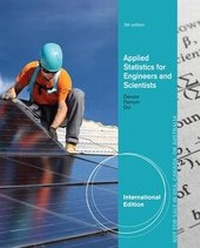
Applied Statistics for Engineers and Scientists
3rd Edition
Book
Paperback/Softback
624 pages
978-1-133-52861-6 (ISBN)
Description
This concise book for engineering and sciences students emphasizes modern statistical methodology and data analysis. Applied Statistics For Engineers And Scientists, 3E, International Edition emphasizes application of methods to real problems, with real examples throughout.
More details
Edition
International ed of 3rd revised ed
Language
English
Place of publication
CA
United States
Publishing group
Cengage Learning, Inc
Target group
College/higher education
Edition type
Revised edition
Dimensions
Height: 246 mm
Width: 189 mm
Thickness: 20 mm
ISBN-13
978-1-133-52861-6 (9781133528616)
Copyright in bibliographic data and cover images is held by Nielsen Book Services Limited or by the publishers or by their respective licensors: all rights reserved.
Schweitzer Classification
Persons
Jimmy Doi earned his B.A. in Mathematics (minors in Biology, Chemistry, Japanese) from California State University, Northridge. He earned his masters and Ph.D. in Statistics at North Carolina State University. Since receiving his doctorate Professor Doi has been on the faculty in the Statistics Department at California Polytechnic State University, San Luis Obispo. His research interests include biostatistics and categorical data analysis. He enjoys travel excursions with his wife Midori, kayak fishing, long board surfing, and playing basketball with his current and former students. Jay Devore earned his undergraduate degree in Engineering Science from the University of California at Berkeley, spent a year at the University of Sheffield in England, and finished his Ph.D. in statistics at Stanford University. He previously taught at the University of Florida and at Oberlin College and has had visiting appointments at Stanford, Harvard, the University of Washington, New York University, and Columbia University. From 1998 to 2006, Jay served as Chair of the Statistics Department at California Polytechnic State University, San Luis Obispo, which has an international reputation for activities in statistics education. In addition to this book, Jay has written several widely used engineering statistics texts and a book in applied mathematical statistics. He is currently collaborating on a business statistics text, and also serves as an Associate Editor for Reviews for several statistics journals. He is the recipient of a distinguished teaching award from Cal Poly and is a Fellow of the American Statistical Association. In his spare time, he enjoys reading, cooking and eating good food, tennis, and travel to faraway places. He is especially proud of his wife, Carol, a retired elementary school teacher, his daughter Allison, the executive director of a nonprofit organization in New York City, and his daughter Teresa, an ESL teacher in New York City. Nicholas Farnum received his B.S. and Ph.D. in Mathematics from University of California at Irvine. He is currently a professor in the Information Systems and Decision Sciences Department at California State University, Fullerton. Professor Farnum has published several papers in applied and theoretical statistics and has also written texts in Quality Control and Forecasting. He is a member of the American Statistical Association and the Mathematical Association of America. In his spare time Professor Farnum enjoys cooking, playing music, and traveling.
Content
1. DATA AND DISTRIBUTIONS. Populations, Samples and Processes. Visual Displays for Univariate Data. Describing Distributions. The Normal Distribution. Other Continuous Distributions. Several Useful Discrete Distributions. Supplementary Exercises. Bibliography. 2. NUMERICAL SUMMARY MEASURES. Measures of Center. Measures of Variability. More Detailed Summary Quantities. Quantile Plots. Supplementary Exercises. Bibliography. 3. BIVARIATE AND MULTIVARIATE DATA AND DISTRIBUTIONS. Scatter Plots. Correlation. Fitting a Line to Bivariate Data. Nonlinear Relationships. Using More Than One Predictor. Joint Distributions. Supplementary Exercises. Bibliography. 4. OBTAINING DATA. Operational Definitions. Data from Sampling. Data from Experiments. Measurement Systems. Supplementary Exercises. Bibliography. 5. PROBABILITY AND SAMPLING DISTRIBUTIONS. Chance Experiments. Probability Concepts. Conditional Probability and Independence. Random Variables. Sampling Distributions. Describing Sampling Distributions. Supplementary Exercises. Bibliography. 6. QUALITY CONTROL. Terminology. How Control Charts Work. Control Charts for Mean and Variance. Process Capability Analysis. Control Charts for Attribute Data. Reliability. Supplementary Exercises. Bibliography. 7. ESTIMATION AND STATISTICAL INTERVALS. Point Estimation. Large-Sample Confidence Intervals for a Population Mean. More Large-Sample Confidence Intervals. Small-Sample Intervals Based on a Normal Population Distribution. Intervals for u1-u2 Based on a Normal Population Distributions. Other Topics in Estimation (Optional). Supplementary Exercises. Bibliography. 8. TESTING STATISTICAL HYPOTHESES. Hypotheses and Test Procedures. Tests Concerning Hypotheses About Means. Tests Concerning Hypotheses About a Categorical Population. Testing the Form of a Distribution. Further Aspects of Hypothesis Testing. Supplementary Exercises. Bibliography. 9. THE ANALYSIS OF VARIANCE. Terminology and Concepts. Single-Factor ANOVA. Interpreting ANOVA Results. Randomized Block Experiments. Supplementary Exercises. Bibliography. 10. EXPERIMENTAL DESIGN. Terminology and Concepts. Two-Factor Designs. Multifactor Designs. 2k Designs. Fractional Factorial Designs. Supplementary Exercises. Bibliography. 11. INFERENTIAL METHODS IN REGRESSION AND CORRELATION. Regression and Models Involving a Single Independent Variable. Inferences About the Slope Coefficient ss. Inferences Based on the Estimated Regression Line. Multiple Regression Models. Inferences in Multiple Regression. Further Aspects of Regression Analysis. Supplementary Exercises. Bibliography. APPENDIX TABLES. ANSWERS TO ODD-NUMBERED EXERCISES. INDEX.