

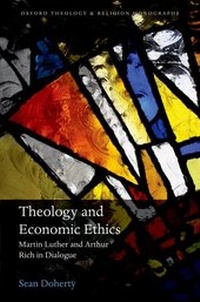
Theology and Economic Ethics
Martin Luther and Arthur Rich in Dialogue
Published on 27. March 2014
Book
Hardback
240 pages
978-0-19-870333-4 (ISBN)
Description
In the wake of the economic crisis, few questions are more pressing than those around the ethics of finance and economics. Theology and Economic Ethics seeks to expand the self-critical resources of contemporary theological economic ethics by bringing the method of a pre-modern thinker, Martin Luther (1483-1546), into interaction with that of a modern contribution to social ethics, the Swiss theologian Arthur Rich (1910-92). The work is undertaken through a close engagement with a selected publication of Luther (his 1519/20 Grosser Sermon von dem Wucher) and of Rich (his masterwork, Wirtschaftsethik, published in two volumes in 1984 and 1990 respectively). It is the first substantial treatment in English of Rich's magnum opus.
Sean Doherty introduces Luther's sermon on usury, situates it in its context, then provides a commentary on this work, discussing how Luther brings key theological motifs to bear on a particular economic question. The study proceeds with a sketch of Arthur Rich's life and work, and presents Rich's method as set out in Wirtschaftsethik. Doherty illuminates Rich's understanding of ethics, his approach to Scripture, and his adoption of the thought of Max Weber and John Rawls. Bringing insights from the study of Luther to bear in an analysis of Rich's method, Doherty questions some of Rich's assumptions, and notes ways in which a more self-critical approach could have made his project more successful. Finally, the book makes tentative suggestions as to the wider applicability of these findings for a Christian approach to economic ethics.
Sean Doherty introduces Luther's sermon on usury, situates it in its context, then provides a commentary on this work, discussing how Luther brings key theological motifs to bear on a particular economic question. The study proceeds with a sketch of Arthur Rich's life and work, and presents Rich's method as set out in Wirtschaftsethik. Doherty illuminates Rich's understanding of ethics, his approach to Scripture, and his adoption of the thought of Max Weber and John Rawls. Bringing insights from the study of Luther to bear in an analysis of Rich's method, Doherty questions some of Rich's assumptions, and notes ways in which a more self-critical approach could have made his project more successful. Finally, the book makes tentative suggestions as to the wider applicability of these findings for a Christian approach to economic ethics.
Reviews / Votes
This book exceeds expectations: it is indeed a pioneering work which reflects Doherty's complex thinking and crisp simplicity of expression. * Ranjeet Guptara, The Journal of Faith in Business * [A] remarkable work ... a major contribution to English-speaking scholarship ... The book is, in any case, gloriously successful in its stated aim to make modern Christian ethicists more methodologically self-aware as they wrestle with God and mammon. * Brian Brock, Studies in Christian Ethics *More details
Series
Language
English
Place of publication
Oxford
United Kingdom
Target group
College/higher education
Dimensions
Height: 241 mm
Width: 162 mm
Thickness: 21 mm
Weight
508 gr
ISBN-13
978-0-19-870333-4 (9780198703334)
Copyright in bibliographic data and cover images is held by Nielsen Book Services Limited or by the publishers or by their respective licensors: all rights reserved.
Schweitzer Classification
Other editions
Additional editions
E-Book
03/2014
1st Edition
OUP eBook
€77.49
Available for download
Person
Revd Dr Sean Doherty is Tutor in Ethics at St Mellitus College and Associate Minister at St Francis, Dalgarno Way, a church plant in an inner-city housing estate in London. He studied theology at Oxford, then completed his doctorate there on economics and ethics. He is a member of the Grove Ethics group.
Content
Introduction ; 1. Luther's moral theological method in his Sermon von dem Wucher ; 2. Arthur Rich's moral theological method in his Wirtschaftsethik ; 3. An analysis of Arthur Rich's method in the light of that of Martin Luther ; Conclusion