

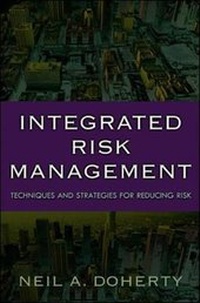
Integrated Risk Management: Techniques and Strategies for Managing Corporate Risk
Published on 16. April 2000
Book
Hardback
646 pages
978-0-07-135861-3 (ISBN)
Description
Over the years, risk management has developed separately in both the insurance and financial fields. Today, the two are finding value in each other's tools and techniques. "Integrated Risk Management" combines the best of the two notions of risk management, insurance and financial, to develop solutions ideal for today's complex risk environment. Tools go beyond hedging strategies to also examine leveraging, post-loss financing, contingent financing, and diversification.
More details
Language
English
Place of publication
United States
Publishing group
McGraw-Hill Education - Europe
Target group
College/higher education
Illustrations
81 Illustrations
Dimensions
Height: 231 mm
Width: 158 mm
Thickness: 38 mm
Weight
1021 gr
ISBN-13
978-0-07-135861-3 (9780071358613)
Copyright in bibliographic data and cover images is held by Nielsen Book Services Limited or by the publishers or by their respective licensors: all rights reserved.
Schweitzer Classification
Person
Neil Doherty, Ph.D., (Philadelphia, PA) is the Ronald A. Rosenfeld Professor of Insurance and Risk Management at the Wharton School of Business. A consultant to major global corporations, Dr. Doherty also wrote Corporate Risk Management.
Content
Part One: Background Analysis. Chapter 1: The Convergence of Insurance Risk Management and Financial Risk Management. Chapter 2: Risk and Utility: Economic Concepts and Decision Rules. Chapter 3: Moral Hazard and Adverse Selection. Chapter 4: Portfolio theory and Risk Management. Chapter 5: Capital Market Theory. Chapter 6: Deriavatives and Options. Part Two: Why Is Risk Costly to Firms? Chapter 8: Risk Management Strategy: Duality and Globality. Chapter 9: Post-loss Investment Decisions and the Measurement of Loss. Chapter 10: Post-Loss financing: Fundability and Dysfunctional Investment. Chapter 11: Post-Loss Financing: Liquidity and Debt Renegotiation. Chapter 12: Contingent Financing. Chapter 13: Contingent Leverage Strategies and Hybrid Debt. Chapter 14: Hedging and Insurance. Chapter 15: Organizational Form and Risk Management: Limited Liability. Chapter 16: A Case Study: The Securitization of Catastrophe Risk. Conclusion. References. Appendix. Index.